
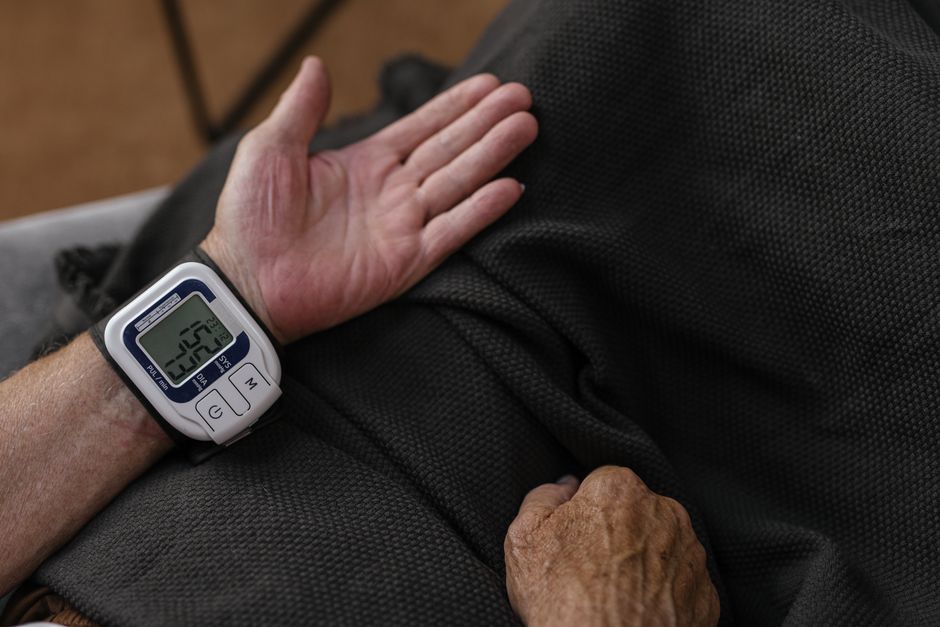
Using a wrist blood pressure monitor correctly means sitting with your feet flat, back supported, and your arm bent so the monitor sits at heart level. Position the cuff about half an inch from your wrist crease, wrap it snugly, and rest your elbow on a table. Wait five minutes in a quiet room before taking a reading. This method gives you results that are accurate enough for home monitoring. Many people get wrong numbers simply because their wrist is too high or too low.
How Do You Position Your Body for an Accurate Reading?
Body position is the most common reason wrist monitors give bad numbers. Sit in a chair with a back. Place both feet flat on the floor. Do not cross your legs. Rest your elbow on a table so your forearm is supported. Your wrist should be at the same height as your heart.
If your wrist is below heart level your reading will be too high. If it is above heart level the reading will be too low. The difference can be 10 points or more. That is enough to change how you or your doctor understand your blood pressure. The American Heart Association recommends supporting your arm at heart level for every reading.
Stay still during the measurement. Do not talk. Do not clench your fist. Do not move your fingers. Even small movements affect the sensor in wrist monitors more than upper arm cuffs.
How Do You Place the Cuff Correctly on Your Wrist?
Slide the cuff onto your bare wrist. No clothing under it. No rolled-up sleeve pressing against it. The bottom edge of the cuff should sit about half an inch from the crease where your hand meets your wrist.
Wrap the cuff snugly. It should feel firm but not tight. You should be able to slide one finger between the cuff and your skin. If it is too loose the sensor will not read correctly. If it is too tight the reading will be falsely high.
Most wrist monitors have a mark or arrow showing where the sensor sits. This mark should be centered on the inside of your wrist, roughly in line with your middle finger. The monitor display should face you so you can read it without twisting your arm.
Use the same wrist for every reading. Most people use their non-dominant arm. If you are right-handed use your left wrist. Consistency matters more than which side you choose.
When Should You Take Your Blood Pressure Reading?
Timing affects your numbers. Take your reading at the same time each day. Morning readings are common because they capture your baseline before daily stress starts. Take it before eating, before taking medication, and before drinking coffee or tea.
Empty your bladder first. A full bladder can raise your reading by 10 to 15 points. Research published in the Journal of Clinical Hypertension found that people with a full bladder had systolic readings about 10 mmHg higher than after emptying.
Sit quietly for five minutes before pressing the start button. Do not check your phone. Do not watch television. Do not have a conversation. Your body needs calm time to reach a resting state. If you are rushed or stressed your reading will reflect that.
Take two or three readings one minute apart. Average them for your record. The first reading is often higher than the rest. Discarding the first and averaging the second and third gives a more reliable number.


How To Use Wrist Blood Pressure Monitor Compared to Upper Arm Monitors
Wrist monitors are smaller and more convenient. They are easier to use if your upper arm is large or if you have trouble raising your arm. They work well for travel. But they have real limits.
Upper arm monitors are considered more accurate because the brachial artery in your upper arm is larger and more stable. The American Heart Association and the American Medical Association both recommend upper arm cuffs as the standard for home monitoring.
Wrist monitors are more sensitive to position errors. A small change in wrist height changes the reading noticeably. Upper arm cuffs are more forgiving of small position differences.
| Feature | Wrist Monitor | Upper Arm Monitor |
|---|---|---|
| Ease of use | Easy to put on | Harder to self-apply |
| Position sensitivity | High — wrist must be at heart level | Lower — arm position less critical |
| Accuracy | Good when used correctly | Better overall standard |
| Best for | Travel, large arms, convenience | Primary home monitoring |
| Cost | Lower to moderate | Moderate to higher |
Both types need validation. Check that your wrist monitor is clinically validated for accuracy. The British and Irish Hypertension Society and the American Medical Association both maintain lists of validated devices. If your monitor is not on those lists consider replacing it.
What Mistakes Make Wrist Monitor Readings Useless?
The most common mistake is letting your wrist drop below heart level. Many people rest their arm in their lap. That puts the wrist several inches below the heart. The reading can be falsely high by 5 to 15 points.
Another mistake is taking a reading right after activity. If you just walked up stairs, carried groceries, or had an argument wait at least 30 minutes. Your blood pressure stays elevated for a while after physical or emotional stress.
Drinking caffeine or smoking within 30 minutes before a reading raises your numbers temporarily. Alcohol the night before can also affect morning readings. These are not false readings — they are real effects of what you put in your body. But they do not represent your usual resting blood pressure.
Some people take readings through clothing. Do not do this. Even a thin sleeve changes the pressure on the sensor. Bare skin only.
Using a wrist monitor that is the wrong size also causes problems. Most wrist cuffs fit wrists between 5.5 and 8.5 inches in circumference. If your wrist is smaller or larger than this the monitor may not work accurately. Check the manual for the size range.
How Do You Track and Interpret Your Readings?
Write down each reading with the date and time. Use a notebook or the app that came with your monitor. Do not rely on memory. Patterns matter more than single numbers.
A normal reading is below 120/80 mmHg. Elevated blood pressure is 120-129 systolic with diastolic below 80. Stage 1 hypertension is 130-139 systolic or 80-89 diastolic. Stage 2 is 140 or higher systolic or 90 or higher diastolic. These thresholds come from the American College of Cardiology and the American Heart Association.
One high reading does not mean you have high blood pressure. Blood pressure changes throughout the day. It is normal for it to be higher in the morning and lower during sleep. A diagnosis of hypertension usually requires elevated readings on multiple occasions.
Share your log with your doctor. Do not change your medication based on home readings without talking to your doctor first. Home monitoring is a tool for awareness and communication, not self-treatment.
Common Misconceptions About Wrist Monitors
Some people think wrist monitors are always inaccurate. That is not true. Studies have found that many wrist monitors are accurate when used exactly as instructed. The problem is user error, not the device itself.
Another misconception is that you can take a reading while lying down. Wrist monitors are calibrated for the seated position with the wrist at heart level. Lying down changes the relationship between your wrist and heart. The reading will not be reliable.
Some people believe that a lower reading is always better. Very low readings can be dangerous too. If your systolic number is consistently below 90 or you feel dizzy when standing, talk to your doctor. Low blood pressure can cause falls and fainting.
There is also a belief that home monitors replace doctor visits. They do not. Home monitors give you a picture of your blood pressure in daily life. Doctors use that information along with office readings and lab tests to make decisions. Both sources matter.
Wrist blood pressure monitors are useful tools when you understand their limits. Position your wrist at heart level. Sit still. Take readings at the same time each day. Validate your device. Track your numbers. Share them with your doctor. That is the complete picture.
Frequently Asked Questions
Can I use a wrist blood pressure monitor if I have arthritis?
Yes, wrist monitors are often easier for people with arthritis because you do not need to raise your arm overhead to apply the cuff. Just make sure you can comfortably bend your elbow to rest it on a table.
How often should I replace my wrist blood pressure monitor?
Most manufacturers recommend replacing the device every two years or after about 1,000 readings. Check the manual for your specific model. The cuff itself may wear out sooner if it does not stay snug.
Do wrist monitors work for people with irregular heartbeat?
Some wrist monitors are designed for irregular heartbeats but many are not. Look for a device labeled as validated for arrhythmia or atrial fibrillation. Standard wrist monitors may give inaccurate readings if your pulse is irregular.
Why does my wrist monitor give different readings each time?
Small differences are normal. Blood pressure changes beat to beat. If readings vary by more than 10 points, check your position and cuff placement. Wait one full minute between readings. If large differences continue, have your device compared against a manual reading at your doctor’s office.
