
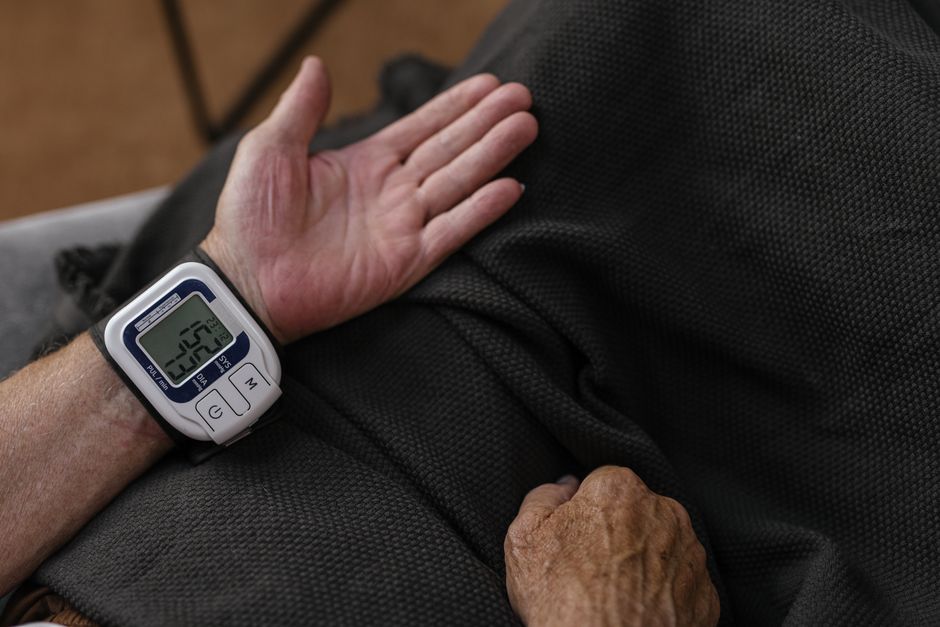
Wrist blood pressure monitors can give you useful information, but they are not as consistently accurate as upper-arm monitors. For most people, a wrist monitor is a reasonable backup option, not the first choice. The upper arm remains the gold standard for home blood pressure measurement because it matches how blood pressure is measured in a doctor’s office.
How Do Wrist Monitors Work?
Wrist monitors measure blood pressure at the radial artery, which runs along the inside of your wrist. The device inflates a cuff around your wrist and uses the same oscillometric method as upper-arm monitors. This method detects the vibration of your artery wall as blood flows through it.
The problem is location. The wrist artery is farther from your heart than the upper arm artery. Blood pressure naturally changes as blood travels through your body. The farther from the heart, the less reliable the reading becomes.
Your wrist is also a smaller, more complex area. The bones, tendons, and ligaments in your wrist can interfere with the sensor. The cuff may not compress the artery evenly, which can skew results.
Why Wrist Monitors Are Less Accurate
The biggest issue is wrist position. Your wrist must be held at heart level for the reading to be correct. If your wrist is below heart level, the reading will be falsely high. If it is above heart level, the reading will be falsely low.
Studies have shown that even a small change in wrist height can change the reading by several points. Many people do not realize their wrist has drifted during the measurement. It is easy to let your arm rest on a table or drop slightly without noticing.
Upper-arm monitors are more forgiving. Your upper arm naturally sits closer to heart level when you sit properly with your arm supported. The larger cuff also covers more surface area, which gives a more stable reading.
Another factor is cuff size. Wrist cuffs come in fewer sizes than upper-arm cuffs. If the cuff does not fit your wrist snugly, the reading will not be accurate. A loose cuff causes falsely low readings. A tight cuff causes falsely high readings.
Who Can Benefit From a Wrist Monitor?
Some people genuinely need a wrist monitor. If your upper arm is too large for a standard cuff, a wrist monitor may be your only practical option. The same applies if you have a medical condition that makes upper-arm measurement painful or difficult.
People with very large upper arms often struggle with home monitoring. Standard adult cuffs may not fit, and extra-large cuffs can be hard to find in stores. A wrist monitor solves this problem, though the accuracy trade-off remains.
Some clinicians also recommend wrist monitors for patients who travel frequently. They are compact and easy to pack. But the convenience does not change the accuracy limitations.
If you have an irregular heartbeat, such as atrial fibrillation, neither wrist nor upper-arm monitors are fully reliable. The oscillometric method assumes a regular heartbeat. Discuss your situation with your doctor before relying on any home monitor.





How to Get the Most Accurate Reading From a Wrist Monitor
If you use a wrist monitor, technique matters more than with an upper-arm device. The following steps are essential for any meaningful reading.
- Sit quietly for five minutes before measuring. Do not talk, eat, or drink caffeine in that time.
- Place the monitor on your bare wrist. Do not wear it over clothing or a watch.
- Rest your elbow on a table. Hold your wrist at heart level. Many monitors have a position sensor that tells you when your wrist is at the correct height.
- Keep your hand relaxed, not clenched or extended backward.
- Take two readings one minute apart. Record both and use the average.
The position sensor is not a gimmick. It is a necessary feature. If your wrist monitor does not have one, consider a different model.
Even with perfect technique, wrist monitors tend to read slightly higher than upper-arm monitors. Some research suggests the difference is small for most people, but it can be significant for others. Do not switch between a wrist monitor and an upper-arm monitor. Pick one device and use it consistently.
What the Evidence Shows
Research on wrist monitors is mixed. Some studies have found that certain models are accurate enough for home use when used correctly. Others have found that wrist monitors consistently overestimate or underestimate blood pressure compared to upper-arm measurements.
A key finding across multiple studies is that the accuracy gap widens in certain groups. Older adults, people with diabetes, and people with vascular disease tend to have less accurate wrist readings. This is likely because their arteries are stiffer, which changes how the pulse wave travels.
The American Heart Association and other major health organizations recommend upper-arm monitors for most people. They do not list wrist monitors as a first-line option. This is not because wrist monitors are dangerous. It is because the evidence for their accuracy is not as strong.
Some wrist monitor manufacturers have received validation from international standards organizations. This means their devices passed laboratory testing for accuracy. However, passing a lab test does not guarantee the same performance in real-world home use. Technique errors are far more common at home than in a controlled study.
When to Avoid a Wrist Monitor
If you are monitoring blood pressure to manage a diagnosed condition like hypertension, an upper-arm monitor is the safer choice. Your doctor will base treatment decisions on your readings. Inaccurate readings can lead to unnecessary medication changes or missed warning signs.
Wrist monitors are also not suitable for diagnosing high blood pressure. Diagnosis requires multiple readings over time, taken with the most accurate method available. A wrist monitor introduces too much variability for this purpose.
Pregnant women should use an upper-arm monitor. Blood pressure changes significantly during pregnancy, and accurate readings are critical for detecting conditions like preeclampsia. No clinical guidelines support wrist monitors for pregnancy monitoring.
If you have peripheral artery disease or another condition that affects blood flow to your arms, talk to your doctor before using any home monitor. Your doctor can tell you whether readings from your wrist or upper arm are meaningful for your situation.
How to Choose a Reliable Monitor
Look for a monitor that has been clinically validated. Independent organizations test blood pressure monitors for accuracy. A device that has passed validation will state this on its packaging or in its documentation.
Check the cuff size. Most monitors come with a standard cuff, but you may need a different size. Measure your wrist circumference and compare it to the cuff range listed by the manufacturer.
Read the user manual carefully. Each device has specific instructions for positioning and use. Following these instructions is not optional. Skipping steps will produce unreliable readings.
Bring your monitor to your next doctor’s appointment. Your doctor can compare its readings to their office equipment. This is the most practical way to know if your specific device is accurate for you.
Frequently Asked Questions
Are wrist blood pressure monitors accurate?
Wrist monitors are less accurate than upper-arm monitors for most people. They can be useful if used correctly, but technique errors are common and readings can be falsely high or low.
Why do wrist blood pressure monitors give different readings than arm monitors?
Wrist monitors measure at the radial artery, which is farther from the heart than the upper arm artery. The reading is also highly sensitive to wrist position, so even a small drop below heart level changes the result.
Can I use a wrist monitor if I have large arms?
Yes, a wrist monitor can be a practical option if upper-arm cuffs do not fit. However, discuss this with your doctor, because the accuracy limitations still apply and may affect your treatment decisions.
Do wrist monitors work for older adults?
Wrist monitors tend to be less accurate in older adults and people with stiff arteries. If you are over 65 or have diabetes or vascular disease, an upper-arm monitor is the safer choice.
Wrist blood pressure monitors are convenient, but convenience does not replace accuracy. If you have a choice, use an upper-arm monitor. If you must use a wrist monitor, follow the positioning instructions exactly and check your device against office equipment regularly.
