
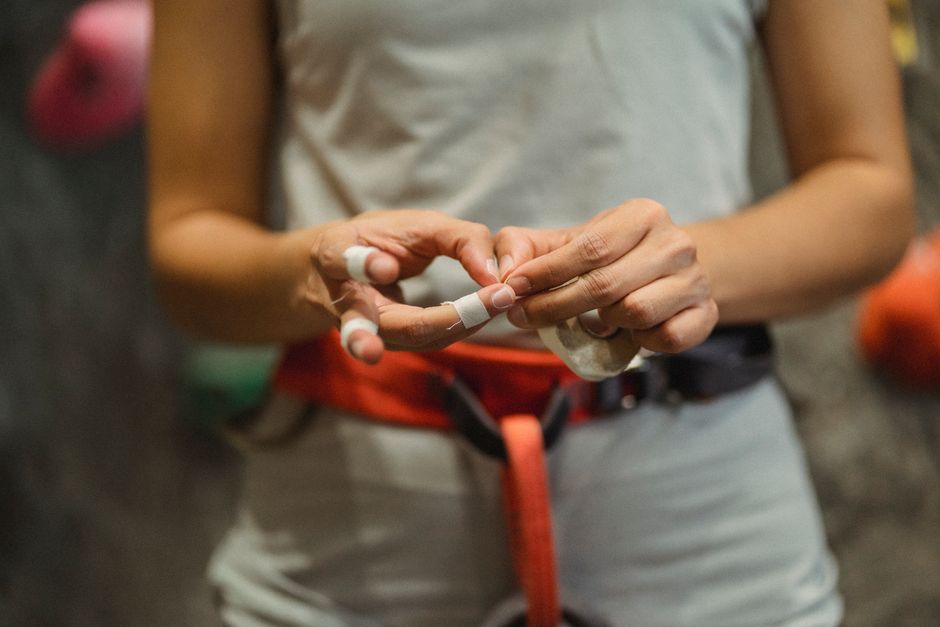
Taping your fingers for climbing is a practical skill, but it is often misunderstood. The tape does not make your tendons stronger. It provides external support that reduces strain on specific structures, most commonly the A2 and A4 pulleys. For most climbers, taping is a temporary measure for minor injuries or a preventative step during intense sessions, not a permanent fix. When done correctly, the tape limits the bowstringing effect of the flexor tendons, which is the primary mechanism of pulley injuries. When done incorrectly, it restricts blood flow, limits movement, or provides no real protection at all.
What Are Finger Pulleys and Why Do They Get Injured?
Your fingers do not have muscles. The muscles that bend them live in your forearm. They connect to your fingertips through long tendons that run along the palm side of each finger. To keep these tendons close to the bone as the finger bends, your body uses a series of small ligament-like bands called pulleys. They act like the eyelets on a fishing rod, holding the line close to the rod so it can bend efficiently.
The A2 pulley sits at the base of the finger, closest to the palm. The A4 pulley sits in the middle of the finger. These two are the most commonly injured in climbing. When you grip a small edge or a deep pocket, the flexor tendons pull hard against these pulleys. If the force is too great, the pulley can strain or tear. This is called a pulley injury. In severe cases, the tendon lifts away from the bone, creating a visible “bowstring” effect on the underside of the finger.
Research consistently shows that the crimp grip—where the finger joints are bent sharply—places the highest load on the A2 pulley. This is why most pulley injuries happen on small edges and crimps rather than on slopers or jugs.
How To Tape Hands For Climbing Pulleys Tips Gloves
The most common and effective method is called the H-tape or X-tape technique. It is designed specifically for the A2 pulley. You will need cloth athletic tape, typically 1.27 cm (half-inch) wide. Do not use elastic or cohesive bandage tape for this—it stretches too much and provides no structural support.
Start with the finger slightly bent, not fully straight and not fully curled. Cut two strips of tape. Each strip should be long enough to wrap around the base of the finger one full time. Place the first strip across the base of the finger, just below the middle joint, on the palm side. The middle of the strip sits directly over the A2 pulley. Wrap the ends around the finger, crossing on the back of the hand side. Press firmly so the tape adheres to itself, but do not pull it tight enough to cut off circulation.
Place the second strip in the same position but slightly overlapping the first, or cross it in an X pattern over the pulley. The goal is to create a rigid band that presses down on the tendon. Some climbers add a third strip that runs lengthwise along the finger, connecting the two bands to form an “H” shape. This prevents the bands from sliding during a session.
For the A4 pulley, use the same technique but position the tape over the middle of the finger, between the middle joint and the fingertip joint. Many climbers tape both A2 and A4 at the same time, especially when climbing pockets or very small edges.
Check your fingertip color after taping. If the fingertip turns white or blue, or if you feel tingling, the tape is too tight. Remove it and reapply with less tension. Taping should feel firm and supportive, not painful or numbing.
Does Taping Actually Prevent Injuries?
The evidence here is mixed. Some studies suggest that taping reduces the strain on the A2 pulley during maximal loading. Other research shows the effect is small and may not be enough to prevent a tear during a sudden, forceful movement. What is clear is that taping does not strengthen the pulley. It only provides mechanical support.
Think of it like a knee brace. A brace can help a slightly injured knee feel more stable during activity, but it does not heal the ligament. The same principle applies to finger taping. If you have a mild pulley strain, taping may allow you to continue climbing at a reduced intensity. If you have a complete rupture, no amount of tape will hold the tendon in place.
One important point: taping can give a false sense of security. If you tape your fingers and feel no pain, you might push harder than your injury can handle. The tape reduces strain, but it does not eliminate it. Climbing through a real injury with tape can turn a minor strain into a full rupture.




What About Climbing Gloves?
Climbing gloves serve a completely different purpose. They do not protect finger pulleys. Standard climbing gloves are designed to protect the skin of the palms from abrasion, keep hands warm in cold conditions, or provide grip on certain surfaces. They do not provide the rigid, localized support that tape offers.
There are specialized “finger sleeves” or “pulley protection gloves” on the market. These are essentially pre-made versions of the H-tape technique sewn into a fabric sleeve. Some climbers find them convenient because they are reusable and do not require tape application skills. However, clinical evidence on their effectiveness compared to traditional taping is very limited. No large human trials have confirmed that these gloves prevent pulley injuries better than tape.
If you prefer gloves for skin protection, you can still tape underneath them. The tape will provide the mechanical support, and the glove will protect your skin. Just make sure the glove is not so tight that it compresses the taped area and restricts blood flow.
When Should You Not Climb on a Taped Finger?
Taping is not a substitute for medical care. If you hear or feel a “pop” in your finger, if you see visible bowstringing on the palm side of the finger, or if you have immediate severe pain and swelling, stop climbing. These are signs of a complete pulley rupture. You need to see a hand specialist or sports medicine doctor. Surgery is sometimes required for multiple pulley ruptures, though many single pulley tears can heal without surgery.
For minor strains—where the finger is sore but you have full range of motion and no bruising—the general clinical direction is rest for 2 to 6 weeks before returning to hard climbing. Taping during this recovery phase can help you climb easier routes with less pain, but it should not be used to enable climbing at your previous maximum level.
No clinical guidelines currently exist for exactly how long to tape after an injury. The general advice from hand therapists is to continue taping for climbing sessions until the finger is pain-free on the hardest holds you plan to use. Then gradually reduce the tape use as your finger strengthens.
How To Strengthen Pulleys Without Climbing
Taping treats the symptom, not the cause. The best way to prevent pulley injuries is to build finger strength gradually. Fingerboarding (hangboarding) is the most direct method, but it carries its own injury risk if done too aggressively.
Start with open-hand hangs on large edges. Do not use the crimp grip during training until your fingers are conditioned. Hang for short intervals—typically 10 seconds on, 2 minutes off—for several sets. Progress to smaller edges only after several weeks of consistent training. This gradual loading allows the pulleys to adapt and strengthen, just like muscles do.
Some research indicates that slow, controlled loading of the finger flexors is safer than explosive movements. Avoid dynamic moves onto small holds when you are fatigued. Most pulley injuries happen at the end of a session, not the beginning, because fatigue reduces your control and increases the load on your fingers.
Common Taping Mistakes
Several mistakes reduce the effectiveness of taping. The first is using tape that is too wide. Wide tape covers too much of the finger and restricts bending. Use half-inch tape for fingers. The second mistake is taping the finger completely straight. The tape will loosen as soon as you bend your finger, providing zero support. The third mistake is wrapping too tightly. This restricts blood flow and can cause nerve compression, which leads to numbness and tingling.
Another common error is taping only the injured finger while ignoring the adjacent fingers. The fingers work together. If your middle finger pulley is sore, taping it alone may not be enough. Some climbers tape the injured finger to the neighboring finger for additional support, but this reduces finger independence and can affect your grip on certain holds.
Finally, do not leave tape on overnight. Tape is not a splint. It is designed for short-term use during activity. Leaving it on for hours can cause skin irritation, reduce circulation, and delay recovery by giving you a false sense that the finger is healed.
When To See a Doctor
See a doctor if the finger remains swollen for more than a few days, if you cannot fully bend or straighten the finger, or if the pain does not improve with rest. An ultrasound or MRI can confirm whether a pulley is partially or completely torn. This matters because the treatment plan differs. Partial tears usually heal with rest and gradual return to climbing. Complete tears may require a splint for several weeks or surgery.
Hand therapists can also teach you proper taping techniques specific to your injury. A generic online tutorial is helpful, but a professional can assess your finger’s range of motion and strength and recommend a taping pattern that fits your anatomy.
Frequently Asked Questions
Does taping fingers help prevent climbing injuries?
Taping can reduce strain on the A2 and A4 pulleys during climbing, but the protective effect is modest. It does not strengthen the pulleys and cannot prevent a tear during a sudden high-force movement.
How tight should climbing tape be on fingers?
Tape should feel firm and supportive without causing numbness, tingling, or discoloration of the fingertip. If the fingertip turns white or blue, the tape is too tight and must be reapplied.
Can you climb with a partially torn finger pulley?
Some climbers climb at reduced intensity with a partial tear if the finger is taped and pain-free. This is a clinical decision best made with a hand specialist, as climbing too soon can turn a partial tear into a complete rupture.
Do climbing gloves protect finger pulleys?
Standard climbing gloves protect the skin and keep hands warm but do not support the pulleys. Specialized pulley sleeves exist, but evidence for their effectiveness compared to tape is very limited.
