
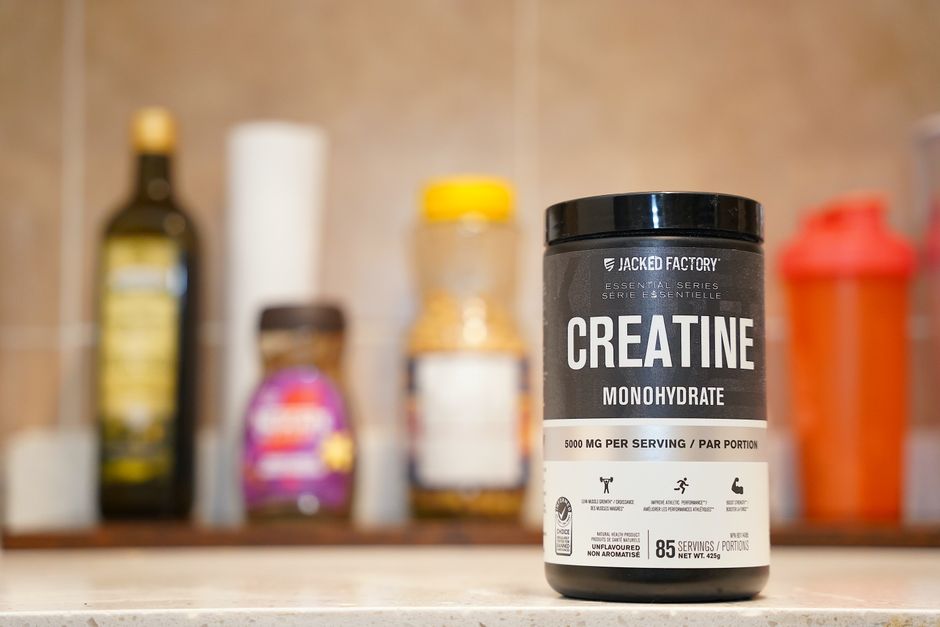
Creatine is one of the most studied supplements in sports nutrition. It is not a steroid, and it is not a stimulant. It is a compound your body already makes and gets from food, mostly meat and fish. People use it to improve strength, build muscle, and improve performance during short, intense exercise. The evidence for these effects is strong and consistent. If you are thinking about using it, the main questions are when to take it and what to expect once you start.
What Does Creatine Actually Do in Your Body?
Your muscles use a molecule called ATP for quick, powerful movements. The problem is your muscles only store enough ATP for a few seconds of all-out effort. Creatine helps your body recycle ATP faster, so you can push harder for a few extra reps or sprint a little longer.
Think of creatine as a backup battery for your muscles. It is stored in the muscle as phosphocreatine. When you lift heavy or sprint, your body taps into this reserve to keep producing energy. Supplementing with creatine increases the amount of phosphocreatine stored in your muscles. More stored fuel means better performance in short, high-intensity efforts.
This explains why creatine helps with weightlifting, sprinting, and other activities that last less than about 30 seconds. It does not help much with endurance sports like long-distance running. That type of exercise relies on a different energy system.
When To Use Creatine: Timing Matters Less Than Consistency
The most important factor is not when you take it, but that you take it every day. Creatine works by saturating your muscles over time. A single dose does nothing. Daily use for several weeks is what raises muscle creatine levels to the point where you notice a difference.
Research consistently shows that taking creatine close to your workout is not necessary. Some studies suggest taking it after a workout may be slightly better than before, but the difference is small. What matters far more is hitting your daily dose consistently, whether that is morning, noon, or night.
Pick a time you can stick with. Many people mix it into a post-workout shake or take it with breakfast. The key is routine. If you miss days, your muscle stores slowly drop, and you lose the benefit.
Do You Need a Loading Phase?
A loading phase means taking a higher dose for the first week to saturate muscles faster. The standard loading protocol is 20 grams per day, split into four doses of 5 grams, for five to seven days. This fills your muscles quickly, and you may notice effects within a week.
You do not need to load. Taking 3 to 5 grams every day will saturate your muscles in about three to four weeks. The end result is the same. Loading just gets you there faster, but it can cause stomach discomfort in some people and increases the chance of water retention.
If you are in a hurry to see results, loading is an option. If you prefer a gentler approach, skip it and just take the daily dose. Both methods work.


What To Expect in the First Weeks
Many people expect to feel something immediately. You probably will not. Creatine is not a stimulant and does not cause an instant energy rush. The effects build gradually as your muscle stores fill up.
The first thing most people notice is weight gain. This is not fat. Creatine pulls water into your muscle cells, which increases muscle volume. Expect to gain about 1 to 2 percent of your body weight in water over the first few weeks. A 180-pound person might gain 2 to 4 pounds. This is normal and not a reason to stop.
After a few weeks, you may notice you can do one or two more reps with the same weight, or you can lift slightly heavier. This is the performance benefit showing up. It is not dramatic. It is the difference between 8 reps and 10 reps, not between 8 and 20.
Some people report feeling fuller or stronger during workouts. Others notice nothing specific until they look at their training log and see progress. Both experiences are normal.
Who Should Consider Creatine and Who Should Skip It
Creatine is well suited for people doing resistance training, sprinting, or any sport requiring short bursts of power. That includes weightlifters, football players, sprinters, and recreational gym-goers. If your training involves heavy lifting or explosive movements, creatine is one of the few supplements with solid evidence behind it.
It is less useful for endurance athletes. Running a marathon or cycling for hours relies on aerobic energy systems that creatine does not directly support. That said, some endurance athletes use it for the sprint finish or hill climbs. The benefit there is small but real.
People with kidney disease or a history of kidney problems should not take creatine without talking to a doctor first. The same applies to anyone taking medications that affect kidney function. For healthy people, decades of research have not shown kidney damage from standard doses, but the risk is not zero for those with existing conditions.
If you are pregnant or breastfeeding, no clinical guidelines currently exist for creatine use. The safest choice is to avoid it until more research is done.
How Much To Take and What Form To Buy
The standard daily dose is 3 to 5 grams. That is the amount shown in studies to maintain full muscle stores. Taking more does not provide extra benefit. Your muscles can only hold so much, and the excess is excreted in urine.
Creatine monohydrate is the form with the most research behind it. It has been studied for decades, and it is the version used in the vast majority of clinical trials. It is also the cheapest form, which is a point in its favor.
Other forms exist, such as creatine hydrochloride and buffered creatine. Some companies claim these are better absorbed or cause less bloating. The evidence does not support these claims. No study has confirmed that any form outperforms creatine monohydrate for strength or muscle gain. Save your money and buy monohydrate.
Common Side Effects and How To Manage Them
Creatine is well tolerated by most people. The most common side effect is stomach discomfort, especially at higher doses. Taking it with food or splitting the dose throughout the day can reduce this.
Water retention is expected and not harmful. It happens because creatine draws water into muscle cells. This is why some people look slightly bigger within the first few weeks. It is not the same as bloating, which is gas in the digestive tract. True bloating is less common and usually related to the form of creatine or taking too much at once.
There is a persistent myth that creatine causes cramping or dehydration. Research has not confirmed this. Some studies actually suggest creatine may help with hydration because it increases water content in muscles. The evidence does not support the idea that creatine causes cramps.
Hair loss is another myth that circulates online. The theory is based on a byproduct of creatine breakdown called creatinine, and how it might interact with a hormone called DHT. No clinical evidence currently confirms that creatine causes hair loss in humans. This is a case where biological reasoning has outpaced actual data.
How Long Should You Use Creatine?
There is no set time limit. Many people use creatine continuously for years. Studies lasting up to five years have not shown harmful effects in healthy people. If you are getting the performance benefit and tolerating it well, there is no reason to cycle off.
Some people prefer to stop after a few months. That is fine. The main effect is that your muscle creatine levels slowly return to baseline over several weeks. You will lose the extra capacity for high-intensity work, but you do not lose muscle automatically. Any muscle you built while using creatine stays as long as you keep training and eating enough protein.
If you stop, you do not need to wean off. Just stop taking it. Your body handles the transition on its own.
Creatine and Muscle Building: What the Research Shows
Creatine does not build muscle on its own. It allows you to train harder, and that extra training stimulus is what drives muscle growth. This is an important distinction. If you take creatine but do not train, you will not gain muscle.
Research consistently shows that people combining creatine with resistance training gain more muscle and strength than people doing the same training without creatine. The effect is modest but real. It is not the difference between no results and dramatic results. It is the difference between good results and slightly better results.
Creatine also helps with recovery between sets. Because it speeds up ATP regeneration, you may feel ready for your next set sooner. Over the course of a workout, this can add up to more total volume, which is a key driver of muscle growth.
Frequently Asked Questions
What time of day should I take creatine?
Any time of day works as long as you take it consistently every day. The research does not show a meaningful difference between morning and evening dosing.
Can I take creatine on rest days?
Yes, take it every day including rest days. Daily use keeps your muscle stores saturated, which is what matters.
Does creatine make you gain fat?
No. Creatine causes water retention in muscles, not fat gain. The weight increase in the first few weeks is water, not fat.
Is creatine safe to take long term?
Research in healthy people has not shown harmful effects from long-term use at standard doses. People with kidney disease should consult a doctor before taking it.
