
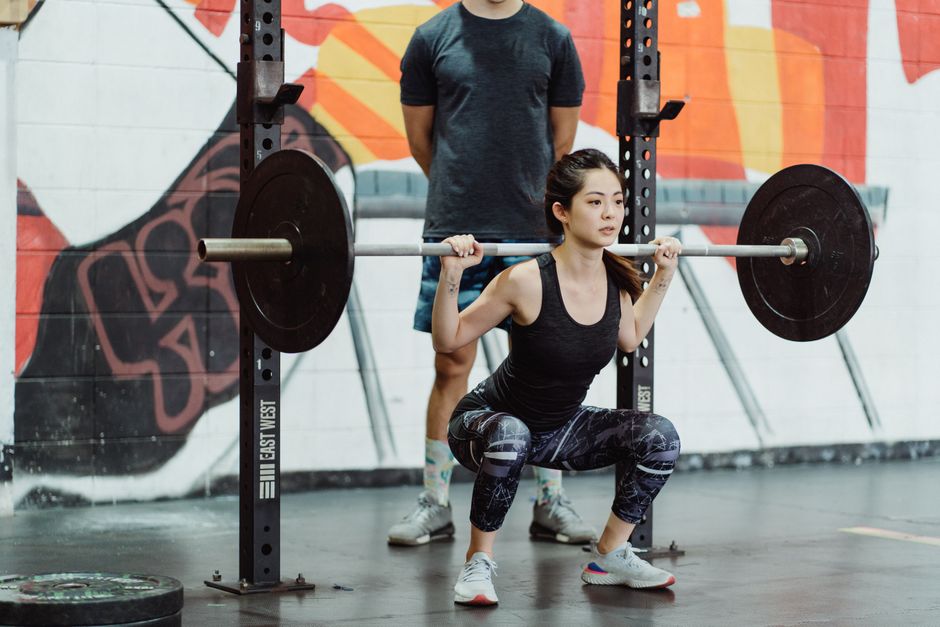
An air squat is a bodyweight exercise where you bend your knees and hips to lower your body toward the ground, then stand back up. No weights, no machines, no equipment. Your body provides all the resistance. Because it needs nothing but a bit of floor space, the air squat is one of the most accessible strength exercises there is, and it shows up in fitness programs ranging from beginner home workouts to military physical training.
What Is Air Squats and How Do You Do One?
An air squat is a squat performed with only your body weight. You stand with feet about shoulder-width apart, push your hips back and bend your knees to lower down, then drive back up to standing. That is the whole movement.
The depth you reach depends on your mobility. Many coaches use “hip crease below the knee” as a target for a full squat, though not everyone can safely reach that depth on day one. A partial squat still works the same muscles through a smaller range of motion.
Here is the basic sequence:
- Stand with feet roughly shoulder-width apart, toes pointed slightly out.
- Brace your midsection and keep your chest up.
- Push your hips back and bend your knees at the same time, as if sitting into a chair.
- Lower as far as you can while keeping your heels down and your back neutral.
- Push through your whole foot to stand back up.
Two form points matter more than depth. First, your knees should track roughly over your toes, not cave inward. Second, your spine should stay neutral, meaning no rounding or over-arching. A rounded lower back under load is a common source of discomfort, though with bodyweight alone the risk is lower than with a barbell.
If your heels lift off the floor, your ankles may lack mobility. Elevating your heels slightly on a small wedge or book can help you squat deeper while you work on ankle flexibility. This is a common coaching cue, not a medical treatment.
Which Muscles Do Air Squats Work?
Air squats primarily work the quadriceps, glutes, and hamstrings. They also engage the calves, the adductors on the inner thigh, and the muscles of the trunk that stabilize your spine.
The quadriceps on the front of your thigh straighten your knee as you stand. The glutes and hamstrings extend your hip. Because the squat combines both actions, it trains the major muscles of the lower body in one movement.
Your core muscles work isometrically. That means they hold your torso steady rather than shortening and lengthening. This is not the same as a dedicated core exercise, but it does mean squats demand trunk stability.
What air squats do not do is build large amounts of muscle mass in most people. Muscle growth depends heavily on progressive overload, meaning gradually increasing the demand on your muscles over time. Body weight alone becomes easy to handle fairly quickly for many people, so growth tends to plateau unless you add resistance or volume.
Air Squats vs. Weighted Squats: What Is the Difference?
The movement pattern is nearly identical. The difference is load. A weighted squat adds resistance through a barbell, dumbbell, kettlebell, or other external weight, which increases the demand on your muscles and generally allows for greater strength and size gains over time.
Air squats are the entry point. They teach the pattern, build basic capacity, and require no equipment. Weighted squats are the progression for people who want to keep getting stronger once bodyweight stops being challenging.
The table below compares the two in general terms.
| Feature | Air Squat | Weighted Squat |
|---|---|---|
| Equipment | None | Barbell, dumbbell, or kettlebell |
| Primary use | Learning form, endurance, warm-ups | Building strength and muscle |
| Muscle growth potential | Limited once bodyweight gets easy | Higher with progressive loading |
| Joint stress | Generally lower | Higher, depends on load and form |
| Accessibility | Anywhere | Needs equipment and space |
Neither is better in absolute terms. The right choice depends on your goal. For general fitness and daily movement, air squats are often enough. For strength or muscle, you will likely need added resistance eventually.


What Are the Health Benefits of Air Squats?
Air squats build lower-body strength and muscular endurance. They also train the movement pattern you use every time you sit down and stand up, which matters for daily function.
Research on exercise in general consistently shows that regular physical activity supports cardiovascular health, blood sugar control, bone density, and mood. Squats contribute to that picture as part of an active lifestyle, but no study shows that air squats alone prevent disease.
One practical benefit is convenience. Because they need no equipment, air squats are easy to fit into a day. Some research suggests that breaking up long periods of sitting with short bursts of movement can support metabolic health, though the specifics vary across studies.
A less obvious point: the squat is a functional pattern, not just a gym move. Losing the ability to stand from a chair without using your arms is a meaningful marker of lower-body weakness as people age. Practicing the pattern keeps it available.
What air squats will not do is replace cardiovascular exercise, and they are not a weight-loss method on their own. Fat loss depends mainly on overall energy balance, not on any single exercise. Be skeptical of any claim that a specific move “melts” fat from a body part. Spot reduction is not supported by evidence.
How Many Air Squats Should You Do?
There is no single correct number. General physical activity guidelines from major health organizations recommend adults get at least 150 minutes of moderate aerobic activity per week plus muscle-strengthening activity on two or more days per week. Air squats can count toward the strengthening portion.
For a beginner, a reasonable starting point is a few sets of 8 to 12 repetitions, done two or three times per week, with rest days in between. That range is a common starting recommendation, not a fixed rule. If you can do far more than that comfortably, you can add reps or sets gradually.
Progression matters more than the starting number. Add a few reps, an extra set, or a slower tempo over time. Once bodyweight squats become easy for high repetitions, adding resistance is usually the next step for continued strength gains.
Stop if you feel sharp pain. Muscle fatigue is expected. Joint pain is not, and it is a signal to check your form or ease off.
Are Air Squats Safe for Your Knees and Back?
Squats are widely considered safe for healthy knees and backs when performed with reasonable form and load. In fact, the squat is a standard movement in rehabilitation and strength programs.
Knees traveling past the toes during a squat has been a debated topic for years. Research on the question has found that restricting forward knee travel does not clearly reduce knee stress and may simply shift load to the hips and lower back. The evidence does not support the old rule that knees must never pass the toes.
People with existing knee or back conditions should get individual guidance. A physical therapist or physician can advise on depth and modifications. This is especially true after surgery or with a diagnosed joint condition.
If you have knee pain during squats, common adjustments include reducing depth, slowing down, widening your stance, or trying a box squat where you sit back to a chair or bench. These are widely used coaching modifications, though individual results vary.
Frequently Asked Questions
What is an air squat?
An air squat is a bodyweight squat performed without any added weight. You lower your hips by bending your knees and hips, then stand back up.
How many air squats should a beginner do?
A common starting point is a few sets of 8 to 12 reps, two or three times per week. There is no fixed number, so build up gradually as you get stronger.
Do air squats build muscle?
They build some lower-body strength and endurance, especially for beginners. Muscle growth tends to plateau once bodyweight becomes easy, so added resistance is usually needed for continued gains.
Are air squats bad for your knees?
For healthy knees, air squats are generally considered safe when done with reasonable form. People with existing knee conditions should get individual guidance from a clinician.
