
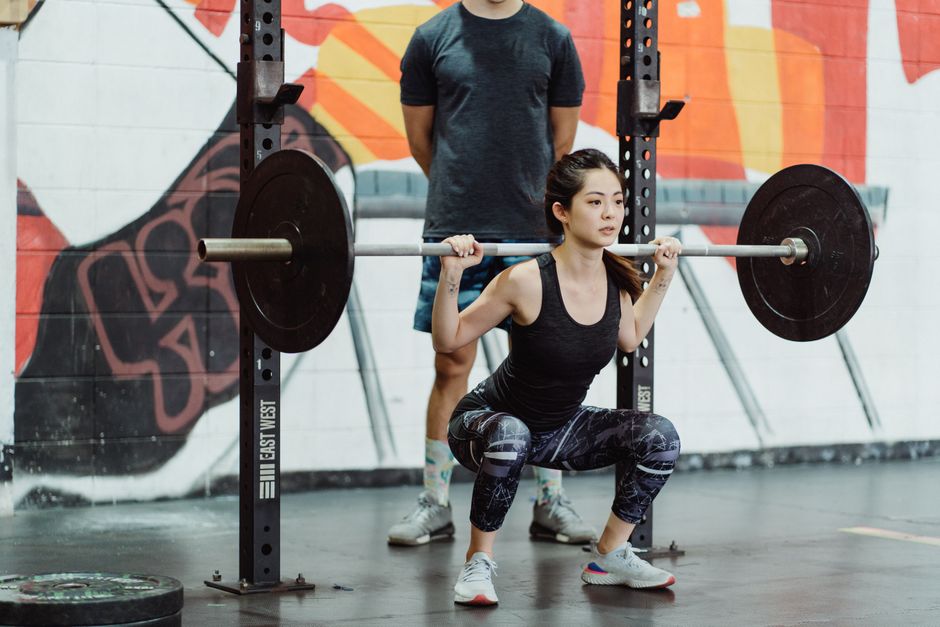
Squats are one of the most effective exercises you can do, but only if you perform them with proper form. To do a squat correctly, stand with your feet shoulder-width apart, push your hips back, bend your knees, and lower yourself as if sitting into a chair, keeping your chest up and your weight in your heels. The key is to maintain a neutral spine and ensure your knees track in line with your toes throughout the entire movement.
Why Squat Form Matters More Than Weight
Perfect form is not about being rigid. It is about protecting your joints and maximizing muscle activation. When your knees cave inward or your lower back rounds, you shift stress away from your leg muscles and onto ligaments and spinal discs.
Studies consistently show that proper squat mechanics increase activation in the quadriceps, hamstrings, and glutes. Poor mechanics do the opposite. They reduce the benefit of the exercise while increasing the risk of injury. This is true whether you are squatting your body weight or a loaded barbell.
Think of the squat as a movement pattern, not just a leg exercise. It involves your ankles, knees, hips, and spine working together. If one joint is restricted, another joint compensates. That compensation is usually where problems start.
How To Do Squats Correctly: Step By Step
Follow these steps exactly. Practice them in front of a mirror until the movement feels natural.
- Set your stance: Stand with your feet slightly wider than shoulder-width apart. Point your toes out slightly, about 5 to 15 degrees. This allows your hips to rotate externally, which creates space for your thighs to lower.
- Brace your core: Take a deep breath into your belly and tighten your abdominal muscles. Do not just puff your chest out. Imagine someone is about to punch you in the stomach. Hold this brace throughout the squat.
- Start the movement at the hips: Push your hips back as if you are closing a car door with your rear end. Your knees will begin to bend naturally. Do not lead with your knees first.
- Lower yourself: Continue bending your knees and hips until your thighs are at least parallel to the floor. If you can go deeper without your lower back rounding, do so. Your chest should stay up and your gaze should be straight ahead.
- Keep your knees tracking: Your knees should stay in line with your toes. They should not cave inward. If they do, your glutes may be weak or your stance may be too narrow.
- Drive through your heels: Push the floor away by pressing through your mid-foot and heels. Do not let your heels lift off the ground. Straighten your hips and knees to return to standing.
- Exhale on the way up: Breathe out as you push back to standing. Inhale again at the top before your next repetition.
That is the complete movement. A full repetition takes about three to four seconds down and two seconds up. Slow and controlled beats fast and sloppy every time.
Common Squat Mistakes and How To Fix Them
Most people make the same few errors. Recognizing them is half the battle.
Knees Caving Inward
This is called knee valgus. It happens when the hip muscles, particularly the gluteus medius, are not strong enough to keep the thigh bone stable. The knee follows the thigh inward, which strains the medial collateral ligament over time.
Fix this by placing a light resistance band around your thighs just above the knees during your warm-up sets. Push your knees out against the band as you squat. This activates the gluteus medius and trains your knees to track correctly.
Heels Lifting Off the Floor
If your heels come up, you are shifting your weight too far forward onto your toes. This usually means your ankles lack sufficient dorsiflexion, which is the ability to bend your ankle so your knee moves forward over your foot.
Fix this by elevating your heels on a small weight plate or a wedge. This is a temporary fix, not a permanent one. Work on ankle mobility by doing calf stretches and knee-to-wall exercises to improve your range of motion over time.
Rounding the Lower Back
This is often called “butt wink” when it happens at the bottom of the squat. It occurs when your hamstrings are tight or your core is not braced properly. When your lower back rounds, the discs in your spine experience uneven pressure.
Fix this by not descending as deep. Only go as low as you can while keeping your spine neutral. Improve hamstring flexibility with regular stretching. And always brace your core before each repetition.
Not Going Low Enough
Partial squats still work muscles, but they do not provide the same benefits as full range squats. A squat is generally considered full when your thighs reach at least parallel to the ground.
If you cannot reach parallel, reduce the weight or use a box to squat down to. Place a box or bench behind you at the height you want to reach. Touch it lightly with your glutes, then stand up. This builds confidence and depth simultaneously.


Breathing and Bracing Techniques for Squats
Your breath is your weight belt. It stabilizes your spine under load. This is not optional for heavy squats.
The Valsalva maneuver is the standard technique used for lifting. Take a deep breath into your belly, hold it, and brace your abdominal muscles as if preparing for impact. Keep holding that breath as you descend and begin to ascend. Exhale forcefully only after you have passed the hardest part of the lift, usually near the top.
This technique increases intra-abdominal pressure, which supports your spine. It is safe for most healthy people. However, if you have high blood pressure or a history of cardiovascular issues, talk to your doctor before using this technique with heavy weights. Some research suggests it causes a temporary spike in blood pressure.
For lighter weights and higher repetitions, you do not need to hold your breath for the entire rep. Exhale on the exertion phase, which is the way up, and inhale on the way down. This is less stable but more practical for endurance training.
How Deep Should You Squat?
Depth is a common debate. The answer depends on your goals and your anatomy.
Full depth, meaning thighs below parallel, maximizes glute activation and overall lower body strength. It also requires more mobility in your ankles and hips. If you have the mobility, full depth squats are generally considered safe for healthy knees.
Research published in the Journal of Strength and Conditioning Research has shown that deep squats do not increase the risk of knee injury when performed with proper form. In fact, some studies suggest deep squats may actually strengthen knee stability by loading the joint through a fuller range of motion.
If you lack mobility, squatting to parallel is acceptable. Forcing depth beyond your range of motion causes your lower back to round, which is where the risk lies. The problem is not the depth. The problem is poor form at that depth.
A good rule of thumb is this: squat as deep as you can while maintaining a neutral spine and flat heels. That is your safe depth. It will improve over time as your mobility improves.
Bodyweight vs. Weighted Squats: Which Should You Do?
Bodyweight squats are excellent for learning form, building endurance, and warming up. They are also perfectly effective for maintaining lower body strength in beginners. If you cannot perform 20 bodyweight squats with perfect form, you are not ready for added weight.
Weighted squats, whether with dumbbells, kettlebells, or a barbell, are necessary for building significant muscle and strength. Muscles grow in response to progressive overload, which means you must gradually increase the resistance over time.
Start with a goblet squat if you are adding weight for the first time. Hold a dumbbell vertically against your chest with both hands. This position naturally encourages an upright torso and proper depth. It is the safest and most effective way to introduce external load.
Barbell back squats are more advanced. They require significant mobility in your shoulders, wrists, and hips. If your mobility is limited, you will compensate with poor posture. Master the goblet squat first.
Frequently Asked Questions
How many squats should I do per day?
For beginners, 3 sets of 10 to 15 repetitions with perfect form is a solid starting point. Focus on quality over quantity and rest at least 48 hours between squat sessions if you are sore.
Should I squat every day?
No, your muscles need time to recover and grow. Two to three squat sessions per week with a rest day in between is generally sufficient for most people.
Can squats hurt my knees?
Squats do not hurt healthy knees when performed with proper form. Knee pain during squats usually indicates poor tracking, excessive weight, or an underlying joint issue that needs evaluation.
Do I need to squat deep to see results?
No, squatting to parallel is enough to build strength and muscle. Deeper squats add more glute activation but only if you can maintain a neutral spine throughout the movement.
