
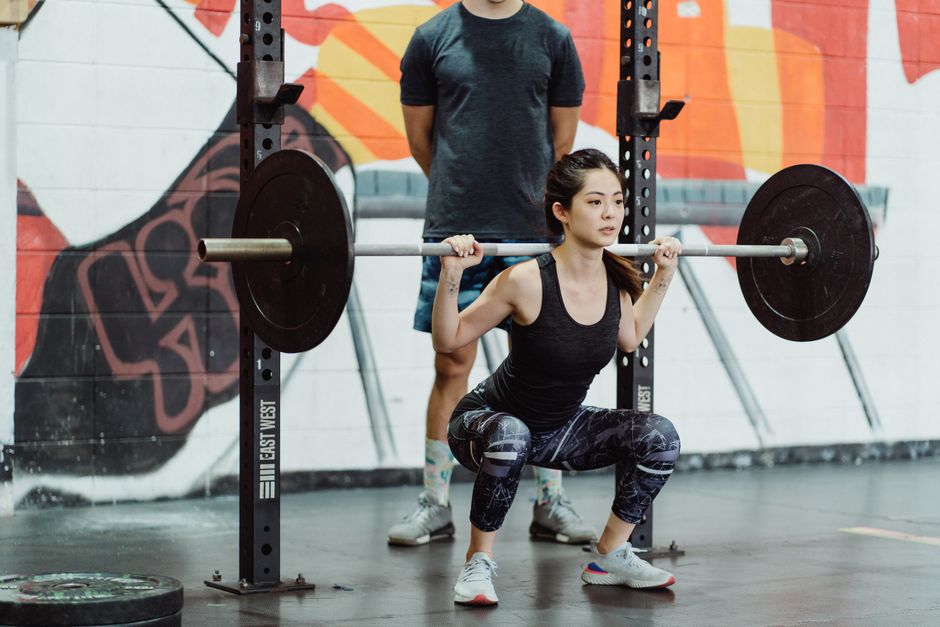
Your gastrocnemius does work during squats, but not in the way most people think. It acts mainly as a stabilizer, not a prime mover. The calf muscle helps keep your lower leg stable and your balance centered as you descend and rise. However, research shows it generates far less force in a squat than it does in a standing calf raise or a jump.
What Does the Gastrocnemius Actually Do During a Squat?
The gastrocnemius is the large, visible calf muscle on the back of your lower leg. It crosses two joints: your knee and your ankle. This makes it unique among calf muscles. During a squat, your knee bends and your ankle dorsiflexes — meaning your shin moves forward toward your toes.
Because the gastrocnemius attaches above the knee, bending the knee actually shortens the muscle. This puts it in a mechanically weak position. At the same time, your ankle is bending the other way, which would normally stretch the muscle. These two opposing actions create a tug-of-war inside the muscle itself. Research published in the Journal of Electromyography and Kinesiology found that gastrocnemius activation during a deep squat is only about 15 to 25 percent of its maximum voluntary contraction. That is low compared to your quads or glutes.
So yes, the muscle fires. But it is not doing heavy lifting. It is working to stabilize your ankle and knee in real time. If your form breaks down or your ankles lack mobility, your gastrocnemius has to work harder to compensate.
Does the Depth of Your Squat Change Calf Activation?
Yes, squat depth changes how much your gastrocnemius works. A partial squat — stopping at parallel or above — keeps your ankle in a more neutral position. The gastrocnemius stays relatively quiet. A deep squat, where your hips drop below your knees, forces your ankles into more dorsiflexion. This stretches the gastrocnemius more, which can increase its activation slightly.
But here is the catch. As you go deeper, your knee bends more, which shortens the gastrocnemius even further. This shortening cancels out some of the stretch from the ankle. The net effect is that even in a deep squat, the gastrocnemius never reaches high activation levels. A 2015 study in PeerJ measured muscle activity across different squat depths and found that the gastrocnemius never exceeded 30 percent of its max, regardless of depth.
If your goal is to build your calves, squats alone will not do it. You need exercises that put the gastrocnemius under tension while the knee is extended — like standing calf raises, donkey calf raises, or jumping exercises.
Does Your Foot Position Affect Gastrocnemius Activation in Squats?
Foot position does matter, but the effect is small. A wider stance with toes turned out reduces the range of motion at the ankle. This means less dorsiflexion and less stretch on the gastrocnemius. A narrower stance with toes forward increases ankle movement, which can slightly raise calf activation.
Some lifters elevate their heels with weightlifting shoes or a small plate. This reduces the amount of dorsiflexion needed. It also shifts more work to the quads. When your heel is elevated, your gastrocnemius stays in a more shortened position throughout the squat. Activation drops even further.
For most people, foot position should be chosen based on comfort, ankle mobility, and overall squat mechanics — not on trying to work the calves. The effect on calf growth is too small to justify changing your stance. A 2018 analysis in Sports Medicine reviewed multiple squat variations and concluded that foot position changes calf activation by less than 10 percent in most lifters.

How Does Squat Form Change What Your Calves Do?
Your squat form influences calf activation indirectly. The main factor is how much your knees travel forward. A squat style that allows the knees to track well past the toes — like a high-bar squat or front squat — puts the ankle into more dorsiflexion. This stretches the gastrocnemius more and increases its stabilizing role.
A low-bar squat, where you sit back more and keep your shins more vertical, reduces ankle movement. The gastrocnemius stays shorter and less active. Powerlifters often use this style to maximize hip and hamstring involvement. Their calves are doing even less work than in a standard squat.
If you squat with poor ankle mobility, your body will compensate. Your heels may lift slightly, or your torso will lean forward. In these cases, the gastrocnemius may fire harder to keep you stable. But this is not a good thing — it is a sign of a mobility limitation, not effective training. Fixing your ankle mobility with dedicated stretches will improve your squat and reduce unnecessary calf strain.
Can Squats Replace Calf Raises for Building Your Calves?
No. Squats cannot replace calf raises for calf development. The evidence is clear on this. The gastrocnemius is not loaded enough during a squat to stimulate significant muscle growth. A 2020 meta-analysis in Frontiers in Physiology looked at muscle activation across dozens of leg exercises. Squats ranked near the bottom for calf activation. Standing calf raises and seated calf raises were at the top.
If you want bigger calves, you need direct calf work. Squats are excellent for your quads, glutes, hamstrings, and core. They are not a calf exercise. Treating them as one will leave you disappointed.
Some people claim that heavy squats build calves through overall systemic stress and hormone release. That idea is not supported by research. Muscle growth is local and load-specific. Your calves need their own dedicated volume, preferably with the knee extended so the gastrocnemius is under full stretch and tension.
| Exercise | Gastrocnemius Activation (% of max) | Best For |
|---|---|---|
| Standing Calf Raise | 70-90% | Direct calf growth |
| Seated Calf Raise | 40-60% | Soleus (deeper calf muscle) |
| Deep Squat | 15-25% | Stabilization only |
| Jump Squat | 30-45% | Explosive power |
Does Your Gastrocnemius Work During Squats for Runners or Athletes?
For runners and athletes, the role of the gastrocnemius during squats matters more for injury prevention than for muscle growth. The calf muscle absorbs a lot of force during running — up to several times body weight with each step. If your calves are weak or imbalanced, squats can expose that weakness.
When you squat, your gastrocnemius helps control ankle movement. If it is underdeveloped, your Achilles tendon takes more stress. Over time, this can contribute to tendinopathy or calf strains. A 2019 study in the American Journal of Sports Medicine found that athletes with weaker calf muscles had higher rates of lower leg injuries during both squatting and running activities.
For these individuals, squats are not enough to build calf strength. But they are useful as a diagnostic tool. If your calves feel overly tight or fatigued after squatting, it may indicate that your ankle mobility is limited or your calves are compensating for weak glutes or poor core stability. Fix the root cause, and your calves will thank you.
Common Misconceptions About Calves and Squats
One common myth is that squatting heavy builds calves because of the “stretch” at the bottom. The idea is that the gastrocnemius is under deep stretch, so it must be working. But stretch alone does not build muscle. You need tension under load. The gastrocnemius is not under significant tension when shortened at the bottom of a squat.
Another misconception is that wearing heeled squat shoes builds calves. Actually, heel elevation reduces calf activation. The whole point of a heel lift is to bypass tight calves and ankles. If you want to build calves, take the shoes off or use flat shoes with good grip and do direct calf work.
Some people also believe that adding a pulse or hold at the bottom of a squat increases calf work. There is no evidence for this. Holding the bottom position increases isometric tension in your quads and glutes, but the gastrocnemius remains in a shortened, low-tension state. You are better off adding a jump squat or a calf raise superset if you want more calf involvement.
How to Train Your Calves Alongside Squats
If you squat regularly and want to develop your calves, add two to three sets of standing calf raises at the end of your leg workout. Use a weight that lets you complete 10 to 15 reps with good form. Pause at the bottom for a full stretch and squeeze at the top.
Do not neglect the soleus. This deeper calf muscle lies underneath the gastrocnemius and responds better to seated calf raises with bent knees. The soleus gives your calves thickness and endurance. Most people need both standing and seated calf work for balanced development.
You can also add one plyometric session per week — box jumps, pogo hops, or jump rope. These exercises recruit the gastrocnemius explosively, which complements the slow, controlled tension of squats. Just do not overdo it. Your calves recover slowly, and adding too much volume too fast can lead to Achilles issues.
Frequently Asked Questions
Do squats build calf muscle?
Squats do not build significant calf muscle because the gastrocnemius is only activated at 15 to 25 percent of its maximum during the movement. For calf growth, you need exercises like standing calf raises that put the muscle under full tension with the knee straight.
Does foot placement change calf activation in squats?
Yes, but the effect is small — less than a 10 percent change in activation. A narrower stance with toes forward increases ankle movement and slightly raises calf work, while a wider stance reduces it.
Can tight calves limit squat depth?
Yes, tight calves can restrict ankle dorsiflexion, which makes it harder to reach depth without your heels lifting. Improving calf and ankle mobility with stretches can help you squat deeper with better form.
Should I do calf raises on the same day as squats?
Yes, doing calf raises after squats is effective and efficient. Your calves are fresh enough to work well, and you save time by combining them in one session.
