
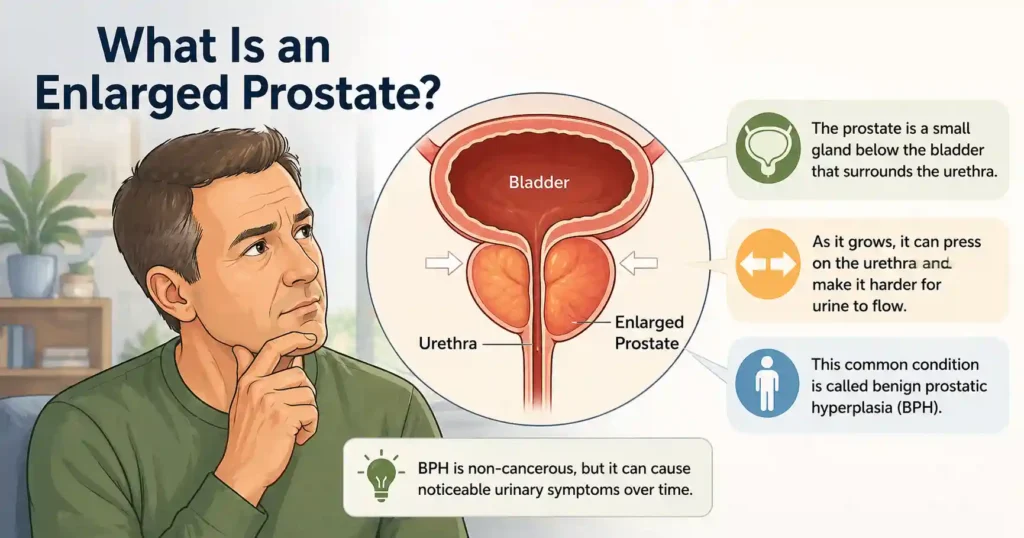
The prostate is a small walnut-sized gland that sits below the bladder in men and people assigned male at birth. It wraps around the urethra, the tube that carries urine and semen out of the body. The prostate produces fluid that mixes with sperm during ejaculation to help protect and nourish sperm as it travels.
Where Exactly Is the Prostate Located?
The prostate sits deep in the pelvis, just in front of the rectum and below the bladder. This location is why doctors can feel the prostate during a rectal exam. The gland surrounds the top portion of the urethra where it exits the bladder.
Because of where it sits, prostate problems often affect urination first. When the gland swells or grows, it can squeeze the urethra and make it harder to empty the bladder. This is one of the earliest signs that something may be changing with prostate health.
The seminal vesicles, which also contribute fluid to semen, attach to the upper back portion of the prostate. Nerves that control erections run along both sides of the gland, which is why prostate surgery or radiation can sometimes affect sexual function.
What Does the Prostate Actually Do?
The prostate’s main job is to produce prostatic fluid. This milky liquid makes up about 30 percent of the total volume of semen. It contains enzymes, zinc, and citric acid that help sperm survive in the acidic environment of the vagina.
During ejaculation, muscles in the prostate contract to push this fluid into the urethra, where it mixes with sperm from the testicles and fluid from the seminal vesicles. The prostate also produces prostate-specific antigen, or PSA, which helps keep semen in liquid form after ejaculation.
The gland does not play a role in urine production or storage. But because the urethra runs through it, prostate changes can block urine flow even though the bladder and kidneys are working normally.
Other Prostate-Related Posts
- How to Self Prostate Massage? Tips That Actually Work

- How Do I Find the Prostate? What You Need to Know
- What Causes a Prostate Infection? The Real Answer



How Big Is a Normal Prostate?
In younger adults, a healthy prostate is roughly the size and shape of a walnut, weighing about 20 to 30 grams. It measures about 3 centimeters long and 4 centimeters wide. Most men will not notice their prostate at all during this phase of life.
The prostate grows in two main phases. The first happens during puberty when the gland roughly doubles in size. The second phase starts around age 25 and continues slowly for the rest of one’s life. This gradual growth is normal, though it can eventually cause symptoms in some men.
By age 60, many prostates have grown to 40 or 50 grams. Some reach 80 grams or more. Size alone does not predict symptoms. Some men with large prostates have no trouble urinating, while others with moderate enlargement struggle significantly.
| Age Range | Typical Prostate Size | Common Changes |
|---|---|---|
| 18-40 years | 20-30 grams | Stable, no symptoms |
| 40-60 years | 30-50 grams | Gradual growth, some may notice changes |
| 60+ years | 40-80+ grams | Enlarged in most men, symptoms common |





What Can Go Wrong With the Prostate?
Three main conditions affect the prostate. The most common is benign prostatic hyperplasia, or BPH, which is a non-cancerous enlargement. More than half of men in their 60s and up to 90 percent of men in their 80s have some degree of BPH. It causes urinary symptoms but does not increase cancer risk.
Prostatitis is inflammation or infection of the prostate. It can develop suddenly with fever and pain or show up as chronic discomfort in the pelvic area. Bacterial infections respond to antibiotics, but chronic prostatitis is harder to treat, and the cause is often unclear.
Prostate cancer is the most serious condition. It develops when cells in the prostate begin to grow uncontrollably. Most prostate cancers grow slowly and may never cause problems during a man’s lifetime. Some types are aggressive and spread quickly.
As of 2026, prostate cancer remains the second most common cancer in men in the United States.
These three conditions can share symptoms, which is why testing is needed to figure out what is actually happening. Difficulty urinating does not mean cancer, and a high PSA test does not automatically mean cancer either.
What Are the Warning Signs of Prostate Problems?
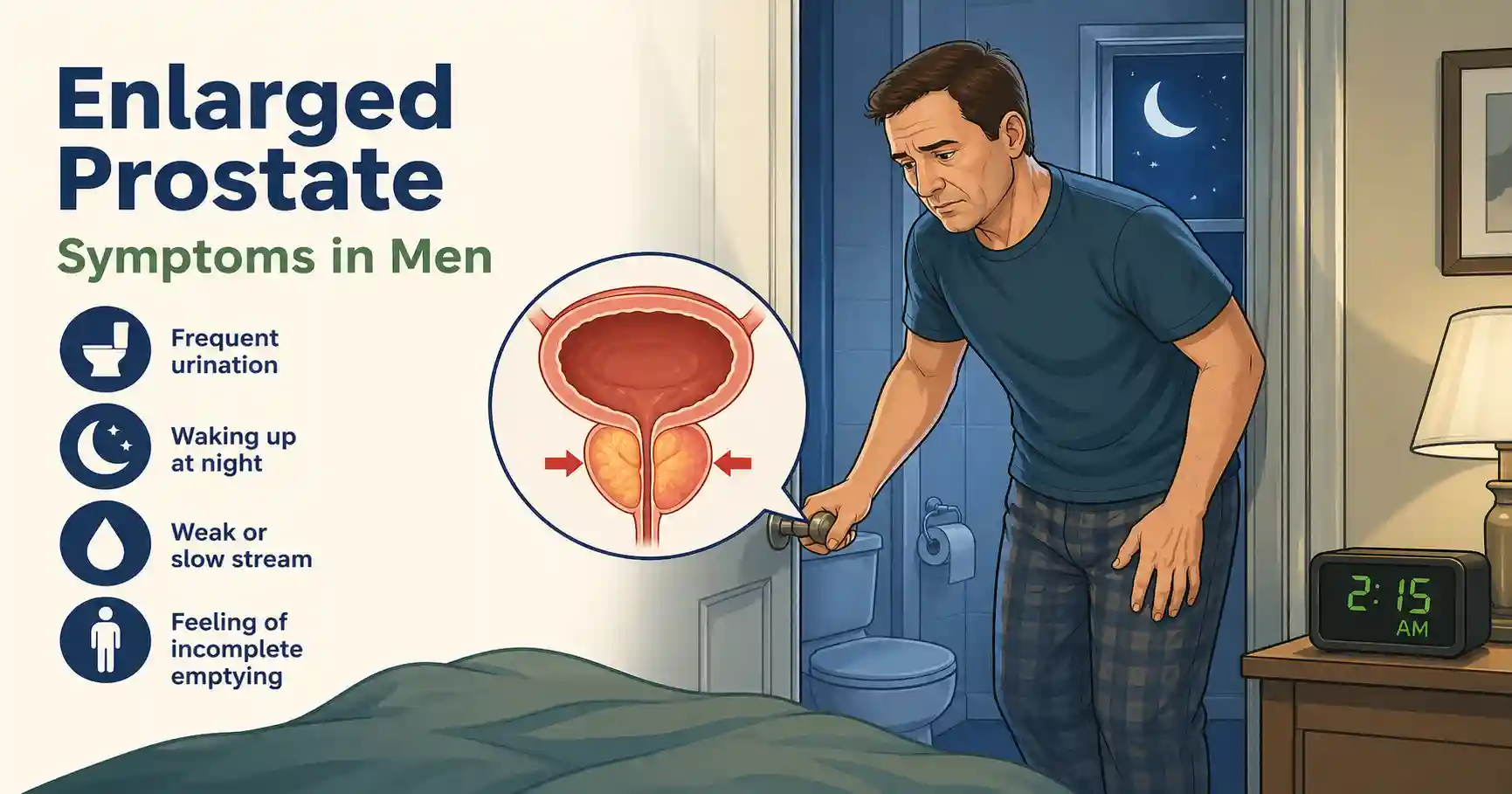
Urinary changes are the most common first signal. These include a weak stream, trouble starting urination, dribbling after finishing, or feeling like the bladder is not empty. Needing to urinate frequently at night is another early sign many men notice.
Pain or burning during urination usually points to infection or inflammation rather than BPH or cancer. Blood in urine or semen should always be evaluated, though it is more often from infection or BPH than cancer. Pain in the lower back, hips, or pelvis can show up with advanced prostate cancer, but is rarely the first symptom.
Early prostate cancer typically causes no symptoms at all. This is why screening with PSA tests and physical exams is recommended for men at higher risk, though guidelines on who should be screened and when continue to be debated among medical organizations.
- Weak or interrupted urine flow
- Frequent urination, especially at night
- Difficulty starting or stopping urination
- Pain or burning when urinating
- Blood in urine or semen
- Persistent pain in the back, hips, or pelvis
How Do Doctors Check Prostate Health?
The digital rectal exam remains one of the simplest ways to check the prostate. A doctor inserts a gloved finger into the rectum to feel the back wall of the prostate. They check for hard areas, lumps, or irregular texture that might suggest cancer, and assess overall size.
The PSA blood test measures prostate-specific antigen levels. Higher levels can indicate BPH, prostatitis, or cancer, but PSA alone cannot tell these apart. Some men with prostate cancer have normal PSA, and many men with elevated PSA do not have cancer. This is why PSA testing is controversial and why some doctors recommend it while others do not.
If results are concerning, the next step is usually an MRI or ultrasound, followed by a biopsy if suspicious areas are found. A biopsy takes small tissue samples from the prostate to check for cancer cells. This is the only way to definitively diagnose prostate cancer.
Frequently Asked Questions About Prostate
Can you live without a prostate?
Yes, men can live without a prostate after surgical removal for cancer or severe disease. Fertility is lost since the prostate contributes fluid needed for semen, though sexual function and urination can often be preserved with proper surgical technique.
Does every man get an enlarged prostate?
Most men experience some prostate growth as they age, but not all develop symptoms. By age 60, about half have noticeable enlargement, and by 85, roughly 90 percent do. Size does not always correlate with symptoms.
What is the difference between BPH and prostate cancer?
BPH is benign non-cancerous growth that may cause urinary symptoms but does not spread or turn into cancer. Prostate cancer involves abnormal cells that can invade other tissues and requires different treatment approaches entirely.
At what age should prostate screening start?
Guidelines vary, but most suggest discussing screening between ages 45 and 50 for average-risk men, or at 40 for those with family history of prostate cancer. The decision should be individualized based on personal risk factors and preferences.
