

The prostate is a small gland about the size of a walnut that sits below the bladder in men. Its main job is to produce fluid that nourishes and protects sperm. This fluid makes up about 20 to 30 percent of the total volume of semen. Without a working prostate, male fertility is not possible. The gland also helps push semen through the urethra during ejaculation. These are the core functions, and they are well established by decades of research.
What Exactly Does the Prostate Do in the Male Body?
The prostate has two primary jobs. The first is producing prostatic fluid. This fluid is thin and milky. It contains enzymes, zinc, and citric acid that keep sperm healthy and mobile. The second job is mechanical. During ejaculation, the prostate muscles contract. This squeezes the fluid into the urethra and helps propel it outward.
The prostate also acts as a valve. It sits right where the urethra leaves the bladder. During ejaculation, a small muscle at the top of the prostate closes off the bladder opening. This prevents urine from mixing with semen and stops semen from flowing backward into the bladder. This is called the internal sphincter function.
Many people do not realize the prostate is not essential for survival. You can live without it. But its role in reproduction is critical. Men who have their prostate removed for cancer treatment will no longer produce semen. They experience what is called a dry orgasm. Urine control can also become more difficult after removal because that valve function is gone.
How Does the Prostate Change as You Age?
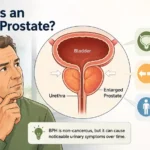
The prostate is small at birth. It grows slowly during puberty under the influence of testosterone. By age 20, it is about the size of a walnut. It stays that size for most of young adulthood. Around age 40, a second growth phase begins for many men. This is not cancer. It is called benign prostatic hyperplasia, or BPH.
BPH is extremely common. Research shows that about 50 percent of men in their 60s have some degree of BPH. By age 85, that number climbs to 90 percent. The prostate can grow from walnut-sized to the size of a lemon or even an orange. This growth is not cancerous, but it squeezes the urethra. That makes it harder to empty the bladder fully.
Current research suggests that BPH is driven by hormonal changes, not just aging. Levels of free testosterone drop while estrogen levels stay steady. This shift may trigger prostate cell growth. Inflammation also plays a role. Men with chronic low-grade inflammation in the prostate tend to have faster growth. This is an active area of research, and the picture is not fully clear yet.
What Are the Warning Signs of Prostate Problems?
The most common early sign of a prostate issue is a change in urination. Men notice they get up more often at night to pee. They feel a sudden urge to go that is hard to ignore. The stream becomes weaker. It may take effort to start peeing, and dribbling at the end is common. Some men feel like their bladder is not empty even right after they finish.
Pain is less common with BPH. If there is pain in the lower back, pelvic area, or during ejaculation, that points more toward prostatitis. Prostatitis is an inflammation or infection of the prostate. It can happen at any age, even in young men. Symptoms include fever, chills, and burning during urination. It is often treated with antibiotics if bacteria are present.
Prostate cancer often has no early symptoms at all. That is why screening matters. By the time symptoms like blood in the urine or bone pain appear, the cancer is usually advanced. The prostate-specific antigen (PSA) blood test is the most common screening tool. It is not perfect. High PSA can mean cancer, but it can also mean BPH or infection. Current guidelines recommend men discuss screening with their doctor starting at age 50, or earlier if they are Black or have a family history of prostate cancer.



Does Diet or Lifestyle Affect the Function of Prostate?
Some studies suggest diet plays a role in prostate health. The evidence is strongest for a few specific foods. Tomatoes contain lycopene, an antioxidant that may slow prostate cell growth. Cooked tomatoes, like those in tomato sauce, release more lycopene than raw ones. Cruciferous vegetables like broccoli and kale contain sulforaphane, which some research links to lower cancer risk. Fatty fish like salmon and mackerel provide omega-3s that may reduce inflammation.
On the flip side, high dairy intake has been linked to higher prostate cancer risk in some large studies. The connection is not fully understood. It may be related to calcium levels or hormones in milk. Red and processed meats are also associated with higher risk. The evidence here is moderate, not strong. No single food causes or prevents prostate problems. Diet is one factor among many.
Exercise matters more than most people think. Men who are physically active have lower rates of BPH and prostate cancer. The reason may be that exercise reduces inflammation and helps regulate hormones. Even moderate activity like brisk walking for 30 minutes a day shows benefit. Obesity, especially belly fat, is linked to more aggressive prostate cancer. Keeping a healthy weight is one of the most practical steps a man can take.
How Is the Function of Prostate Tested and Evaluated?
The most common test is the digital rectal exam, or DRE. The doctor inserts a gloved finger into the rectum to feel the prostate. They check for size, firmness, and any hard lumps. It is uncomfortable but quick. The DRE is not the most accurate test, but it gives immediate information. A normal-feeling prostate does not rule out cancer.
The PSA blood test measures a protein made by prostate cells. A higher level means more prostate activity, which can be due to cancer, BPH, or infection. There is no single cutoff for normal. Most labs use 4.0 ng/mL as the upper limit, but some men with lower levels have cancer and some with higher levels do not. This is why doctors use PSA trends over time rather than a single number.
For men with elevated PSA or an abnormal DRE, the next step is often a prostate biopsy. A needle takes small tissue samples from different parts of the gland. This is the only way to confirm cancer. As of 2026, newer tests like the 4Kscore test and the Prostate Health Index offer more specific information than PSA alone. They measure different forms of PSA and other markers to better predict risk. These are not yet standard for every man, but they are becoming more common.
What Treatments Are Available for Prostate Conditions?
Treatment depends entirely on the condition. For BPH, the first step is often lifestyle changes. Reducing caffeine and alcohol, especially in the evening, can help with nighttime urination. Double voiding — peeing, waiting a moment, then trying again — helps empty the bladder more completely.
Medications are the next step. Alpha blockers like tamsulosin relax the muscles around the prostate and bladder neck. They help urine flow better within days. 5-alpha reductase inhibitors like finasteride shrink the prostate itself. These take months to work and are better for larger prostates. Some men take both.
| Condition | Common First Treatment | How It Works |
|---|---|---|
| BPH (enlarged prostate) | Alpha blockers or 5-alpha reductase inhibitors | Relax muscles or shrink gland |
| Prostatitis (inflammation) | Antibiotics or anti-inflammatory drugs | Kill bacteria or reduce swelling |
| Prostate cancer (localized) | Active surveillance, surgery, or radiation | Monitor or remove/destroy cancer cells |
| Prostate cancer (advanced) | Hormone therapy | Lower testosterone to slow cancer growth |
For prostate cancer, treatment choices are complex. Many early-stage prostate cancers grow so slowly they never cause problems. Active surveillance means monitoring with regular PSAs and biopsies instead of treating immediately. This avoids side effects like incontinence and erectile dysfunction. For more aggressive cancers, surgery and radiation are the main options. Hormone therapy is used when cancer has spread beyond the prostate.
What Common Myths About the Prostate Should You Ignore?
One persistent myth is that frequent ejaculation causes prostate problems. The opposite may be true. Some studies suggest men who ejaculate more often — 21 or more times per month — have a slightly lower risk of prostate cancer. The reason is not clear. It may be that ejaculation flushes out carcinogens from the prostate ducts. This is not proven, but the idea that ejaculation is harmful has no evidence behind it.
Another myth is that prostate problems always lead to cancer. BPH is not cancer and does not turn into cancer. They can occur together, but one does not cause the other. Having BPH does increase your chance of being diagnosed with cancer, but only because you are seeing a urologist and getting tested more often. It is a detection bias, not a biological link.
A third myth is that supplements can cure prostate problems. Saw palmetto is widely promoted for BPH. Large, well-designed studies have found it does not work better than a placebo for improving urine flow or reducing symptoms. Zinc and selenium supplements are also popular, but high doses may actually increase prostate cancer risk in some studies. Do not take supplements for prostate health without talking to your doctor first.
Frequently Asked Questions About function of prostate
What is the main function of the prostate?
The prostate produces fluid that nourishes and protects sperm. It also helps push semen through the urethra during ejaculation.
Can a man live without a prostate?
Yes, a man can live without a prostate. However, he will no longer produce semen and may have issues with urine control.
What are the first signs of prostate problems?
The earliest signs are usually changes in urination, like getting up more at night, a weak stream, or feeling the bladder is not empty. Pain is less common with enlargement but can occur with infection.
Does an enlarged prostate always mean cancer?
No. An enlarged prostate is usually benign prostatic hyperplasia, which is not cancer. BPH does not turn into cancer, though both conditions can exist at the same time.
