

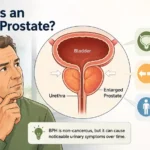
The prostate is a small walnut-sized gland located just below the bladder in men, sitting directly in front of the rectum. It wraps around the upper part of the urethra, the tube that carries urine and semen out of the body. This location is why prostate problems often affect urination and sexual function.
What Exactly Is the Prostate and Where Does It Sit in the Body?
The prostate is part of the male reproductive system. It sits in a spot that makes it both important and vulnerable. Picture it nestled in the pelvis, positioned between the bladder above and the pelvic floor muscles below. The rectum sits right behind it, which is why doctors can feel the prostate during a digital rectal exam.
The gland surrounds the first inch or so of the urethra as it exits the bladder. This positioning means that when the prostate enlarges, it can squeeze the urethra and make urination difficult. The seminal vesicles, which produce part of the fluid in semen, attach to the back and top of the prostate. Nerves that control erections run along both sides of the gland, which is why prostate surgery can sometimes affect sexual function.
In a typical adult, the prostate weighs about 20-30 grams and measures roughly 3-4 centimeters wide. It tends to grow larger with age, which is completely normal but can cause problems for some men.
Why Does the Prostate’s Location Matter for Your Health?
The prostate’s position explains why so many prostate conditions share similar symptoms. When the gland swells or grows, it presses on the urethra. This creates the classic symptoms of prostate trouble: weak urine stream, frequent urination, difficulty starting to urinate, and waking up multiple times at night to use the bathroom.
The proximity to the rectum makes diagnosis possible through physical examination. A doctor can press gently on the front wall of the rectum and feel the back surface of the prostate. They can detect hard nodules, unusual textures, or significant enlargement this way. This simple exam has been used for decades and remains part of standard prostate cancer screening.
The location also determines which treatments work for different conditions. Radiation therapy can target the prostate while trying to spare surrounding organs like the bladder and rectum. Surgeons must navigate around critical nerves and blood vessels when removing the gland. The position makes some procedures technically challenging but also allows for minimally invasive approaches through the urethra.
How Can You Find Your Own Prostate?
You cannot feel your prostate from the outside of your body. The only way to physically locate it is through the rectum, which is how medical exams work. The prostate sits about 2 inches inside the rectal wall on the front side, toward the belly.
Some men become aware of their prostate location when they develop symptoms. Pressure in the area between the scrotum and anus, called the perineum, can signal prostate inflammation. Pain or discomfort during bowel movements sometimes indicates prostate problems because of how close the two organs sit.
During ejaculation, you might sense activity in the area where the prostate sits, though what you feel is actually the muscle contractions that help expel semen. The prostate itself does not have many nerve endings that sense pain under normal circumstances.




What Organs Surround the Prostate?
Understanding what sits near the prostate helps explain both symptoms and treatment side effects. The bladder rests directly on top of the prostate. When the prostate grows, it can push up into the bladder or create a bump that protrudes into the bladder’s interior space. This explains why enlarged prostates often cause bladder problems.
The rectum lies immediately behind the prostate, separated by a thin layer of tissue called Denonvilliers’ fascia. Radiation treatment to the prostate can sometimes irritate the rectum, causing bowel urgency or discomfort. This proximity is also why prostate infections can occasionally cause pain with bowel movements.
Below the prostate sits the external urinary sphincter, a muscular valve that controls urine release. Above and behind are the seminal vesicles. On both sides run the neurovascular bundles, thin packages of nerves and blood vessels that control erections. Prostate cancer sometimes spreads first to nearby lymph nodes in the pelvis.
| Direction | Neighboring Structure | Clinical Significance |
|---|---|---|
| Above | Bladder | Prostate growth can obstruct urine flow from bladder |
| Behind | Rectum | Allows digital examination and biopsy access |
| Below | Urinary sphincter | Surgery here can affect continence |
| Both sides | Nerve bundles | Damage during treatment may cause erectile dysfunction |
Does the Prostate’s Position Change with Age or Health Conditions?
The prostate stays in the same anatomical location throughout life, but it changes size and sometimes shape. Most men experience benign prostatic hyperplasia as they age, which means the gland gradually enlarges. This growth typically starts in the transition zone, the part closest to the urethra, which is why it affects urination.
An enlarged prostate does not shift position, but it can extend upward into the bladder or press harder against the rectum. Some men develop a middle lobe that grows up into the bladder opening, creating a ball-valve effect that makes urination particularly difficult. Research shows that by age 60, more than half of men have some degree of prostate enlargement, and by 85, that figure reaches 90 percent.
Inflammation from prostatitis can cause the gland to swell temporarily. This makes it feel larger during examination but does not change its location. Prostate cancer usually starts in the peripheral zone, the outer back part of the gland, which is why tumors are often detected during rectal exams before they cause urinary symptoms.
What Symptoms Indicate a Problem with the Prostate’s Function?
Most prostate symptoms relate directly to the gland’s location around the urethra. The warning signs include:
- Difficulty starting urination or maintaining a steady stream
- Weak urine flow or a stream that stops and starts
- Feeling like the bladder does not empty completely
- Waking up multiple times at night to urinate
- Sudden strong urges to urinate that are hard to control
- Pain or burning during urination
- Blood in urine or semen
- Pain in the lower back, hips, or pelvis that does not go away
These symptoms are not specific to any one condition. Benign enlargement, infection, inflammation, and cancer can all cause similar problems. That is why doctors use additional tests beyond symptom assessment.
Some men with early prostate cancer have no symptoms at all. The disease can grow in the outer portions of the gland without pressing on the urethra until it becomes quite advanced. This is part of the reason screening tests like PSA exist, though their use remains debated.
How Do Doctors Examine the Prostate Given Its Location?
The digital rectal exam remains the most direct way to assess the prostate. The doctor inserts a gloved, lubricated finger into the rectum and presses gently on the front wall. They can feel the size, shape, and texture of the back surface of the gland. A healthy prostate feels firm but slightly spongy, similar to the pad of flesh at the base of your thumb.
Hard nodules, unusual firmness, or asymmetry can indicate cancer, though biopsy is needed to confirm. An enlarged but smooth gland typically suggests benign growth. A tender, swollen prostate often points to infection or inflammation.
Imaging provides more detailed information. Transrectal ultrasound uses a probe inserted into the rectum to create images of the prostate. This helps measure size accurately and guide biopsy needles to suspicious areas. MRI scans can detect tumors and show whether cancer has spread beyond the prostate capsule. CT scans help evaluate lymph nodes and bones if doctors suspect advanced disease.
Blood tests for PSA do not examine the prostate directly but measure a protein the gland produces. Levels rise with various prostate conditions, though elevated PSA does not always mean cancer. As of 2026, researchers continue working on more specific biomarkers that can distinguish aggressive cancers from slow-growing ones.
What Happens to Nearby Organs When the Prostate Is Treated?
Treatment side effects often involve structures near the prostate. Surgery to remove the gland requires cutting through surrounding tissue and separating the prostate from the bladder and urethra. Surgeons must reconnect these structures, and healing can temporarily affect urinary control. Most men regain continence, but it can take weeks to months.
The nerve bundles that control erections run right along the prostate. Nerve-sparing surgery attempts to preserve these, but it is not always possible depending on cancer location. Radiation therapy can also damage these nerves over time. Studies show that erectile function preservation depends heavily on age, baseline function, and treatment approach.
Radiation affects whatever tissue falls within the treatment field. The rectum sits so close that some irritation is common, causing urgency, cramping, or loose stools during treatment. These effects usually resolve, but a small percentage of men develop chronic issues. The bladder can also become irritated, leading to frequency and urgency that typically improves after treatment ends.
Treatments through the urethra, like transurethral resection for benign enlargement, work precisely because of the prostate’s location around this channel. Surgeons insert instruments through the penis and carve out overgrown tissue from the inside. This improves urine flow but can affect the structures that control ejaculation.
Frequently Asked Questions About Where the Prostate Is Located
Can you live without a prostate?
Yes, the prostate can be surgically removed without threatening life. Men who have their prostate removed can still urinate and often maintain sexual function, though they will not ejaculate fluid and cannot father children naturally.
Why is the prostate located where it is?
The prostate’s location around the urethra allows it to add fluid to semen during ejaculation. This positioning evolved to serve reproductive function, mixing prostatic fluid with sperm at the moment of ejaculation.
Does the prostate move when you sit or stand?
No, the prostate stays fixed in position by surrounding tissues and ligaments. Sitting can put pressure on the area, which is why men with prostatitis sometimes feel worse after prolonged sitting.
Can women have a prostate?
Women have structures called Skene’s glands that are sometimes referred to as the female prostate because they share developmental origins and produce similar fluids. These are much smaller and located near the urethra but serve different functions.
