
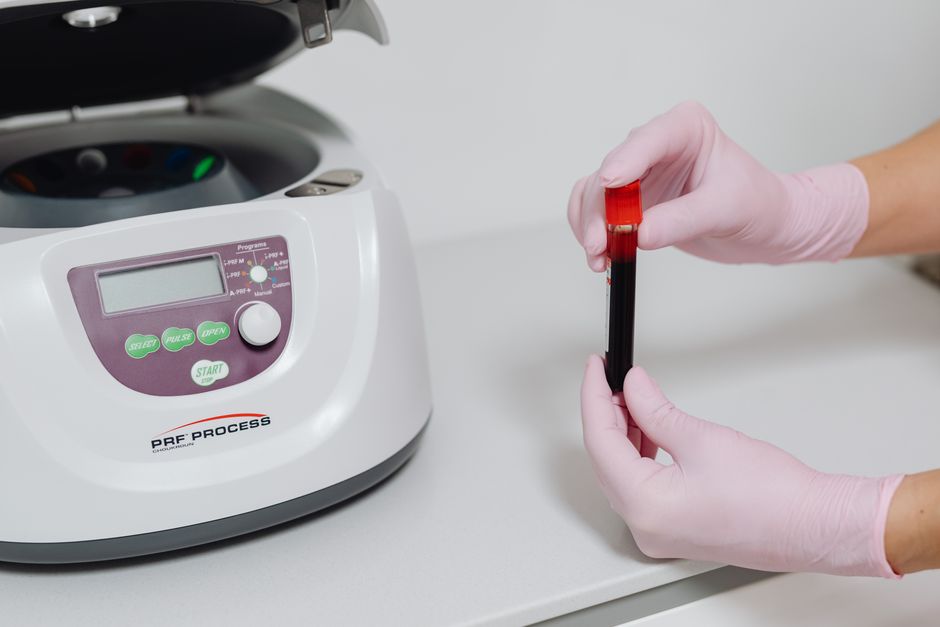
Platelet rich plasma, usually called PRP, is a sample of your own blood that has been spun in a centrifuge so it contains far more platelets than normal. Platelets are cell fragments that help blood clot, and they also release proteins called growth factors. The idea behind PRP injections is to deliver a concentrated dose of those platelets and growth factors into injured tissue, with the goal of speeding up healing. It is used most often for tendon, ligament, muscle, and joint problems, and in some cosmetic skin and hair treatments.
What Are Platelet Rich Plasma Injections?
A PRP injection is a treatment made from your own blood, prepared and injected back into you, usually in the same visit. A clinician draws a small tube of blood, spins it in a centrifuge to separate the components, and collects the layer that is richest in platelets. That concentrate is then injected into the target area.
The word “rich” is relative. Normal blood contains roughly 150,000 to 450,000 platelets per microliter. PRP is generally defined as having a platelet concentration above that of whole blood, and many preparations aim for several times the baseline. The exact concentration varies widely depending on how the blood is processed, which is one reason studies of PRP are hard to compare.
There is no single standard recipe. Different systems produce different platelet counts, different volumes, and different amounts of white blood cells. Some preparations include white cells and some do not. This lack of standardization is a major reason the research on PRP is uneven.
How Is Platelet Rich Plasma Prepared?
The process is straightforward and takes place in a clinic, not a lab. A small amount of blood — typically a few tablespoons — is drawn from a vein in your arm. That blood goes into a tube or device and is spun at high speed.
Spinning separates the blood by density. Red blood cells, which are heaviest, settle to the bottom. Platelets and white cells form a middle layer, and plasma, the liquid part, sits on top. The clinician collects the platelet-rich layer and injects it.
Preparation methods differ in important ways:
- Platelet concentration — how many times above baseline the platelets are concentrated.
- White blood cell content — some methods keep white cells in, others remove them.
- Activation — some clinicians add a substance to trigger the platelets to release growth factors before injecting; others let the body do this naturally.
- Volume — how much fluid is injected into the target area.
Because these variables are not standardized, two clinics offering “PRP” may be giving you meaningfully different products. If you are considering treatment, it is reasonable to ask what system is used and how the plasma is prepared.
What Is PRP Used For?
PRP is most commonly used for musculoskeletal problems. The best-studied areas include elbow tendinopathy (tennis elbow), knee osteoarthritis, and certain tendon injuries. It is also used for plantar fasciitis, rotator cuff problems, and ligament sprains.
Beyond muscles and joints, PRP has been explored for skin rejuvenation, hair loss, and wound healing. In cosmetic settings it is sometimes marketed as a “vampire facial” or similar name. The evidence for these uses varies widely, and marketing often runs ahead of the science.
One clarification worth making: PRP is not a stem cell treatment, even though it is sometimes marketed alongside stem cell language. PRP contains platelets and plasma from your own blood. It does not contain stem cells in any meaningful therapeutic quantity. Some clinics combine PRP with other procedures, but the two are not the same thing.




Does PRP Actually Work?
The evidence is mixed, and it depends heavily on what condition is being treated. For some uses there is reasonable supporting evidence; for others the data is thin or conflicting.
For tennis elbow and some other tendon problems, some studies suggest PRP may reduce pain and improve function compared with doing nothing or with certain other injections. But results across trials are inconsistent, and several well-designed studies have found little or no advantage over placebo injections. The evidence is genuinely mixed.
For knee osteoarthritis, some studies indicate PRP injections may improve pain and function in the short to medium term, sometimes compared with corticosteroid or hyaluronic acid injections. But trials vary in quality, preparation methods differ, and longer-term benefits are not well established. Some research suggests benefit; the picture is not settled.
For hair loss and skin rejuvenation, the evidence is weaker and more preliminary. Some small studies suggest possible benefit for certain types of hair loss, but larger, well-controlled trials are limited. No clinical evidence currently confirms that PRP reliably regrows hair or reverses skin aging.
For wound healing and many other applications, the evidence is limited or early-stage.
The honest summary: PRP is not a proven cure for anything, and it is not useless either. Its effects appear modest at best in the conditions studied, and the quality of evidence varies by condition. Anyone presenting PRP as a guaranteed fix is overstating what the research shows.
What Are the Risks and Side Effects?
Because PRP is made from your own blood, the risk of allergic reaction or rejection is very low. That is one of its main selling points compared with other injectable treatments. But “low risk” is not “no risk.”
Common side effects are usually mild and short-lived:
- Pain, swelling, or bruising at the injection site.
- Temporary increase in pain in the treated area, sometimes for a few days.
- Bleeding or bruising where the blood was drawn.
More serious risks are uncommon but possible. Any injection carries a small risk of infection. If the procedure is not done with proper sterile technique, that risk rises. There is also a risk of injury to nearby structures if the injection is placed incorrectly, which is why the skill and experience of the clinician matter.
People with certain blood or platelet disorders, active infection, or who are on blood-thinning medication should discuss risks with a clinician. PRP is generally not recommended during pregnancy or breastfeeding, and no clinical guidelines currently establish its safety for those groups.
How Does PRP Compare With Other Treatments?
PRP is often positioned as an alternative to corticosteroid injections or as a way to avoid surgery. The comparison is not straightforward.
Corticosteroid injections are well established for reducing inflammation and pain in many joint and tendon conditions, often providing fairly quick relief. Their downside is that relief may be temporary, and repeated steroid injections can have negative effects on tissue over time. PRP is sometimes proposed as a longer-lasting alternative, but the evidence that it outperforms steroids consistently is not strong.
Compared with surgery, PRP is far less invasive and requires little downtime. But for many conditions, surgery has more established evidence of benefit. PRP is not a substitute for surgery in cases where surgery is clearly indicated.
Compared with physical therapy, PRP is more invasive and more expensive, and physical therapy has solid evidence for many tendon and joint problems. Some clinicians use PRP alongside physical therapy rather than instead of it.
One practical point: PRP is often not covered by insurance and can be costly, since it is frequently considered experimental or elective for many uses. The cost varies widely by clinic and condition.
What Should You Expect During and After Treatment?
A PRP session usually takes under an hour, including the blood draw and preparation. The injection itself is quick. Some clinicians use ultrasound guidance to place the injection accurately, which is reasonable for deeper or harder-to-target areas.
Afterward, many people have soreness in the treated area for a few days. Some clinicians advise avoiding strenuous activity for a short period, though specific guidance varies and is not strongly standardized. Follow the instructions your clinician gives you.
Results, when they occur, are not immediate. Unlike steroid injections, which can ease pain within days, PRP is thought to work gradually as growth factors act on tissue. Some people report improvement over weeks to a few months. Not everyone responds, and some people notice no difference.
Multiple sessions are often recommended, but there is no single agreed-upon protocol for how many injections or how far apart they should be spaced. This is another area where practice varies and evidence is limited.
Frequently Asked Questions
Is PRP injection painful?
Most people describe the injection as uncomfortable rather than severely painful, and the treated area may be sore for a few days afterward. The blood draw feels like a standard blood test.
How long does it take for PRP to work?
PRP is thought to act gradually, and some people notice improvement over several weeks to a few months. Not everyone responds, and there is no reliable timeline that applies to everyone.
Is PRP covered by insurance?
PRP is often not covered by insurance and is frequently treated as elective or experimental for many uses. Coverage varies, so check with your insurer and the clinic before treatment.
Is PRP the same as stem cell therapy?
No. PRP is made from platelets and plasma in your own blood and does not contain stem cells in any meaningful therapeutic amount. Marketing sometimes blurs the two, but they are different treatments.
