
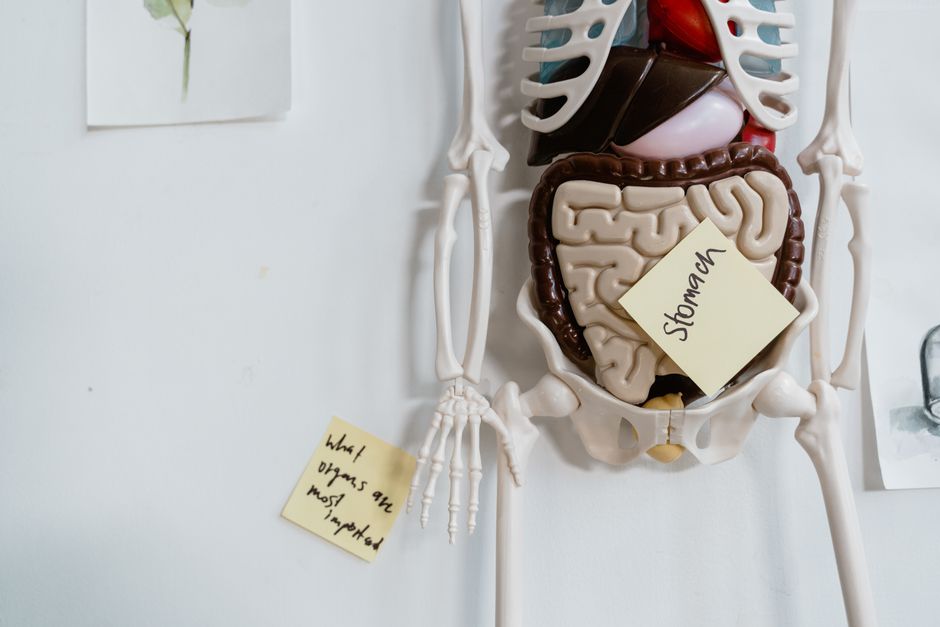
The digestive system is often described as a long tube, but that tube cannot do its job alone. It relies on several supporting organs that are not part of the tube itself. These are the accessory organs in the digestive system: the salivary glands, liver, gallbladder, and pancreas. They produce or store the enzymes, bile, and other chemicals that break down food into nutrients your body can use. Without these organs, digestion would essentially stop at the mouth.
What Are the Accessory Organs in the Digestive System?
The accessory organs are distinct from the primary digestive tract. The primary tract includes the mouth, esophagus, stomach, small intestine, and large intestine. Food physically passes through those structures. The accessory organs sit outside this tract, but they connect to it through small ducts or tubes.
There are four main accessory organs:
- Salivary glands — produce saliva that starts breaking down carbohydrates in the mouth.
- Liver — produces bile, which helps digest fats, and processes nearly everything you absorb.
- Gallbladder — stores and concentrates bile until it is needed.
- Pancreas — produces digestive enzymes and bicarbonate to neutralize stomach acid.
Each organ has a specific role. They do not digest food directly by touching it. Instead, they secrete substances through ducts that empty into the small intestine or mouth. This is why they are called accessory — they assist the main digestive tract rather than being part of the passage itself.
What Does the Liver Do in Digestion?
The liver is the largest internal organ in the body and performs hundreds of tasks. In digestion, its primary role is producing bile. Bile is a yellow-green fluid made of water, bile salts, cholesterol, and bilirubin. It is essential for breaking down and absorbing dietary fats.
Bile does not contain enzymes. It works more like a detergent. Bile salts break large fat globules into smaller droplets, a process called emulsification. This increases the surface area of the fat so that lipase, the fat-digesting enzyme from the pancreas, can work on it effectively.
The liver also processes nutrients after they are absorbed. Blood from the intestines travels directly to the liver through the portal vein. The liver filters toxins, stores vitamins and iron, and converts glucose into glycogen for storage. It is the body’s main chemical processing plant. If the liver fails, digestion and metabolism both collapse.
Bile production is continuous. The liver makes about 500 to 700 milliliters of bile each day. But it does not release it all directly into the intestine. Instead, bile flows into the gallbladder, where it is concentrated and stored until a meal triggers its release.
How Does the Gallbladder Support Digestion?
The gallbladder is a small, pear-shaped sac tucked beneath the liver. It stores bile and concentrates it by removing water. This makes the bile up to ten times stronger, which allows the body to store a large digestive capacity in a small space.
When you eat, especially a meal containing fat, the gallbladder contracts. It squeezes stored bile through the common bile duct into the small intestine. The timing is precise — bile arrives just as partially digested food enters the duodenum, the first section of the small intestine.
Some people have their gallbladder removed due to gallstones or inflammation. This is one of the most common surgeries in the United States. After removal, the liver still produces bile, but it drips continuously into the intestine rather than being released in concentrated bursts. Most people can digest food normally after surgery, though some experience difficulty with very fatty meals. The body adapts over time, and most people have no long-term dietary restrictions.




What Role Does the Pancreas Play?
The pancreas is a long, flat gland located behind the stomach. It has two major jobs: producing hormones and producing digestive enzymes. The hormones, including insulin and glucagon, regulate blood sugar. The digestive enzymes are released into the small intestine through the pancreatic duct.
The pancreas produces several key enzymes:
- Amylase — breaks down carbohydrates into simple sugars.
- Lipase — breaks down fats into fatty acids and glycerol.
- Proteases — break down proteins into amino acids.
These enzymes are released in an inactive form. They only become active once they reach the small intestine. This is a critical safety mechanism. If the enzymes activated inside the pancreas, they would digest the organ itself. That is exactly what happens in acute pancreatitis, a painful and potentially dangerous condition.
The pancreas also secretes bicarbonate. This neutralizes the acidic chyme that enters the small intestine from the stomach. The small intestine needs a slightly alkaline environment for its enzymes to work. Without pancreatic bicarbonate, the intestinal lining would be damaged by stomach acid, and digestion would slow dramatically.
Why Are the Salivary Glands Considered Accessory Organs?
Salivary glands are the first accessory organs to act on food. You have three pairs of major salivary glands: the parotid, submandibular, and sublingual. Hundreds of tiny minor glands also line the mouth and throat.
Saliva serves several functions. It moistens food so it can be chewed and swallowed easily. It contains amylase, which begins breaking down starches into maltose. It also contains mucus, which lubricates the food bolus as it travels down the esophagus. Saliva even contains lysozyme, an enzyme with antibacterial properties that helps protect the mouth and teeth.
Salivary amylase continues working in the stomach for a short time. Stomach acid eventually inactivates it, but the initial breakdown of carbohydrates begins in the mouth. Chewing food thoroughly and mixing it with saliva is the first step in digestion, and it matters more than most people realize.
Digestion of carbohydrates starts in the mouth. Digestion of proteins and fats does not begin until food reaches the stomach and small intestine. This is why the salivary glands are considered accessory organs — they start a process that other organs continue.
How Do the Accessory Organs Work Together?
The accessory organs do not work in isolation. They coordinate their actions through hormones and nerve signals triggered by eating.
When you see, smell, or chew food, the brain sends signals that stimulate saliva production and prepare the stomach. When food enters the stomach, the stomach lining releases the hormone gastrin. Gastrin signals the stomach to produce acid and also stimulates the pancreas to prepare enzymes.
When fatty food enters the small intestine, the intestinal lining releases cholecystokinin, or CCK. CCK tells the gallbladder to contract and release bile. It also tells the pancreas to release digestive enzymes. Another hormone, secretin, is released when acidic chyme enters the intestine. Secretin triggers the pancreas to release bicarbonate and signals the liver to increase bile production.
This system is tightly regulated. Each hormone triggers a specific response, and the organs respond within minutes. If any part of this signaling fails, digestion becomes incomplete. Food may pass through the system without being fully broken down, leading to nutrient malabsorption, bloating, and fatty stools.
What Happens When an Accessory Organ Fails?
Each accessory organ can fail in different ways, and the consequences vary.
Gallbladder disease is the most common. Gallstones can block the bile duct, causing severe pain, nausea, and jaundice. If bile cannot reach the intestine, fats are not digested properly. Stools may become pale, greasy, and foul-smelling because undigested fat is passed through.
Pancreatic insufficiency occurs when the pancreas cannot produce enough enzymes. This happens in conditions like chronic pancreatitis and cystic fibrosis. Without sufficient lipase, fat digestion fails. This leads to weight loss, vitamin deficiencies, and steatorrhea — the medical term for fatty stools. Pancreatic enzyme replacement therapy is the standard treatment, and it is highly effective when taken with meals.
Liver failure is the most serious. The liver performs so many functions that its failure affects nearly every system in the body. In digestion, the loss of bile production severely impairs fat absorption. Fat-soluble vitamins — A, D, E, and K — cannot be absorbed without bile. This can lead to deficiencies that affect vision, bone health, blood clotting, and nerve function.
Salivary gland dysfunction is less dangerous but still disruptive. Dry mouth, or xerostomia, makes chewing and swallowing difficult. It also increases the risk of tooth decay, since saliva normally protects teeth from acids. Dry mouth can be caused by medications, autoimmune conditions, or radiation therapy to the head and neck.
Frequently Asked Questions
Are the teeth and tongue accessory organs?
Yes, the teeth and tongue are also classified as accessory digestive organs. They mechanically break down food into smaller pieces, which increases the surface area for enzymes to work on.
Can you live without your gallbladder?
Yes, you can live a normal life without a gallbladder. The liver continues to produce bile, but it flows directly into the intestine instead of being stored, and most people adapt without major dietary changes.
Which organ produces the most digestive enzymes?
The pancreas produces the most digestive enzymes. It releases amylase for carbohydrates, lipase for fats, and proteases for proteins into the small intestine.
What is the difference between primary and accessory digestive organs?
Primary digestive organs form the continuous tube that food passes through, from mouth to anus. Accessory organs sit outside this tube and release secretions into it through ducts.
