
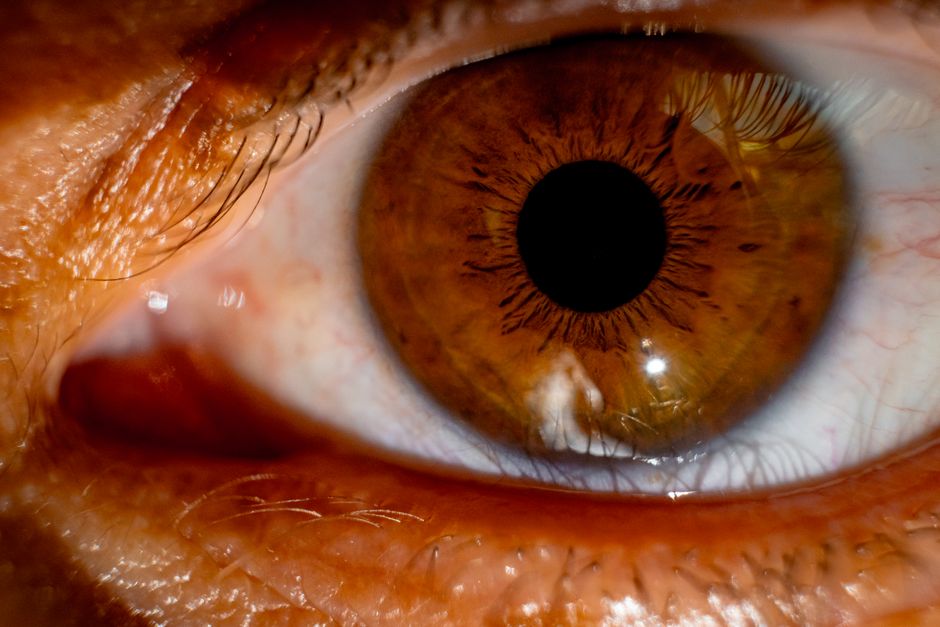
Color blindness is overwhelmingly genetic. It is caused by a gene mutation on the X chromosome, which is why it affects about 1 in 12 men but only about 1 in 200 women. This inherited condition makes it difficult to tell certain colors apart, most commonly red and green. While there are other causes, like eye disease or injury, the vast majority of cases are passed down through family DNA.
What Causes Color Blindness at the Genetic Level?
Your ability to see color depends on cone cells in your retina. These cells contain photopigments that react to different wavelengths of light. Most people have three types of cones — sensitive to red, green, or blue light. Each type is coded by a specific gene.
The genes for red and green photopigments sit right next to each other on the X chromosome. This close arrangement makes them prone to errors during cell division. If the gene sequence gets rearranged or deleted, the cone cells may produce the wrong photopigment or none at all. The result is that the brain receives incomplete color information.
Blue color blindness is rarer and follows a different pattern. The gene for blue photopigment is on chromosome 7, not the X chromosome. This means blue-yellow color blindness affects men and women equally. It is also much less common, occurring in about 1 in 10,000 people.
Why Is Color Blindness More Common in Men?
This comes down to basic genetics. Women have two X chromosomes. Men have one X and one Y. If a woman inherits a faulty color vision gene on one X chromosome, her second X chromosome often carries a working copy that compensates. She becomes a carrier without symptoms.
Men have no backup X chromosome. If the X they inherit from their mother carries the mutation, they will have color blindness. There is no second copy to compensate. This is why the condition follows what geneticists call an X-linked recessive inheritance pattern.
Research published in the journal Nature Genetics has mapped the specific gene rearrangements responsible. The most common form, deuteranopia (green blindness), results from a missing or altered OPN1MW gene. Protanopia (red blindness) involves the OPN1LW gene. These are not diseases — they are genetic variations that affect how the brain interprets color signals.
Is Color Blindness Genetic in All Cases?
No. While the genetic form is by far the most common, color vision deficiency can also be acquired later in life. This is important to understand because the causes and treatments differ completely.
| Cause | Inherited? | Common Trigger |
|---|---|---|
| Genetic (congenital) | Yes | X-linked gene mutation |
| Acquired | No | Eye disease, injury, medication |
| Age-related | No | Cataracts, macular degeneration |
| Chemical exposure | No | Toxic chemicals, solvents |
Acquired color blindness can affect one eye only, while genetic color blindness always affects both eyes equally. If you suddenly notice color changes in one eye, that is not genetic. That requires an eye exam immediately.
Some medications can also cause color vision changes. The drug hydroxychloroquine, used for autoimmune conditions, is known to affect color perception with long-term use. This is not genetic and may be reversible if caught early.





Can You Inherit Color Blindness from One Parent?
Yes, but the pattern matters. A color blind father cannot pass the condition to his sons because he gives them a Y chromosome, not an X. He will pass the gene to all of his daughters, who become carriers. Those daughters will typically have normal vision unless the father is color blind and the mother is also a carrier.
For a daughter to be color blind, she must inherit a faulty X from both parents. This is why the condition is so much rarer in women. The odds of a color blind father and a carrier mother having a color blind daughter are 50% for each daughter. For a son, the odds are 50% if the mother is a carrier, regardless of the father’s vision status.
Some people report having color blind parents but normal vision themselves. This is possible. A woman with one faulty X and one normal X will have normal color vision. She may never know she is a carrier until she has a color blind son.
How Is Genetic Color Blindness Diagnosed?
The standard test is the Ishihara color plates. These are circles filled with colored dots that form numbers or shapes. People with normal color vision see one number. People with red-green color blindness see a different number or no number at all.
More advanced testing uses the Farnsworth-Munsell 100 Hue Test. This requires arranging colored caps in order of hue. It measures the severity and specific type of color deficiency. The test takes about 15 minutes and provides a detailed score.
Genetic testing is also available but rarely necessary for diagnosis. A blood test or cheek swab can identify the specific gene mutation. This is most useful for family planning or research purposes. The CDC notes that about 8% of men of Northern European descent have some form of color blindness, making it one of the most common genetic conditions in humans.
Children are often first identified during routine vision screenings at school. If your child consistently struggles with color-based worksheets or seems frustrated identifying colors, a formal eye exam is the right next step.
Can Genetic Color Blindness Be Treated or Cured?
As of 2026, there is no cure for genetic color blindness. It is a permanent condition caused by the way your retina is built. No medication, surgery, or supplement can give you new photopigment genes. Be very skeptical of any product that claims otherwise.
Color correcting glasses like EnChroma are widely discussed. They work by filtering specific wavelengths of light to enhance contrast between colors. Some people report meaningful improvement in distinguishing reds and greens while wearing them. However, they do not give you normal color vision. They do not work for everyone. Research published in Optometry and Vision Science found that results vary significantly between individuals and depend on the specific type of color blindness.
There are also smartphone apps that identify colors using the phone’s camera. These are practical tools that help with daily tasks like matching clothes or reading traffic lights. They do not change your vision but they do change what you can do.
Gene therapy is being studied in animal models and early human trials. The approach involves delivering a working copy of the missing gene directly to the cone cells. Results in monkeys have been promising, but this is not available for humans outside of research settings. Do not expect a gene therapy cure in the near future.
What Are Common Misconceptions About Color Blindness?
Many people think color blind people see only in black and white. This is false. Complete color blindness, called achromatopsia, is extremely rare and affects about 1 in 30,000 people. The vast majority have difficulty distinguishing between specific colors, most commonly red and green.
Another myth is that color blindness means you cannot see any red or green at all. In reality, most people with red-green color blindness see these colors as muted or shifted. They may confuse dark red with brown or struggle to see red on a green background. They do not see gray where others see red.
Some people believe color blindness can be improved with eye exercises or special diets. There is no clinical evidence for this. The retinal cones are physically structured differently. No amount of training changes that structure. If a program claims to “train your brain” to see new colors, it is overstating what is possible.
There is also a belief that color blind people cannot drive. This is not true in most places. Traffic light position — red on top, green on bottom — helps color blind drivers identify the signal. Many learn to distinguish the brightness difference between red and green lights. Some countries have restrictions for certain professions like pilots or electricians, but everyday driving is rarely affected.
Frequently Asked Questions
Can color blindness skip a generation?
Yes. A carrier mother with normal vision can pass the gene to her son, who will be color blind. The condition can appear in grandchildren even if the parents have normal vision.
Is color blindness more common in certain ethnic groups?
Yes. The highest rates are found in Caucasian men of Northern European descent, where about 8% are affected. Rates are lower in African, Asian, and Indigenous populations.
Can a girl be color blind if her father is not?
Yes, if her mother is a carrier and her father has normal vision. The father must carry the gene on his only X chromosome, but he does not have to be color blind himself to pass it to a daughter.
Does color blindness worsen with age?
Genetic color blindness does not get worse over time. It stays the same from birth. If your color vision changes as you age, it is likely caused by cataracts, macular degeneration, or another eye condition.
