
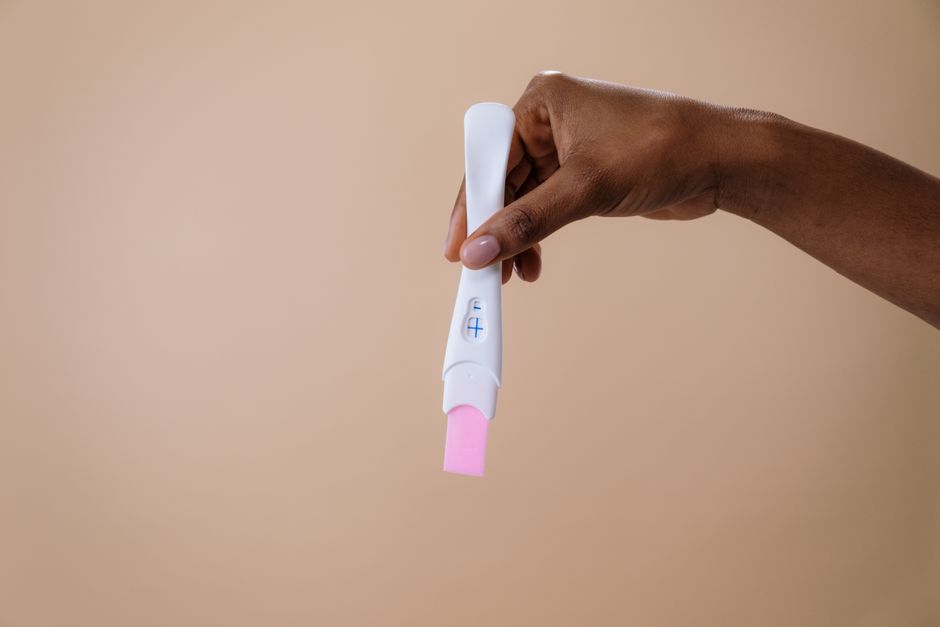
A positive pregnancy test is one of the most emotionally loaded results a person can see. It is also a chemical test, and chemical tests can be wrong. False positives are real, but they are far less common than most people assume. The test is designed to detect a hormone, not to confirm a pregnancy, and those two things are not the same.
Yes, a false positive pregnancy test is possible. It happens when the test detects human chorionic gonadotropin (hCG) for a reason other than a normal, ongoing pregnancy. The reasons range from reading the test too late to certain medical conditions and medications. Understanding how these tests actually work is the fastest way to understand when a positive result might not mean what it appears to mean.
How Do Pregnancy Tests Actually Detect hCG?
Home pregnancy tests use antibodies that bind to human chorionic gonadotropin, a hormone the placenta produces after a fertilized egg implants in the uterine lining. The test strip contains a region coated with these antibodies. When urine flows across it, any hCG in the sample attaches to the antibodies. A second set of antibodies carrying a colored particle then binds to the captured hCG, creating the visible line or plus sign.
This is called a sandwich immunoassay. The design matters because it explains both the test’s strengths and its failure modes. The antibodies are specific to hCG, so the test is not simply reacting to “a hormone” in a general sense. But specificity is not absolute. Other molecules that resemble hCG closely enough can occasionally bind to the same antibodies.
Most home tests can detect hCG at concentrations around 20 to 25 milli-international units per milliliter (mIU/mL) in urine. Some tests claim sensitivity as low as 10 mIU/mL. These are manufacturer-stated thresholds, and real-world sensitivity can vary based on when you test, how diluted your urine is, and how the test is stored.
After implantation, hCG levels roughly double every 48 to 72 hours in early pregnancy. This is why testing too early often produces a false negative rather than a false positive. The hormone simply is not there yet in detectable amounts.
What Causes a False Positive Pregnancy Test?
The most common cause is misreading the result window. Every test comes with a specific timeframe for reading the result, usually within 3 to 5 minutes depending on the brand. If you look at the test hours later, an evaporation line can appear. This is a faint, colorless or grayish line that forms as the urine dries. It is not a positive result, but it is frequently mistaken for one.
Beyond reading errors, several genuine biological and medical causes exist:
- Recent pregnancy loss. After a miscarriage or termination, hCG does not disappear immediately. It declines gradually, and a test can remain positive for days to several weeks depending on how far along the pregnancy was. Some clinicians track hCG to zero before considering the loss complete.
- Ectopic pregnancy. An embryo implanted outside the uterus still produces hCG. A test will be positive, but the pregnancy is not viable and can be life-threatening if untreated. This is not a false positive in the chemical sense, but it is a positive test that does not indicate a normal pregnancy.
- Molar pregnancy. This is an abnormal growth of placental tissue that produces hCG, sometimes at very high levels. It is a rare condition that requires medical management.
- Certain medications. Injectable fertility drugs that contain hCG, such as those used for ovulation induction, can cause a positive test for up to about 10 days after the injection. This is a well-documented effect. Other medications generally do not contain hCG.
- Medical conditions unrelated to pregnancy. Some tumors, including certain cancers, can produce hCG. This is uncommon but documented. Conditions like pituitary disorders have also been associated with low-level hCG production in rare cases.
- Contaminated or expired tests. Using a test past its expiration date or exposing it to moisture can affect results. This is less common than reading errors but possible.
One point that is often misunderstood: a false positive is not the same as a “chemical pregnancy.” A chemical pregnancy is a very early miscarriage that occurs shortly after implantation. The test was correctly positive. The pregnancy simply did not continue. The test did its job.
Can Medications or Medical Conditions Cause a False Positive?
Yes, but the list is shorter than many people fear. The clearest and most well-established cause is injectable hCG, often sold under brand names used in fertility treatment. If you received an hCG trigger shot to induce ovulation, a pregnancy test can read positive for roughly 7 to 14 days afterward, depending on the dose and your metabolism. Your fertility clinic typically provides specific guidance on when to test.
Other medications, including most antibiotics, pain relievers, and hormonal contraceptives, do not contain hCG and are not known to cause false positives on standard home tests. Older tests sometimes cross-reacted with certain drugs, but modern antibody-based tests are more specific.
Medical conditions that can produce hCG outside of pregnancy include:
- Certain germ cell tumors and some other cancers
- Pituitary gland abnormalities in rare cases
- Kidney disease, which can affect how hCG is cleared from the body
These are uncommon. If a positive test is unexplained and repeat testing or ultrasound does not show a pregnancy, a doctor may order a quantitative blood test to measure the exact hCG level and investigate further.


How Common Are False Positive Pregnancy Tests Really?
True false positives from the test itself, meaning the test detected something that was not hCG at all, are rare. The more common scenario is a positive test that reflects a real but non-viable pregnancy, or a test that was misread.
Research on home pregnancy tests has generally found high specificity, meaning they rarely produce a positive result when hCG is truly absent. Most reported “false positives” in real life trace back to user error, evaporation lines, or early pregnancy loss that was not recognized as such.
This distinction matters. If you get a positive result, the odds strongly favor that hCG is present. The question is why it is present and whether the pregnancy will continue. That is a different question than whether the test was accurate.
What Should You Do If You Get a Positive Test and Doubt It?
Wait 48 to 72 hours and test again with a fresh test, ideally first thing in the morning when urine is most concentrated. If hCG is rising normally in early pregnancy, the line should get darker or the result should remain clearly positive. If it fades or disappears, that can indicate a very early loss or that the first result was not a true positive.
Do not rely on line darkness alone to judge hCG levels. Home test lines are qualitative, not quantitative. They are not designed to measure how much hCG is present, only whether it crosses the detection threshold. Two tests from different brands can look different even with the same urine sample.
If you have any of the following, contact a healthcare provider promptly:
- Pelvic pain, especially sharp or one-sided pain
- Shoulder pain, which can indicate internal bleeding
- Heavy vaginal bleeding
- Dizziness or fainting
These symptoms alongside a positive test can suggest an ectopic pregnancy, which is a medical emergency. Ectopic pregnancy cannot be ruled out by a home test alone, and it is not something to wait on.
A quantitative blood test, which measures the exact amount of hCG, gives far more information than a urine test. A healthcare provider can also use ultrasound to look for a gestational sac. These are the tools that distinguish a normal early pregnancy from other possibilities.
How Reliable Are Home Pregnancy Tests Compared to Blood Tests?
Home urine tests are reliable when used correctly and at the right time. Blood tests are more sensitive and can detect hCG earlier, sometimes within 6 to 8 days after ovulation, compared to roughly 12 to 14 days for most urine tests. Blood tests also provide an exact number rather than a yes-or-no result.
That said, a correctly used home test taken after a missed period is generally considered highly accurate. The main limitations are timing and interpretation, not the underlying chemistry. If you test too early, you may get a false negative. If you read the test too late, you may see an evaporation line and mistake it for a positive.
No home test can tell you whether a pregnancy is viable, whether it is ectopic, or how far along you are. Those questions require clinical evaluation.
Frequently Asked Questions
Can a false positive pregnancy test happen without being pregnant?
Yes, but it is uncommon. The most likely explanations are reading the test after the result window, recent pregnancy loss, or an hCG-containing fertility medication.
How long after a miscarriage can a pregnancy test stay positive?
It varies widely depending on how far along the pregnancy was. hCG can remain detectable for days to several weeks, and some clinicians track levels to zero before confirming the loss is complete.
Do antibiotics or birth control pills cause false positive pregnancy tests?
No. Standard antibiotics and hormonal contraceptives do not contain hCG and are not established causes of false positive home pregnancy tests.
What does an evaporation line look like on a pregnancy test?
An evaporation line is usually faint, colorless, or gray, and appears after the test’s reading window has passed. A true positive line typically has color and appears within the recommended timeframe.
