
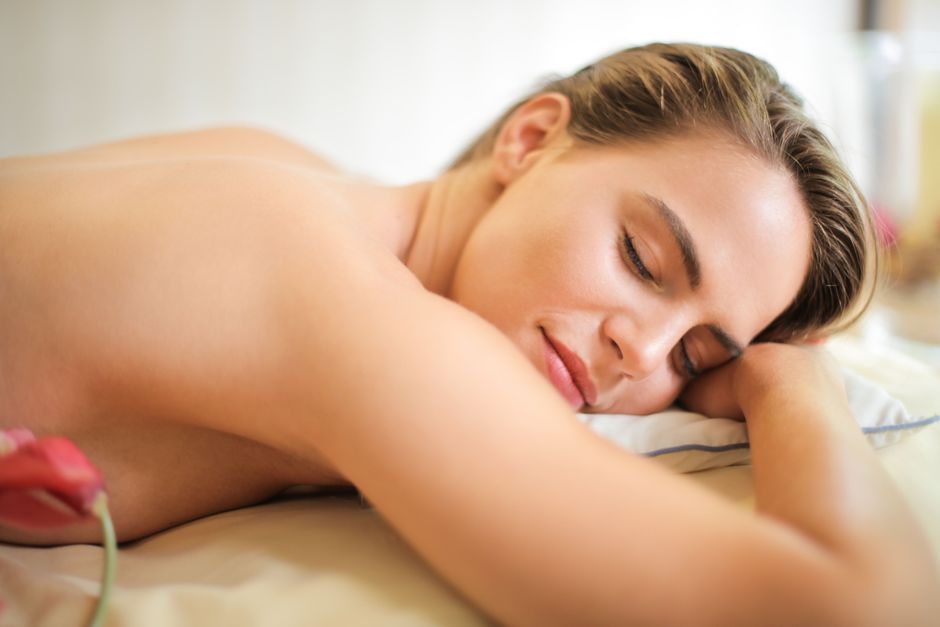
You cannot fall asleep because your brain is doing exactly what it evolved to do: stay alert to threat. At bedtime there is no lion, no deadline, no email. So your mind scans for problems instead. That is why the harder you try to sleep, the more awake you feel. The way out is not force. It is giving your nervous system the signals it uses to power down: slow breathing, muscle relaxation, a cooler body, and a mind that has somewhere to put its unfinished business.
Why Can’t I Fall Asleep When My Mind Won’t Stop Racing?
Racing thoughts at night are not a character flaw. They are physiology.
Your body runs two branches of the autonomic nervous system. The sympathetic branch handles arousal and threat response. The parasympathetic branch handles rest, digestion, and sleep. These two do not run at the same time. When one is active, the other is suppressed. Racing thoughts are a sign the sympathetic branch is still running the show.
There is a second problem layered on top. Sleep onset depends on a drop in core body temperature. Your body dumps heat through your hands and feet to cool its core by roughly 1°F as you drift off. If you are tense, stressed, or mentally activated, that cooling process gets delayed.
The third piece is cognitive. Unfinished tasks and unresolved worries stay in a kind of mental queue. When external stimulation drops away at night, there is nothing left to drown out that queue. Your brain starts working through it. Some researchers describe this as the brain’s default mode network becoming more active when you are idle and unoccupied.
None of this means something is wrong with you. It means your system is behaving normally under conditions that do not support sleep.
How To Relax To Sleep Quiet Your Body And Racing Thoughts
You cannot command your nervous system to calm down. You can give it inputs that reliably shift it toward parasympathetic activity. Slow breathing is one of the most direct.
Breathing at roughly six breaths per minute — slower than typical resting rate — increases what is called heart rate variability, a marker of parasympathetic activity. This is well documented in physiology research. The mechanism is straightforward: slow exhalation stimulates the vagus nerve, which is the main pathway of the parasympathetic branch.
A simple approach:
- Breathe in through your nose for a count of four
- Breathe out slowly for a count of six to eight
- Keep the exhale longer than the inhale
- Continue for five to ten minutes
The longer exhale is the active ingredient. Many people focus on the inhale. The exhale is where the calming signal lives.
Progressive muscle relaxation is another method with real evidence behind it. You tense a muscle group for about five seconds, then release it for fifteen to twenty seconds, moving through your body from feet to face. The release phase is where the relaxation response occurs. This technique has been studied for decades and is used in clinical settings for insomnia and anxiety.
Neither of these is a cure. They are tools that work for many people and do not work for everyone. If you have tried both consistently and sleep has not improved, that is information, not failure.
What Actually Happens In Your Body When You Relax?
Relaxation is not a vague feeling. It is a measurable physiological state.
When the parasympathetic branch takes over, several things happen at once. Heart rate drops. Blood pressure falls slightly. Breathing slows and becomes more regular. Muscle tension decreases. Digestion resumes. Core body temperature begins its nocturnal decline.
This is sometimes called the relaxation response, a term coined by researcher Herbert Benson at Harvard in the 1970s. His work showed that meditation, breathing practices, and repetitive prayer all produced similar physiological changes regardless of the specific technique. The common factor was not belief or intention. It was the physical act of slowing down.
The important point: you do not need to feel calm to trigger this state. You need to do the things that produce it. Feeling follows physiology more often than the other way around.




Does A Cool Body Temperature Help You Sleep?
Yes. Core body temperature and sleep are tightly linked.
Your body follows a daily temperature rhythm. Core temperature peaks in the late afternoon and drops through the evening, reaching its lowest point in the early morning hours. Sleep onset typically happens as temperature is falling. This is not coincidence. The cooling is part of the signal that triggers sleep.
Practical steps that support this:
- Keep your bedroom cool — most sleep guidance points to a range around 60 to 67°F for adults
- Take a warm shower or bath one to two hours before bed — the subsequent cooling as your body releases heat helps lower core temperature
- Avoid heavy exercise within two hours of bedtime
- Avoid alcohol — it initially causes drowsiness but disrupts the temperature drop and fragments sleep later in the night
That warm bath detail surprises people. It seems backwards. The bath raises skin temperature, which increases heat loss from your body, which lowers core temperature. The net effect supports sleep onset.
What Should I Do With Racing Thoughts At Bedtime?
The worst thing you can do with racing thoughts is try to suppress them. Thought suppression reliably backfires. The more you try not to think about something, the more it returns.
A more effective approach is to give the thoughts a destination before bed. This is sometimes called a worry journal or constructive worry exercise. You set aside ten to fifteen minutes earlier in the evening — not in bed — and write down what is on your mind and what you plan to do about it. The idea is to close the loop on unfinished mental tasks so they do not resurface at 2 a.m.
Some studies support this approach for people with sleep-onset difficulties related to worry. The evidence is not overwhelming. It is a reasonable strategy with low risk.
If a thought arrives while you are in bed, the standard advice from behavioral sleep medicine is this: do not engage with it. Do not try to solve it. Do not try to push it away. Note it and return your attention to your breathing or to a neutral mental image. This is essentially mindfulness, and it has moderate evidence for improving sleep quality in adults with insomnia symptoms.
If you are still awake after roughly twenty minutes, get out of bed. Do something quiet and boring in dim light. Return when you feel sleepy. This is a core component of cognitive behavioral therapy for insomnia, or CBT-I, which is considered the first-line treatment for chronic insomnia in clinical guidelines.
When Racing Thoughts At Night Are A Sign Of Something More
Occasional difficulty falling asleep is normal. Chronic insomnia is different.
Insomnia disorder is generally diagnosed when sleep difficulty occurs at least three nights per week for at least three months and causes distress or problems during the day. If that describes your situation, the evidence strongly supports CBT-I over sleep medication as a first approach. CBT-I has been shown in multiple trials to be effective and to produce lasting improvement. Medication can help short-term but does not address the underlying patterns.
Racing thoughts at night can also be a symptom of an anxiety disorder, depression, or post-traumatic stress disorder. If worry is not limited to bedtime — if it runs through your day, interferes with work or relationships, or comes with physical symptoms like a racing heart or tight chest — that is worth discussing with a clinician. Treating the underlying condition often improves sleep more than any sleep-specific technique.
Certain medical conditions can also disrupt sleep and should be ruled out: sleep apnea, thyroid disorders, chronic pain, and restless legs syndrome are common examples. If you snore heavily, wake gasping, or feel exhausted despite adequate time in bed, mention it to a doctor.
What Makes Racing Thoughts Worse At Night?
Several common habits make the problem harder to solve.
Caffeine has a half-life of about five to six hours in most adults. That means half the caffeine from a 3 p.m. coffee is still in your system at 9 p.m. Individual variation is large. Some people clear it much more slowly.
Alcohol is widely used as a sleep aid and reliably makes sleep worse. It reduces sleep latency — the time it takes to fall asleep — but increases awakenings in the second half of the night and suppresses REM sleep.
Screens affect sleep through at least two routes. Light exposure delays melatonin release. And content — news, social media, work email — activates the same mental queue that keeps you awake. The content matters more than the light for most people.
Clock-watching is a specific trap. Checking the time repeatedly increases arousal and makes sleep less likely. Turn the clock away from the bed.
Lying in bed awake teaches your brain that bed is a place for frustration and alertness. This is called conditioned arousal, and it is one of the main targets of CBT-I.
None of these are moral failures. They are common patterns with clear physiological explanations.
Frequently Asked Questions
How long does it take to fall asleep when relaxed?
For most healthy adults, falling asleep takes about ten to twenty minutes. Consistently taking longer than thirty minutes may suggest a sleep-onset problem worth discussing with a clinician.
Does breathing 4-7-8 really work for sleep?
Slow breathing with a longer exhale does increase parasympathetic activity, which supports relaxation. The specific 4-7-8 pattern is one version of this, and the evidence supports slow breathing generally rather than that exact count.
Why do my thoughts get worse when I try to sleep?
When external stimulation drops away, your brain has less to occupy it and turns to unresolved worries. Trying to suppress those thoughts tends to make them return more strongly.
Should I take melatonin for racing thoughts at night?
Melatonin can help shift sleep timing but has limited evidence for quieting a racing mind. For chronic insomnia, CBT-I has stronger evidence than melatonin or most sleep medications.
