
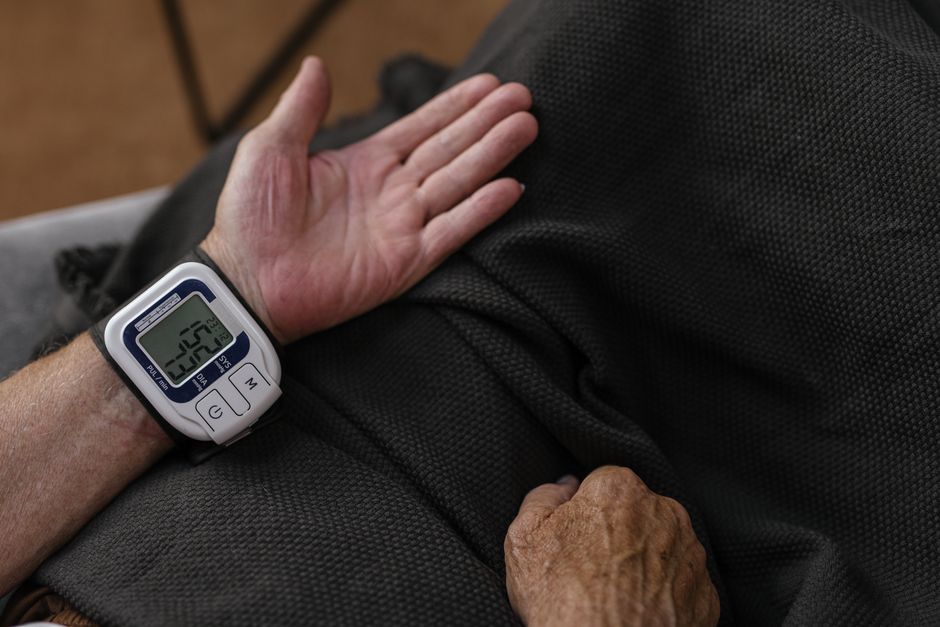
If you want to know how much REM sleep you got last night, the most accurate way to find out is a sleep study called polysomnography, which measures brain waves, eye movement, and muscle activity directly. Consumer wearables and phone apps cannot measure REM sleep directly. They estimate it by tracking your heart rate, movement, and breathing patterns, then applying algorithms that guess which stage you were in. That estimate can be useful for spotting trends, but it is not the same as a clinical measurement.
What Is REM Sleep and Why Does Measuring It Matter?
REM stands for rapid eye movement. It is the sleep stage where most vivid dreaming happens. Your brain becomes highly active, close to waking levels, while your body’s voluntary muscles go temporarily limp. This is called muscle atonia, and it likely exists to keep you from acting out your dreams.
Sleep is not one uniform state. It cycles through stages roughly every 90 to 120 minutes. A typical night moves through light sleep, deep slow-wave sleep, and REM in a repeating pattern. REM periods tend to get longer toward morning, which is why people who cut sleep short often lose a disproportionate amount of REM.
REM sleep appears to play a role in memory consolidation, emotional processing, and brain development. That said, the precise functions of REM are still an active area of research. Scientists do not fully agree on everything REM does. What is well established is that it is a distinct physiological state, and it requires specific measurements to identify with confidence.
How Is REM Sleep Measured Clinically?
Polysomnography is the clinical standard. It is usually done overnight in a sleep lab, though home sleep studies exist for some purposes. The test records several signals at once:
- EEG (electroencephalogram): electrodes on the scalp measure brain wave activity
- EOG (electrooculogram): sensors near the eyes detect rapid eye movements
- EMG (electromyogram): sensors on the chin detect muscle tone, which drops during REM
- EKG: measures heart rhythm
- Airflow and breathing effort sensors: detect pauses in breathing
- Oxygen saturation: a finger clip measures blood oxygen levels
A trained technologist scores the recording in 30-second segments, called epochs, using standardized rules. REM is identified when the EEG shows certain patterns, the eyes move rapidly, and muscle tone is low. This combination is what makes the identification reliable. No single signal is enough on its own.
Polysomnography is not perfect, and scoring can vary somewhat between trained reviewers. But it remains the reference standard against which everything else is compared.
How Do Wearables and Apps Estimate REM Sleep?
Consumer devices use a completely different approach. They do not measure brain activity. Instead they rely on signals they can detect from the wrist, finger, or phone:
- Movement: accelerometers detect how much you are moving. Stillness suggests sleep.
- Heart rate and heart rate variability: optical sensors on the wrist or finger track blood flow changes.
- Blood oxygen: some devices estimate oxygen levels using light sensors.
- Breathing rate: derived from heart rate patterns or movement.
An algorithm then classifies each period as awake, light sleep, deep sleep, or REM. The logic is that REM tends to come with certain heart rate patterns, low movement, and specific breathing rhythms. The problem is that these signals overlap heavily with other sleep stages and with quiet wakefulness.
This is why device estimates of REM are approximations, not measurements. The device is inferring, not detecting. That distinction matters when you are looking at a number on a screen and deciding what it means.



How Accurate Are Sleep Trackers and Apps for REM?
Accuracy varies widely. Some research comparing consumer wearables to polysomnography has found that devices tend to be reasonably good at detecting whether you are asleep or awake. They are generally less accurate at distinguishing between sleep stages, and REM detection is one of the harder problems.
Several studies have found that consumer devices often misclassify REM, sometimes confusing it with light sleep or with periods of quiet wakefulness. The direction of the error is not always the same. Some devices overestimate REM, others underestimate it. Results vary by device, by person, and by night.
It is also worth knowing that most validation studies are small and often funded or supported by the device manufacturers themselves. Independent, large-scale comparisons are less common. That does not make the findings wrong, but it does mean the evidence base is thinner than the marketing suggests.
One practical point: even a device that is only moderately accurate at staging sleep can still be useful for tracking your own patterns over time. If your estimated REM is consistently low for weeks, that is a signal worth discussing with a clinician, even if the absolute number is off.
What Affects the Accuracy of REM Estimates?
Several factors can throw off a device’s estimate:
- Fit and placement: a loose wristband or a finger sensor that shifts can produce poor signal quality
- Skin tone and perfusion: optical heart rate sensors can be less accurate on darker skin tones or in people with poor circulation
- Movement during sleep: restlessness can be misread as wakefulness
- Alcohol and medications: these can change sleep architecture and confuse algorithms trained on typical sleepers
- Sleep disorders: conditions like sleep apnea can fragment sleep in ways the algorithm was not designed for
- Individual variation: heart rate patterns during REM are not identical for everyone
Age matters too. Sleep architecture changes across the lifespan, and REM percentage tends to decline with age. An algorithm validated in young adults may not perform as well in older adults.
Can Phone Apps Measure REM Sleep Without a Wearable?
Some apps use only the phone’s microphone and accelerometer. They detect sounds and movements, then estimate sleep stages from that. This approach has even less physiological information to work with than a wrist device. It cannot detect heart rate or blood oxygen at all.
Apps that use actigraphy alone, meaning movement only, are generally poor at distinguishing REM from other sleep stages. Movement is a crude proxy for sleep state. Quiet wakefulness and light sleep and REM can all look similar from a movement standpoint.
If an app claims to measure REM accurately using only your phone’s sensors, that claim is not supported by the available evidence. The app is estimating, and the estimate is likely to be less reliable than a wearable with heart rate sensing.
Should You Trust the REM Number on Your Device?
Treat it as a rough estimate, not a clinical measurement. It can be useful for noticing trends in your own sleep over time. It is not reliable enough to diagnose a sleep disorder or to make medical decisions on its own.
If you are concerned about your sleep, the number on your device is not the right thing to focus on. How you feel during the day matters more. Persistent daytime sleepiness, difficulty falling or staying asleep, loud snoring, or waking up gasping are reasons to see a clinician. Those symptoms point to a possible sleep disorder, and a proper evaluation is the only way to know for sure.
One thing worth saying plainly: no consumer device has been validated as a diagnostic tool for REM sleep disorders. If you suspect a problem with your sleep, a sleep study is the appropriate next step, not a comparison of app data.
Frequently Asked Questions
Can a smartwatch accurately measure REM sleep?
No consumer smartwatch measures REM sleep directly. It estimates REM by tracking heart rate, movement, and breathing, and those estimates are less accurate than a sleep lab study.
How accurate are sleep apps at detecting REM sleep?
Apps that rely on movement or phone sensors alone tend to be poor at distinguishing REM from other sleep stages. Accuracy improves somewhat with heart rate sensing, but no app matches polysomnography.
What is the most accurate way to measure REM sleep?
Polysomnography, an overnight sleep study that records brain waves, eye movements, and muscle activity, is the clinical standard. It is the only method that directly identifies REM sleep.
Do I need a sleep study to know if my REM sleep is normal?
Not necessarily. If you feel rested and have no symptoms, a sleep study is usually not needed. Talk to a clinician if you have persistent daytime sleepiness, loud snoring, or trouble staying asleep.
