
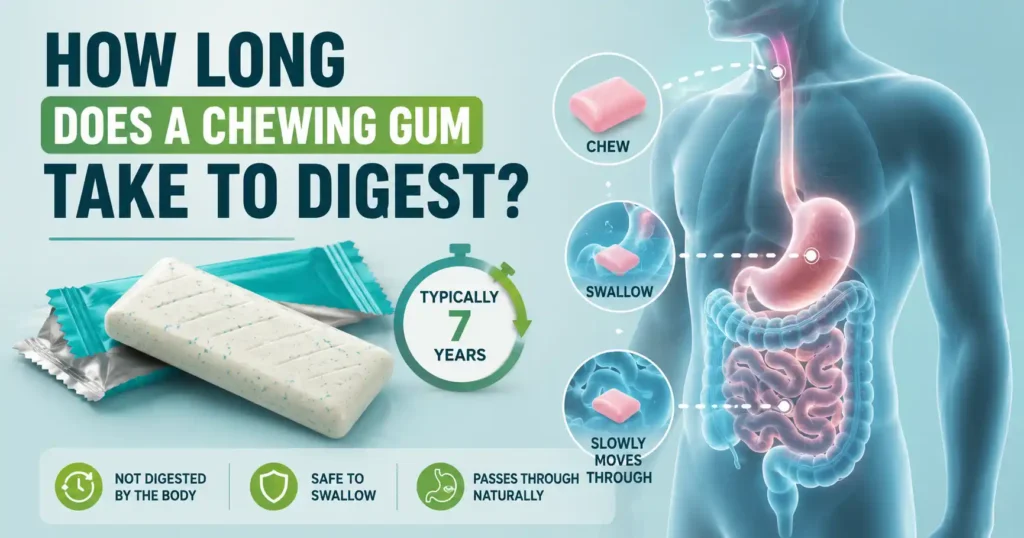
You have probably heard the old saying that the gum you swallow stays in your stomach for seven years. It is one of the most persistent health myths out there. The short answer is that chewing gum does not take seven years to digest. It usually passes through your digestive system in about 24 to 48 hours, just like most other foods. The body cannot break down the gum base, but that does not mean it gets stuck. It moves through your gut and exits with your next bowel movement.
What Actually Happens When You Swallow Gum?
Your digestive system is a tough environment. It handles raw vegetables, tough meats, and even some bones. Chewing gum is not special in its ability to survive this process. The stomach churns and mixes gum with food and digestive juices. The acids and enzymes work on the sweeteners, flavors, and softeners in the gum.
The gum base, which is a synthetic rubber, is not digestible. Your body treats it like fiber. It passes through the small intestine and into the colon. From there, it leaves the body in your stool. Research shows that the body does not store gum for years. It just moves it along like anything else; it cannot break down.
The fear about gum sticking to your intestines comes from a misunderstanding of how the digestive tract works. Your intestines are lined with a layer of mucus that helps food slide through. Gum does not stick to this lining. It is not like glue. It is a soft, pliable mass that gets pushed forward by muscle contractions called peristalsis.
These contractions are strong enough to move gum along without any trouble. As of 2026, current research suggests that swallowed gum poses no real risk for healthy people.
Swallowed Gum in Children: Should Parents Worry?
Parents often panic when a child swallows gum. The concern is understandable, but the evidence is reassuring. Swallowing a single piece of gum is harmless for most children. The gum will pass through their system in the same 24 to 48-hour window.
The real risk comes from swallowing large amounts of gum at once. There are rare case reports of children who swallowed many pieces of gum over a short period. This can create a mass that blocks the digestive tract. This is called a bezoar. These cases are extremely rare and usually involve children who swallowed dozens of pieces at a time.
If your child swallows one piece of gum, do not worry. Give them water and a normal meal. The food will help push the gum through. The only time to call a doctor is if your child has belly pain, vomiting, or cannot have a bowel movement after swallowing gum. These symptoms are very uncommon. Most children never have any issues. The myth of seven years causes more anxiety than the actual event ever does.
| Factor | What Actually Happens |
|---|---|
| Time to pass | 24 to 48 hours |
| Digestibility | Gum base is not digestible, but passes through |
| Risk for one piece | Essentially zero for healthy people |
| Risk for many pieces | Rare risk of blockage if dozens are swallowed |
| What happens inside | Moves like fiber, pushed by muscle contractions |
Does Sugar-Free Gum Change the Digestive Process?
Sugar-free gum contains sugar alcohols like sorbitol, xylitol, and mannitol. These ingredients can affect your digestion in different ways. Your body does not fully absorb sugar alcohols. They pull water into your intestines. This can cause loose stools or diarrhea if you eat too much. Some people are more sensitive than others.
A single piece of sugar-free gum is unlikely to cause problems. But chewing several pieces a day can add up. There are case reports of people who chewed large amounts of sugar-free gum and developed chronic diarrhea. Once they stopped chewing the gum, their digestion returned to normal.
Xylitol is safe for humans but extremely dangerous for dogs. If you have a dog in your home, keep sugar-free gum out of reach. Even a small amount of xylitol can cause a rapid drop in a dog’s blood sugar. This can be fatal. The gum base itself is not the issue here. It is the sweetener that matters. For humans, the concern is mostly about bowel habits.
If you notice loose stools and you chew a lot of sugar-free gum, try cutting back for a few days. See if your digestion improves. Some studies suggest that excessive gum chewing can also cause you to swallow more air, which leads to bloating and gas. This is not dangerous, but it is uncomfortable.





What About Gum and Digestive Health Myths?
The seven-year myth is the most famous, but there are others. Some people believe that gum wraps around your heart or gets stuck in your throat permanently. None of these is true. Gum cannot wrap around anything in your digestive system. It is too soft and moves too quickly. The myth likely started because gum base is rubbery and seems indestructible.
People assumed that if it does not break down, it must stay inside you. That logic is flawed. Many things you eat are not fully digestible. Corn kernels, seeds, and some vegetables pass through your body intact. No one claims those stay for seven years.
Another common claim is that gum takes longer to digest than food. That is technically true because the gum base is not digested at all.
But that does not mean it takes longer to pass through. Transit time depends on how fast your intestines move things along, not on whether the material is broken down. Fiber is not digested either, but it does not stay in your body for years.
The same is true for gum. Some people report that swallowing gum gives them a stomachache. This is more likely due to swallowing air while chewing than to the gum itself. If you chew gum slowly and do not gulp air, you probably will not feel anything.
What to Do If You Swallow Gum Accidentally
If you swallow gum by accident, there is nothing special you need to do. Drink water normally. Eat your next meal as usual. The gum will come out in your stool within two days. Do not try to induce vomiting. That is unnecessary and can be harmful.
Do not take laxatives either. Your digestive system handles gum on its own just fine. The only exception is if you swallowed a large amount of gum at once. In that very rare case, watch for signs of a blockage. These include severe stomach pain, vomiting, and constipation that lasts more than a few days. If you have those symptoms, see a doctor. Otherwise, forget about it.
Children who swallow gum need the same approach. Reassure them. Do not make a big deal out of it. If you act worried, they will get scared. Just tell them it is okay and that their body will take care of it. Offer them a glass of water and a snack. The snack helps move the gum along. Do not give them extra fiber or prune juice to speed things up.
That is not needed and can cause cramping. The body handles gum efficiently without any help. The myth of seven years is just that, a myth. It has no basis in medical science. Your digestive system works well, and gum is no match for it.
Frequently Asked Questions About How Long Does a Chewing Gum Take to Digest
How long does a chewing gum take to digest in the body?
It takes about 24 to 48 hours for gum to pass through your digestive system. The body does not digest the gum base, but it moves through your intestines and exits in your stool.
Can swallowing gum cause a blockage in your intestines?
Swallowing one piece of gum rarely causes a blockage. Blockages only happen in very rare cases where someone swallows many pieces of gum at the same time.
Is it dangerous if a child swallows gum?
No, a single piece of gum is not dangerous for a child. It will pass through their system normally. Call a doctor only if the child has belly pain or trouble having a bowel movement.
Does sugar-free gum digest differently from regular gum?
The gum base digests the same way. But sugar-free gum contains sugar alcohols that can cause loose stools or diarrhea if you chew a lot of it in one day.
