

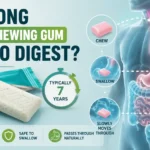
You have heard it since you were a kid: swallow gum and it stays in your stomach for seven years. It is one of the most persistent health myths out there. The short answer is no. Gum does not stay in your digestive system for years. It passes through your body in roughly the same time as most food, usually within 24 to 48 hours. Your body simply cannot digest the gum base, so it moves through your system and comes out the other end. That old tale is completely false. Let us look at what actually happens when you swallow gum and what the research really says.
What Happens When You Swallow Gum?
Gum is made of a few basic parts. There is the sweetener, the flavoring, and the gum base. The sweetener and flavoring dissolve quickly in your saliva. Your stomach handles them easily. The gum base is the problem. It is a synthetic rubber-like material that your digestive enzymes cannot break down.
Think of it like eating a piece of corn or a seed. Your body does not break down the outer shell of a corn kernel. It passes through your digestive tract mostly intact. The same thing happens with gum base. Your stomach muscles churn and push it along. Your intestines keep moving it forward. It does not get stuck. It does not cling to your stomach lining.
The idea that gum sits in your stomach for years is not supported by any medical evidence. Gastroenterologists have looked for this. They have not found gum just sitting there. It moves through the digestive system like any other indigestible object, just a bit slower than a fully digestible meal.
How Long Does It Actually Take to Pass?
Research shows that most swallowed gum passes through the digestive tract in under 48 hours. For many people, it happens in 24 hours or less. The speed depends on your individual digestive system and what else you have eaten.
Your digestive system is a continuous tube from mouth to anus. It is designed to move things forward. The stomach empties its contents into the small intestine within a few hours. The small intestine moves things along in about 4 to 6 hours. The large intestine, or colon, takes the longest, usually 12 to 48 hours. Gum follows this same path.
A small study from the 1990s looked at this directly. Researchers gave children gum with a special marker to track it. They found the gum passed through the digestive system in most children within a few days. No gum was found stuck anywhere. Current research suggests the same thing. The seven-year myth is just that, a myth with zero evidence behind it.
Can Swallowing Gum Cause Problems?
For most people, swallowing one or two pieces of gum is harmless. It passes through without any trouble. There is no need to panic or call a doctor. Your body handles it just fine.
Problems are extremely rare but they do exist. The main risk is when someone swallows a very large amount of gum at once. This is not common. It usually happens in children who swallow an entire pack or more. In these rare cases, the gum can clump together and form a blockage in the digestive tract.
There are also case reports of gum getting stuck in the esophagus. This happens if someone swallows gum without chewing it properly or if they already have a narrowing in their esophagus. Symptoms include chest pain, trouble swallowing, or a feeling that something is stuck. This is an emergency situation, but it is not caused by the gum being in your stomach. It is a physical blockage in the tube leading to your stomach.
Another risk is aspiration. This means the gum goes down the wrong pipe into your airway instead of your esophagus. This can cause coughing or choking. It is a risk with any small object, not just gum. Chewing gum thoroughly before swallowing reduces this risk significantly.




Does Gum Have Any Health Benefits?
Chewing gum is not just about fresh breath. Some research shows real benefits for certain situations. The key is to choose the right kind of gum.
Sugar-free gum has been studied for dental health. Chewing it increases saliva flow. Saliva helps wash away food particles and neutralizes acid in your mouth. This can reduce the risk of cavities. The American Dental Association recognizes this benefit for sugar-free gum. Chewing it for about 20 minutes after meals is a reasonable habit.
Some studies suggest gum can help with focus and alertness. Chewing increases blood flow to the brain. This effect is small but measurable. People report feeling more awake and attentive when chewing gum during tasks that require sustained attention. The evidence is not strong enough to call it a cognitive enhancer, but the effect is real.
There is also some evidence that gum can help with stress. Chewing has a calming effect for some people. It gives the jaw something to do. It can be a way to manage nervous energy. As of 2026, the research on this is still mixed, but many people report it helps them feel less anxious in stressful situations.
What About Gum and Digestion?
Chewing gum can affect your digestion in ways you might not expect. The act of chewing signals your body to prepare for food. Your stomach starts producing acid and your digestive enzymes get ready. If you chew gum but do not swallow food, your stomach has nothing to work on.
This can cause problems for some people. The extra stomach acid with no food to digest can lead to heartburn or indigestion. This is more common in people who already have acid reflux or a sensitive stomach. If you notice your stomach feels upset after chewing gum, this may be the reason.
There is also the issue of swallowing air. When you chew gum, you tend to swallow more air than usual. This air can get trapped in your digestive tract. It leads to bloating, gas, and abdominal discomfort. For people with irritable bowel syndrome or similar conditions, this can be a real issue.
Some people also find that certain artificial sweeteners in gum cause digestive upset. Sorbitol and xylitol are common sweeteners in sugar-free gum. They are not fully absorbed by the body. In large amounts, they can cause diarrhea and gas. This is well documented in the medical literature. If you chew a lot of sugar-free gum and have loose stools, the gum might be the cause.
What to Do If You Swallow Gum
If you or your child swallows a piece of gum, do not worry. It will pass on its own. The best thing to do is nothing. Let your digestive system do its job. Drink water as you normally would. Eat your regular meals. The gum will move through your system with the rest of your food.
There is no need to take laxatives or special remedies. Your body handles indigestible material every day. It knows what to do. Trying to force the gum out faster can cause more problems than it solves.
You should only be concerned if you notice specific symptoms. These include severe abdominal pain, vomiting, inability to pass gas or stool, or a feeling that something is stuck in your throat. These symptoms are rare but warrant a call to a doctor. In almost every case, the swallowed gum passes without anyone ever noticing.
For parents, the main concern is preventing large amounts of gum from being swallowed at once. Keep gum out of reach of very young children. Teach older children to spit gum out after chewing. One piece is fine. A whole pack is not.
Common Misconceptions About Gum and Digestion
The seven-year myth is the biggest one, but it is not the only myth out there. Another common claim is that gum wraps itself around your heart or your intestines. This is false. Gum does not have the structure to wrap around anything. It is a soft, pliable mass that moves through your system in a clump.
Some people believe that drinking soda or eating certain foods will dissolve gum in your stomach. This is also false. Your stomach acid is far stronger than soda or any food. If stomach acid cannot dissolve gum, nothing you eat or drink will either. The gum simply passes through unchanged.
There is also a belief that gum can cause appendicitis. This is extremely rare. There are a few case reports of gum being found in the appendix during surgery. But the appendix can get blocked by many things, including seeds, stool, and infections. Gum is not a common cause. The risk is so low it is not worth worrying about.
Finally, some people think you should never swallow gum under any circumstances. While it is not recommended to make a habit of it, swallowing one piece occasionally is not dangerous. The advice to never swallow gum is good for children who might not understand the difference between one piece and a whole pack. For adults, it is more of a preference than a medical necessity.
Frequently Asked Questions About Gum and Digestion
Does gum really stay in your stomach for seven years?
No. This is a complete myth. Gum passes through your digestive system in 24 to 48 hours like most other indigestible material.
Can swallowing gum cause a blockage?
It is extremely rare. Blockages only happen when someone swallows a very large amount of gum at once, such as an entire pack.
Is sugar-free gum better for your teeth?
Yes. Sugar-free gum increases saliva flow which helps wash away food and neutralize acid. It can reduce cavity risk when chewed after meals.
What should I do if my child swallows gum?
Nothing. One piece of gum will pass through their system without any problems. Only call a doctor if they have severe pain or cannot eat.
