
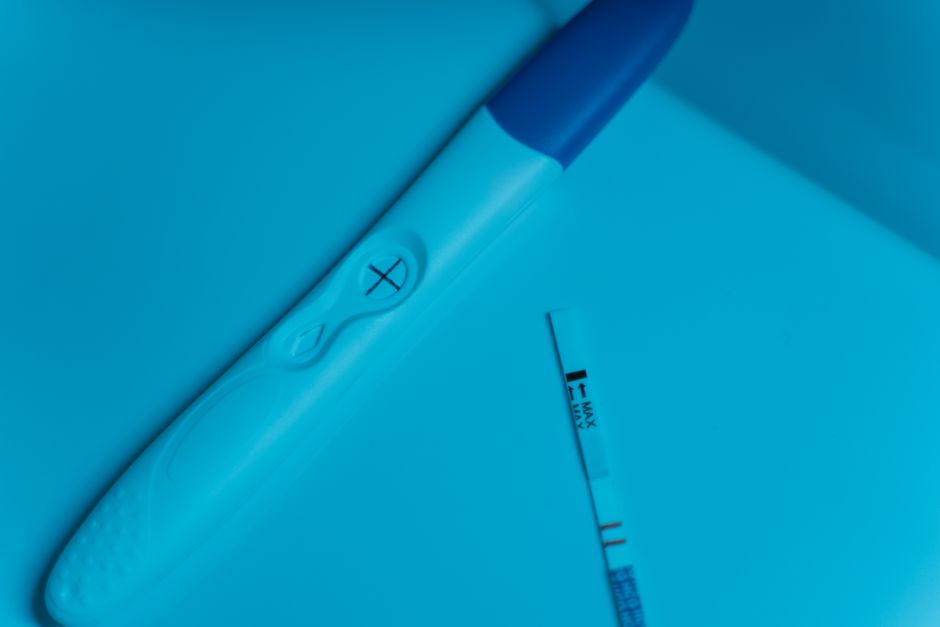
Home pregnancy tests detect a hormone called human chorionic gonadotropin, or hCG, in your urine. This hormone is produced by cells that form the placenta after a fertilized egg implants in the uterus. A test strip contains antibodies that react to hCG and produce a visible line or symbol, usually within a few minutes.
That is the basic answer. The details — when hCG appears, how much is needed for a positive result, and why timing matters so much — explain both why these tests work well and why they sometimes give confusing results.
How Does A Pregnancy Test Work Hcg Test Strips?
A pregnancy test strip is a small piece of treated paper inside a plastic casing. When urine soaks into the strip, it moves by capillary action — the same force that pulls water up a paper towel — across several zones that have been prepared with biological materials.
The key component is an antibody that binds specifically to hCG. Antibodies are proteins your immune system makes to recognize specific targets. Test manufacturers use antibodies that lock onto hCG and essentially nothing else. That specificity is why a pregnancy test does not react to other hormones in your urine.
The strip usually has three zones:
- A reaction zone where hCG in the urine binds to antibody-coated particles. If enough hCG is present, these particles clump and form a visible line.
- A control zone that always produces a line when the strip works properly, regardless of whether hCG is present. This confirms the test functioned.
- A sample pad at the bottom where urine is applied.
Most modern tests use a “sandwich” design. One antibody attached to a colored particle binds hCG. A second antibody fixed to the strip captures the hCG-antibody complex. The result is a colored line that only appears when hCG is present. This design is sensitive and specific.
The control line is not a pregnancy indicator. It is a quality check. If no control line appears, the test is invalid and should be repeated with a new strip.
What Is hCG And When Does It Appear?
Human chorionic gonadotropin is a hormone produced by syncytiotrophoblast cells — the cells that become the placenta. It is not normally present in meaningful amounts in non-pregnant women or in men.
After a fertilized egg implants in the uterine lining, hCG production begins. Implantation typically occurs about 6 to 12 days after ovulation, though this range varies. Before implantation, there is no placental tissue producing hCG, so no test can detect pregnancy.
Once implantation happens, hCG levels rise quickly in early pregnancy. The hormone doubles approximately every 48 to 72 hours during the first weeks. This rapid rise is what makes early detection possible — a test that is negative one day may be positive two or three days later.
hCG appears in blood before it appears in urine at detectable levels. Blood tests can detect pregnancy slightly earlier than urine tests because they measure the hormone directly in the bloodstream, where concentrations rise first.
How Sensitive Are Home Pregnancy Tests?
Most home pregnancy tests claim to detect hCG at concentrations of 20 to 25 milli-international units per milliliter (mIU/mL) in urine. Some advertise sensitivity as low as 10 mIU/mL. These numbers come from the manufacturers’ own testing.
Sensitivity is not the same as accuracy in real life. A test may be able to detect 20 mIU/mL under ideal laboratory conditions, but several factors affect whether it detects hCG in your actual urine on a given day.
These factors include:
- How much hCG is present. If you test very early, levels may be below the detection threshold.
- How diluted your urine is. Drinking a lot of water before testing can lower hCG concentration.
- When you test. First-morning urine is usually the most concentrated, which can help early detection.
- How you use the test. Following the instructions matters. Testing too early or reading the result outside the recommended window can lead to errors.
Research on home pregnancy tests has found that they generally perform well when used correctly and after a missed period. However, studies have also shown that some tests are less sensitive in real-world use than their labels suggest. The evidence here is mixed — some studies find good performance, others find variability between brands.


When Should You Take A Pregnancy Test?
The most reliable time to test is after a missed period. By that point, if you are pregnant, hCG levels are usually high enough for most tests to detect.
Testing before a missed period can work, but it is less reliable. Implantation timing varies, and hCG may not have risen to detectable levels yet. A negative result taken too early does not rule out pregnancy.
If you test early and get a negative result, waiting a few days and testing again is reasonable. hCG rises quickly in early pregnancy, so a test that was negative may become positive within 48 to 72 hours if pregnancy is progressing.
Some people test multiple times on the same day or use several brands. This does not improve accuracy and can add confusion. One test, used correctly, is usually enough.
What Causes A False Negative Or False Positive?
A false negative means you are pregnant but the test says you are not. This is more common than a false positive. The most frequent cause is testing too early, before hCG reaches detectable levels.
Other causes of false negatives include diluted urine and using an expired or improperly stored test. Rarely, a test may fail to work correctly due to a manufacturing defect, which is why the control line matters.
A false positive means the test says you are pregnant but you are not. This is uncommon but possible. Causes include:
- Medications containing hCG. Some fertility treatments use hCG injections, which can trigger a positive test.
- Certain medical conditions. Rare tumors and some other conditions can produce hCG.
- Evaporation lines. If a test is read after the recommended time window, a faint line may appear that is not a true positive.
- Chemical pregnancy. A very early miscarriage can produce a brief positive result before hCG levels fall.
If you get a positive result but are unsure, a blood test at a doctor’s office can confirm pregnancy and measure hCG levels directly.
How Do Blood Tests Compare To Urine Tests?
Blood tests for hCG are more sensitive than urine tests. They can detect pregnancy earlier and provide a precise measurement of hCG concentration. There are two main types: qualitative (yes or no) and quantitative (exact level).
Quantitative blood tests are used to track hCG levels over time. This is helpful in early pregnancy when doctors want to confirm that levels are rising appropriately. A single hCG value is less informative than the trend over 48 to 72 hours.
Urine tests are convenient, private, and inexpensive. They are accurate enough for most people who test after a missed period. Blood tests are typically used when there is a concern about early pregnancy, unusual symptoms, or when confirmation is needed.
| Feature | Urine Test | Blood Test |
|---|---|---|
| Detection threshold | Typically 20-25 mIU/mL | As low as 1-2 mIU/mL (quantitative) |
| Earliest detection | Around the time of missed period | A few days earlier |
| Result type | Yes/no | Yes/no or exact level |
| Where performed | At home | Doctor’s office or lab |
What Else Should You Know About hCG Testing?
hCG tests are not designed to monitor pregnancy progression at home. Once you have a positive result, your doctor will determine what follow-up is appropriate. hCG levels are one piece of information among many.
Some people use hCG test strips — often called “internet cheapies” — to track line darkening over time. This practice is common in fertility communities. It is not a medically validated way to monitor pregnancy. Line darkness can vary with urine concentration, test brand, and timing. It does not reliably indicate hCG levels.
If you are undergoing fertility treatment, your clinic may give you specific instructions about when to test. hCG trigger shots, which are used to induce ovulation, contain hCG and can cause a false positive if you test too soon after the injection. Follow your clinic’s guidance.
No home test can tell you the location of a pregnancy. A positive test means hCG is present. It does not confirm that the pregnancy is in the uterus. Ectopic pregnancy — where a fertilized egg implants outside the uterus — can also produce a positive test. Symptoms like sharp pain, dizziness, or heavy bleeding require immediate medical attention.
Frequently Asked Questions
How early can a pregnancy test detect hCG?
Most home tests can detect hCG around the time of a missed period, which is roughly two weeks after ovulation. Some tests claim earlier detection, but implantation timing varies and testing too early can give a false negative.
Can a pregnancy test be positive before implantation?
No. hCG is produced by placental cells that form after the fertilized egg implants in the uterus. Before implantation, there is no source of hCG, so no test can detect pregnancy.
What does a faint line on a pregnancy test mean?
A faint line usually means hCG is present but at a low level, which is common in very early pregnancy. However, a faint line can also be an evaporation line if the test was read after the recommended time window.
Do pregnancy tests ever give false positives?
False positives are uncommon but possible. Medications containing hCG, certain rare medical conditions, and reading a test after the time limit can all cause a positive result when you are not pregnant.
