
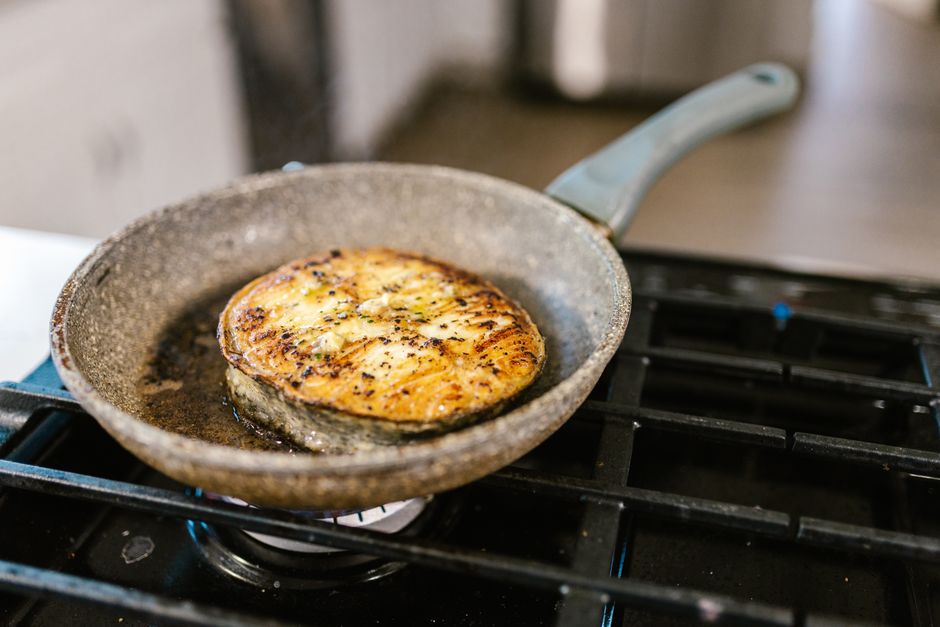
You tell if salmon is cooked by checking two things: the internal temperature and the flesh itself. The center of the thickest part should reach 145°F, and the meat should turn from translucent to opaque with flakes that separate easily. If you do not have a thermometer, firmness and color changes are useful clues — but they are less reliable than temperature.
What Internal Temperature Means Salmon Is Safe to Eat
The Food and Drug Administration and the USDA both set 145°F as the minimum internal temperature for safe cooked fish. That number is not arbitrary. It is the point at which foodborne pathogens commonly found in fish, including Listeria and certain parasites, are killed.
Measure at the thickest part of the fillet. For a whole side of salmon, that is usually the center. Insert the probe horizontally from the side so it reaches the middle without passing through to the pan. If your fillet is thin, fold it or measure at the widest point.
Here is where people get confused. The 145°F guideline is a food safety threshold, not a culinary preference. Many chefs pull salmon at 125°F to 130°F for medium-rare. That is a personal choice, and it comes with a real trade-off: lower temperatures may not eliminate all pathogens.
The USDA recommends 145°F because it is the temperature that makes the fish safe for everyone, including people with weaker immune systems, pregnant women, young children, and older adults. If you are cooking for anyone in those groups, 145°F is the number to hit.
Why Carryover Cooking Matters
Salmon continues to cook after you take it off the heat. The internal temperature can rise another 5°F to 10°F while the fish rests. If you pull it at exactly 145°F, it may end up closer to 150°F to 155°F by the time you serve it.
Some cooks pull salmon at 140°F and let it rest, knowing it will reach 145°F. This works if you are confident in your thermometer and your resting time. It is riskier if you are not measuring carefully.
How Do You Tell If Salmon Is Cooked Without a Thermometer?
Without a thermometer, you rely on visual and tactile cues. These are helpful but not foolproof. The flesh should be opaque all the way through, with no glossy or translucent patches in the center.
Press the top of the fillet with a fork or your finger. Cooked salmon feels firm and springs back slightly. Raw or undercooked salmon feels soft and squishy, and the flesh may separate too easily.
Look at the flakes. Cooked salmon separates into distinct flakes when you gently push it with a fork. If the meat looks like a solid block or tears into mushy clumps, it may be undercooked or overcooked.
Check the color. Raw salmon is translucent and shiny. As it cooks, the proteins denature and the flesh turns opaque. The exact color depends on the species — sockeye is deep red, coho is orange-red, Atlantic is pinkish-orange — but the change from see-through to solid is consistent.
One more clue: albumin. That white stuff oozing out of the salmon is a protein called albumin. It coagulates when heated. A little albumin is normal. A lot of it usually means the fish was cooked at high heat or for too long.
Why Color Alone Can Mislead You
Color is the cue most people rely on, and it is the one that fails most often. Farmed salmon is often dyed with astaxanthin, a pigment also found in wild salmon. That dye can make the flesh look more “cooked” than it is.
Cold-smoked salmon is another trap. It looks opaque and cooked, but it is technically raw. Cold smoking does not raise the internal temperature enough to kill pathogens. Hot-smoked salmon, by contrast, is fully cooked.
Some salmon varieties also hold their color differently. Wild sockeye stays deep red even when fully cooked. Atlantic salmon fades to a pale pink. Neither color tells you the internal temperature.
This is why a thermometer beats every visual cue. It is the only way to know for certain.




How Cooking Method Changes the Signs
Different cooking methods produce different visual cues. What looks done in a pan may not look done in the oven.
- Baking: The top may look dry and flaky while the center is still translucent. Always check the thickest part.
- Pan-searing: The outside can look browned and crisp while the inside is raw. Sear skin-side down, then finish in the oven or cover the pan to cook through.
- Grilling: Grill marks and char can hide undercooked flesh. Use indirect heat or a grill basket to cook evenly.
- Poaching: The fish looks pale and opaque throughout. It is easy to overcook because the liquid hides the flesh.
- Steaming: Similar to poaching. The fish cooks gently and stays moist, but color changes are subtle.
No matter the method, the internal temperature rule stays the same: 145°F at the thickest part.
What Happens If You Eat Undercooked Salmon?
Undercooked salmon carries two main risks: bacteria and parasites. The most common bacterial concern is Listeria, which can cause fever, muscle aches, and gastrointestinal symptoms. For most healthy adults, the illness is mild and self-limiting.
For pregnant women, older adults, and people with weakened immune systems, Listeria can be serious. It can cause severe infections and, in pregnancy, lead to miscarriage or stillbirth. This is why those groups are advised to avoid raw or undercooked fish.
Parasites are the other concern. Wild salmon can carry Anisakis worms. These are killed by proper cooking or by commercial freezing. Fresh wild salmon that has not been frozen and is eaten raw is a real risk.
Farmed salmon raised in controlled conditions has a lower parasite risk, but it is not zero. The FDA still recommends cooking farmed salmon to 145°F for safety.
If you eat undercooked salmon and feel unwell, symptoms usually appear within hours to days. Seek medical attention if you have severe abdominal pain, high fever, or signs of dehydration.
Does Salmon Need to Rest Before You Check It?
Yes. Resting is not just about juiciness. It also lets the internal temperature stabilize. If you check the temperature immediately after pulling salmon from the heat, you may get a reading that is lower than the final temperature.
Let the fillet rest for 3 to 5 minutes. Then check the temperature again. If it has reached 145°F, it is safe to eat. If it is still below, return it to the heat.
Resting also allows the juices to redistribute. Cut into salmon too soon and the moisture runs out, leaving the flesh dry. A short rest keeps it moist.
Common Mistakes That Lead to Undercooked Salmon
Even experienced cooks run into trouble. These are the most common reasons salmon ends up underdone.
- Checking the wrong spot: The thin end of a fillet cooks faster than the thick end. Measure the thickest part.
- Trusting the timer: Recipe times vary by fillet thickness, starting temperature, and pan. A thermometer is more reliable.
- Not accounting for carryover: Pulling at 145°F can lead to overcooking. Pulling at 140°F can lead to undercooking if you do not rest it.
- Using a dull thermometer: A thermometer that reads too low can give you a false sense of safety. Check it in ice water (32°F) and boiling water (212°F at sea level).
- Cooking from frozen: Frozen salmon takes longer and cooks unevenly. Thaw it first for the most predictable results.
How to Check Temperature Correctly
Use a digital instant-read thermometer. Insert the probe into the thickest part of the fish, away from bone and fat. Wait for the reading to stabilize.
For thin fillets, you may need to insert the probe at an angle. For whole fish, check behind the head or in the thickest part of the body. For salmon burgers or pieces, check the center of each piece.
Clean the probe with hot soapy water between checks, especially if you are checking multiple pieces. Cross-contamination from a probe that touched raw fish is a real risk.
If you do not own a thermometer, buy one. They cost less than a takeout meal and they are the single most useful tool for cooking salmon safely.
Frequently Asked Questions
Is it safe to eat salmon at 125°F?
The USDA recommends 145°F for safety, so 125°F is below the guideline. Some healthy adults choose to eat salmon at that temperature, but it carries a higher risk of foodborne illness.
Can you tell if salmon is cooked by color alone?
No. Color is a helpful clue but not reliable, especially because farmed salmon is often dyed and cold-smoked salmon looks cooked while remaining raw. A thermometer is the only sure way.
How long should salmon rest before checking temperature?
Let it rest for 3 to 5 minutes, then check the internal temperature. This allows carryover cooking to finish and gives you a more accurate reading.
What does undercooked salmon look like?
Undercooked salmon has a translucent, glossy center and feels soft when pressed. The flesh may not flake apart easily and the color is often brighter and more see-through than cooked salmon.
