
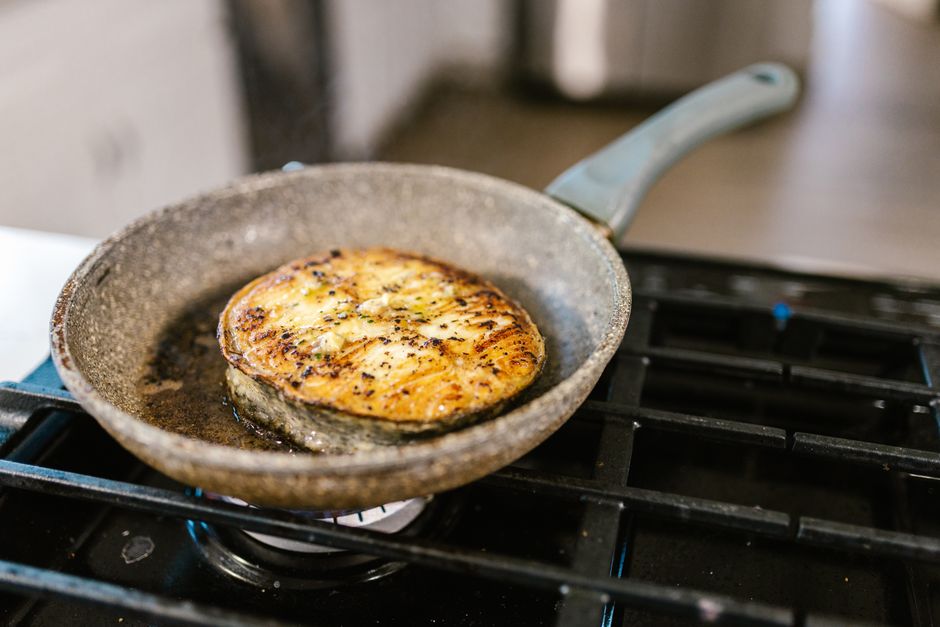
Stovetop salmon is one of the fastest ways to get a restaurant-quality piece of fish on the table. A one-inch-thick salmon fillet cooks in about 4 to 6 minutes per side over medium-high heat, for a total of roughly 8 to 12 minutes. Thinner fillets cook faster, sometimes in as little as 3 to 4 minutes per side. The real skill isn’t the clock — it’s reading the fish so you pull it at the right moment.
How Long Do You Cook Salmon On The Stove?
The timing depends almost entirely on thickness, not weight. A fillet that is one inch thick at its center needs about 4 to 6 minutes per side. A half-inch fillet might need only 2 to 3 minutes per side. A thick center-cut piece over an inch and a half could take 6 to 8 minutes per side.
Heat level matters just as much. Medium-high heat is the standard for a good sear without burning the outside before the inside cooks through. If your pan is too hot, the exterior will scorch while the center stays raw. Too low, and the fish steams in its own moisture instead of browning.
Here is a rough guide based on thickness:
- ½ inch thick: 2 to 3 minutes per side
- 1 inch thick: 4 to 6 minutes per side
- 1½ inches thick: 6 to 8 minutes per side
These are starting points, not guarantees. Every stove, pan, and piece of fish behaves a little differently. Use the clock as a guide, then confirm with the methods below.
How Do You Know When Salmon Is Done?
The most reliable test is an instant-read thermometer inserted into the thickest part of the fillet. The USDA recommends cooking fish to an internal temperature of 145°F. At that temperature, the fish is fully cooked and safe to eat.
That said, many chefs pull salmon earlier — around 125°F to 130°F — for a medium-rare center, then let it rest. Resting allows the internal temperature to rise a few more degrees. This is a matter of personal preference, but if you are cooking for anyone in a high-risk group, including pregnant women, young children, older adults, or people with weakened immune systems, the USDA’s 145°F target is the safer choice.
Without a thermometer, look for these visual cues:
- The flesh turns from translucent to opaque
- The color shifts from bright orange to a paler pink
- White protein (albumin) may begin to bead on the surface — a sign it is fully or nearly fully cooked
- A fork or knife slides in with little resistance and the fish flakes easily
One common mistake is cooking salmon until it flakes apart completely. At that point, it is overcooked and dry. The flesh should separate into flakes but still look moist.
Should You Cook Salmon Skin-Side Down First?
Yes, if your fillet has skin. Starting skin-side down in a hot pan gives you two advantages. The skin crisps and protects the delicate flesh from direct heat. It also releases easily from the pan once it is properly browned, usually after about 4 to 6 minutes.
Press the fillet gently with a spatula for the first 20 to 30 seconds to keep the skin flat against the pan. This prevents curling and helps the skin brown evenly. Once the skin is crisp and releases on its own, flip and finish the flesh side for another 2 to 4 minutes, depending on thickness.
If you are using skinless fillets, you lose that protective layer. Reduce the heat slightly and watch the fish more closely, since the flesh side can dry out faster.





What Pan and Oil Should You Use?
A heavy skillet — cast iron or stainless steel — gives the best sear. Nonstick pans work, but they don’t develop the same browned crust. Whatever you use, the pan needs to be fully preheated before the fish goes in. A drop of water should sizzle and evaporate immediately.
For oil, choose something with a high smoke point. Avocado oil, canola oil, and clarified butter all work well. Olive oil is fine for medium heat but can smoke at higher temperatures. Add just enough to coat the bottom of the pan — about one to two tablespoons for a standard skillet.
Do not crowd the pan. If you are cooking multiple fillets, leave space between them. Crowding lowers the pan temperature and causes the fish to steam rather than sear. Cook in batches if needed.
Common Mistakes That Ruin Stovetop Salmon
Most stovetop salmon problems come down to a few repeatable errors.
- Cold fish going into the pan. Let fillets sit at room temperature for 15 to 20 minutes before cooking. Cold centers cook unevenly.
- Wet surface. Pat the fillet completely dry with paper towels. Moisture steams the fish and prevents browning.
- Moving the fish too soon. Let it sear undisturbed. It will release from the pan on its own when it is ready to flip.
- Not resting after cooking. Let the fillet rest for 2 to 3 minutes before serving. This allows juices to redistribute.
- Judging doneness by time alone. Thickness varies. Always confirm with a thermometer or visual cues.
The resting step is easy to skip and makes a real difference. Cutting into salmon immediately sends the juices onto the plate instead of keeping them in the fish.
How Does Stovetop Cooking Compare to Other Methods?
Each cooking method has trade-offs. Here is a quick comparison for a one-inch fillet:
| Method | Approximate Time | Best For |
|---|---|---|
| Stovetop (pan-seared) | 8 to 12 minutes | Crispy skin, fast weeknight meals |
| Oven (400°F) | 12 to 15 minutes | Hands-off cooking, larger batches |
| Broiler | 6 to 10 minutes | Quick browning without flipping |
| Poaching | 8 to 12 minutes | Gentle cooking, moist texture |
Stovetop cooking gives you the most control and the fastest results. The trade-off is that you need to stay at the pan. Oven cooking is more forgiving if you need to step away, but you won’t get the same crispy skin without finishing under the broiler.
One note on food safety: the USDA 145°F internal temperature applies regardless of cooking method. If you are cooking salmon from frozen, add a few minutes to your total time and check the center carefully, since frozen fish cooks less evenly than fresh.
Does the Type of Salmon Matter?
Yes, but mostly for fat content and flavor, not cooking time. Atlantic salmon (farmed) tends to be fattier, which makes it more forgiving if you slightly overcook it. Wild-caught varieties like sockeye and coho are leaner and drier, so they benefit from slightly shorter cooking times and a little more oil in the pan.
King salmon (Chinook) is the fattiest and richest. Sockeye is the leanest and most intensely flavored. Coho falls somewhere in between. For stovetop cooking, all of them work — just keep an eye on the leaner types so they don’t dry out.
Fresh or thawed, the thickness of the fillet matters more than the species. A thin sockeye fillet and a thin Atlantic fillet will cook in roughly the same time.
Frequently Asked Questions
How long do you cook salmon on the stove per side?
For a one-inch fillet, cook about 4 to 6 minutes per side over medium-high heat. Thinner fillets need 2 to 3 minutes per side.
What temperature should salmon be when done on the stove?
The USDA recommends an internal temperature of 145°F. Some people prefer pulling it at 125°F to 130°F for a medium-rare center, but 145°F is the safe target for anyone in a high-risk group.
Do you flip salmon when cooking on the stove?
Yes, you flip it once. Start skin-side down for about 4 to 6 minutes until the skin is crisp and releases, then flip and finish the flesh side for 2 to 4 minutes.
How do you keep salmon from drying out on the stove?
Use medium-high heat, don’t overcook past 145°F, and let the fillet rest for 2 to 3 minutes before serving. Leaner varieties like sockeye benefit from slightly shorter cooking times.
