
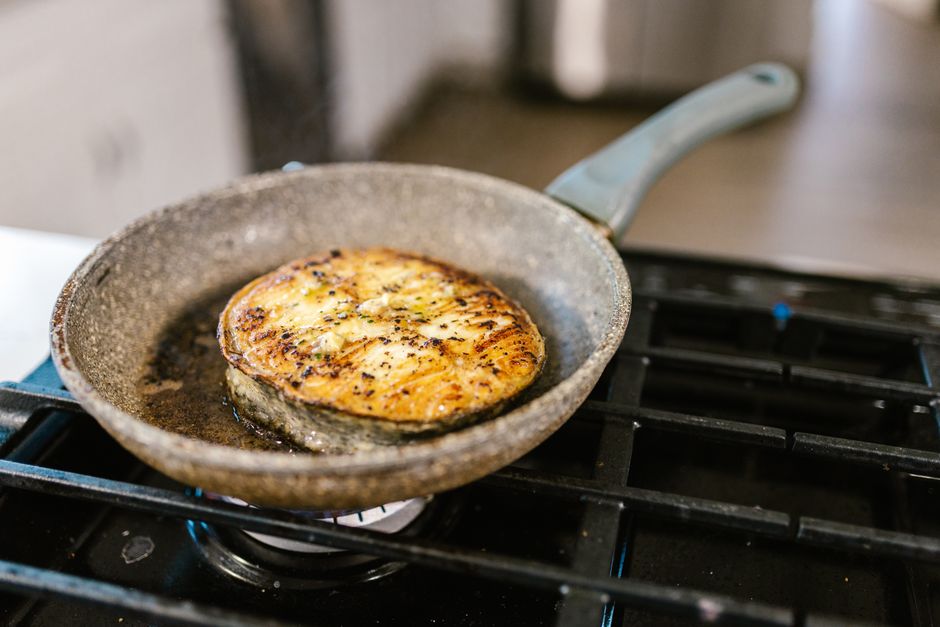
Cooked salmon should look opaque and pale pink to light orange all the way through, with no translucent or glossy raw patches in the center. The flesh separates into soft flakes when you press it with a fork, and the color turns lighter and more matte than it was raw. If the middle still looks shiny, wet, or deep orange-pink, it is undercooked.
That is the short answer. The longer answer involves a few details that matter — because salmon can look “done” on the outside and still be raw at the center, and because the safe internal temperature for salmon is lower than most people assume.
What Should Cooked Salmon Look Like When It Is Done?
Fully cooked salmon is opaque throughout. There is no see-through section, no jelly-like sheen, and no darker orange core that looks wetter than the rest of the fillet.
The color shifts noticeably during cooking. Raw farmed salmon is typically a deep pink-orange. As it cooks, the pigments that give salmon its color change structure, and the flesh turns a paler, softer pink. Wild sockeye, which starts a deeper red, usually finishes a lighter pinkish-red. The color change is one of the most reliable visual cues you have.
Texture matters just as much as color. Properly cooked salmon flakes apart along its natural muscle lines when you nudge it with a fork. The flakes stay moist but hold their shape. If the flesh mashes into a paste, it is overcooked. If it resists flaking and springs back like rubber, it is likely undercooked or the cut is very thick.
One detail worth knowing: a white substance often oozes out of salmon as it cooks. This is a protein called albumin, and it coagulates when heated. Seeing it does not mean the fish is bad or overcooked. It is normal, though more of it tends to appear when salmon is cooked quickly at high heat.
What Does Undercooked Salmon Look Like?
Undercooked salmon has a translucent, glossy center. The middle of the fillet looks wet and shiny rather than matte, and the color there is a deeper, more saturated orange-pink than the surrounding flesh.
You can often spot it before cutting in. If the thickest part of the fillet still looks slightly glassy, the heat has not reached the center. Pressing the fish with a finger can help too — undercooked salmon feels soft and squishy throughout, while cooked salmon feels firm but still yields slightly.
The tricky part is that salmon is often intentionally served medium or medium-rare, and that is a legitimate style in restaurants. The problem is that “medium-rare salmon” and “raw salmon” can look nearly identical to an untrained eye. The difference is temperature, not appearance alone.
This matters for food safety. The USDA recommends cooking fish to an internal temperature of 145°F (63°C) to kill parasites and bacteria. Some chefs and food scientists argue that salmon is safe at lower temperatures if it has been previously frozen, because freezing kills parasites. That is a real distinction, but it depends on whether the fish was commercially frozen and for how long — details a home cook usually cannot verify.
Does Color Alone Tell You Salmon Is Cooked?
No. Color is a useful clue, not a guarantee. Salmon can look pale on the outside while the center stays raw, especially with thick fillets or when cooking from a cold refrigerator.
Several things affect how cooked salmon looks:
- Thickness: A thin fillet cooks through fast and looks uniformly pale. A thick center-cut piece can look done at the edges while the middle stays translucent.
- Starting temperature: Fish straight from the fridge takes longer to cook through than fish that has sat at room temperature for a few minutes.
- Cooking method: Pan-searing browns the outside quickly, which can make the surface look more done than the interior actually is.
- Species and diet: Wild and farmed salmon differ in color, and farmed salmon color depends partly on what the fish were fed.
Because of all these variables, visual checks work best alongside a thermometer. An instant-read thermometer inserted into the thickest part of the fillet gives you a number instead of a guess.




What Internal Temperature Should Salmon Reach?
The USDA food safety guideline for fish is 145°F (63°C). At that temperature, salmon is fully opaque and flakes easily. Many people find it slightly dry at that point, which is why some cooks pull it earlier.
Here is the practical issue. Salmon continues to cook after you remove it from the heat — a phenomenon called carryover cooking. The internal temperature can rise several more degrees while the fish rests. If you pull salmon at exactly 145°F, it may end up noticeably higher by the time you eat it.
Some cooks aim for around 125°F to 135°F in the center and let it rest, producing a moister, slightly translucent middle. That approach is common in restaurants and in home cooking guides. It is also below the USDA’s recommended safety temperature. Whether that trade-off is acceptable depends on the fish’s source and how it was handled, and it is a decision each person makes for themselves.
What is not in dispute: if you want a clear, evidence-based answer on safety, 145°F is the number public health agencies use.
How Can You Tell Salmon Is Cooked Without a Thermometer?
You can get close with a few combined checks. No single one is foolproof, but together they are reliable.
Press the thickest part of the fillet with a fork or finger. Cooked salmon gives slightly and separates into flakes. Raw salmon feels soft and springs back. Then look at the center — if you can see any shine or translucency, keep cooking.
Another method: insert a thin knife into the thickest part and hold it there for a few seconds, then touch the blade to your lip. A warm blade suggests the interior is heated through. This is an old kitchen trick, not a laboratory test, but it works better than eyeballing the surface.
If the salmon is in a pan, look at the sides. As the fillet cooks, the color change moves upward from the bottom. When the pale, opaque color has climbed most of the way up the side, the center is usually close to done.
What Does Overcooked Salmon Look Like?
Overcooked salmon looks dry and chalky. The color turns uniformly pale, sometimes grayish-pink, and the flesh may crack or separate into distinct, tough chunks rather than soft flakes.
A lot of white albumin on the surface is another sign, though not a definitive one — it also appears with fast, high-heat cooking. The clearest indicator is texture. Overcooked salmon feels dense and fibrous, and it leaves a dry sensation in your mouth rather than a moist one.
The gap between perfectly cooked and overcooked salmon is narrow. Fish cooks faster than most meats because the muscle fibers are shorter and the connective tissue is different. A fillet that needs two more minutes can go from ideal to dry in that same window. Staying nearby and checking early is the simplest way to avoid it.
Frequently Asked Questions
Is it safe to eat salmon that is pink in the middle?
Salmon that is pink and translucent in the center is undercooked by USDA standards, which recommend 145°F. It may still be safe if the fish was commercially frozen, which kills parasites, but the bacterial safety risk is not eliminated by freezing alone.
How do I know when salmon is fully cooked?
Fully cooked salmon is opaque all the way through, flakes easily with a fork, and reaches 145°F at the thickest point. Any shiny or translucent center means it needs more time.
Why does cooked salmon turn white?
The white substance is a protein called albumin that coagulates when heated. It is normal and does not indicate the fish is spoiled or improperly cooked.
Can salmon look cooked but still be raw inside?
Yes. A browned or pale exterior can hide a raw center, especially in thick fillets or when cooking from cold. Checking the internal temperature is the only reliable way to be sure.
