
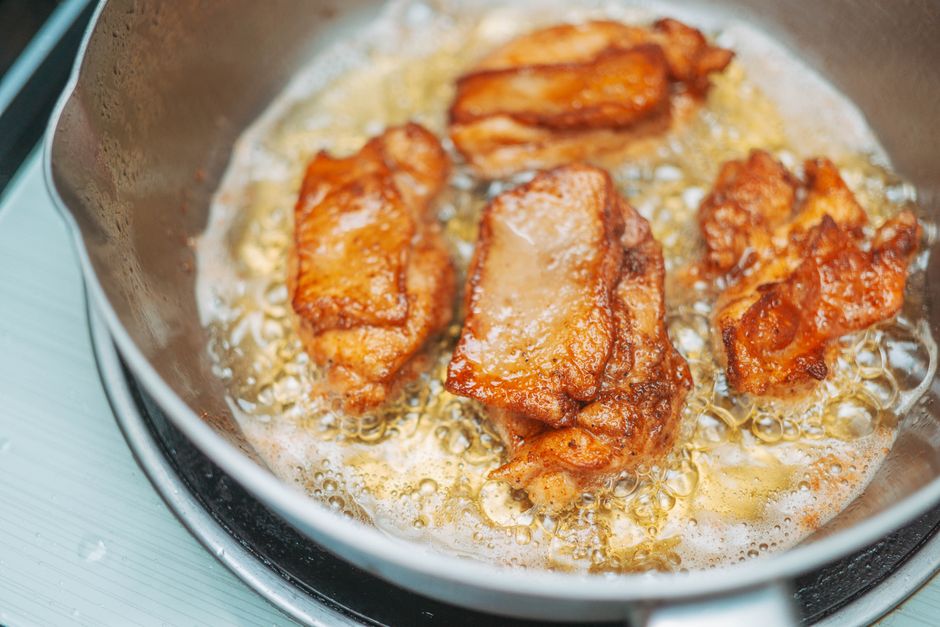
Chicken needs to reach an internal temperature of 165°F (74°C) to be safe to eat. That number comes from the USDA and applies to all chicken — breasts, thighs, wings, ground chicken, and leftovers. A food thermometer inserted into the thickest part of the meat is the only reliable way to confirm it.
What Internal Temperature Makes Chicken Safe to Eat?
165°F (74°C) is the temperature at which Salmonella and other harmful bacteria in chicken are killed quickly enough to be considered safe. The USDA Food Safety and Inspection Service sets this as the minimum internal temperature for all poultry.
The key word is internal temperature. The outside of a chicken breast can look browned and cooked while the center is still underdone. Color is not a reliable indicator. Neither is the firmness of the meat or whether the juices run clear. A thermometer is the only tool that tells you what is actually happening inside the meat.
Insert the probe into the thickest part of the meat, avoiding bone and fat. Bone conducts heat differently than muscle and can give you a false reading. For a whole chicken, check the thickest part of the thigh and the thickest part of the breast.
Why Is 165°F the Standard and Not Some Other Number?
Food safety is about time and temperature together, not temperature alone. Bacteria die faster at higher heat and slower at lower heat. At 165°F, the bacteria of concern in poultry are killed almost instantly — within seconds.
At lower temperatures, the same level of bacterial reduction can still be achieved, but it takes much longer. For example, holding chicken at a lower temperature for a sustained period can produce the same safety outcome. This is the principle behind sous vide cooking, where chicken can be safely cooked at temperatures below 165°F as long as it is held there long enough.
The 165°F figure is a practical standard because it works instantly. It does not require the cook to track time. For home cooks without specialized equipment, it is the simplest reliable target.
One thing worth understanding: 165°F is a safety threshold, not a culinary one. It tells you when the chicken is safe. It does not tell you when it tastes best. Those are two different questions.
Does White Meat Need a Different Temperature Than Dark Meat?
The safety temperature is the same for all parts of the chicken. White meat and dark meat both need to reach 165°F to be considered safe.
But white meat and dark meat have different textures and respond differently to heat. Chicken breast is lean and can become dry and stringy when cooked past 165°F. Dark meat — thighs and legs — contains more connective tissue and fat, which means it holds up better to longer cooking and higher temperatures.
This is why some cooks pull chicken breasts out of the oven right at 165°F while letting thighs go a bit higher. The safety minimum is identical. The preferred eating quality is not.
Ground chicken is a separate consideration. Because grinding mixes bacteria throughout the meat rather than leaving it on the surface, ground chicken must be cooked to 165°F all the way through with no pink areas. You cannot safely serve ground chicken patties medium-rare.
Can You Cook Chicken at a Lower Temperature Safely?
Yes, but only with controlled time and temperature. This is not something to guess at.
Bacteria reduction follows a predictable relationship between how hot the meat is and how long it stays at that temperature. Lower temperatures require longer holding times to achieve the same safety result. This is well established in food microbiology.
Sous vide cooking uses this principle. Chicken can be cooked at temperatures below 165°F when held at that temperature for a sufficient period. The exact time depends on the temperature. This requires precise equipment and reliable time tracking.
For stovetop, oven, grill, or air fryer cooking, there is no practical way to hold chicken at a lower temperature for a controlled duration. In those methods, 165°F remains the target.
If you are not using sous vide equipment with a calibrated circulator, cook chicken to 165°F. That is the honest guidance.
What Happens If You Eat Chicken That Is Not Fully Cooked?
Undercooked chicken can carry Salmonella, Campylobacter, and other bacteria that cause foodborne illness. These bacteria are common in raw poultry. The CDC estimates that Campylobacter and Salmonella are among the leading causes of bacterial foodborne illness in the United States.
Symptoms of foodborne illness from undercooked chicken typically include nausea, vomiting, diarrhea, and abdominal cramps. These can start within hours to a few days after eating, depending on the organism. Most healthy adults recover without treatment, but some cases can be severe.
Certain groups face higher risk of serious illness:
- Adults over 65
- Children under 5
- Pregnant women
- People with weakened immune systems
For these groups, a foodborne infection can lead to complications that require medical care. This is not a reason to panic. It is a reason to use a thermometer every time.
How Should You Measure Chicken Temperature Correctly?
Measuring temperature correctly matters as much as reaching the right number. A wrong reading gives false confidence.
Here is how to do it:
- Insert the thermometer probe into the thickest part of the meat.
- Avoid touching bone, fat, or the pan — these give inaccurate readings.
- For thin cuts like cutlets, insert the probe from the side into the center.
- For a whole chicken, check both the thigh and the breast.
- Wait for the reading to stabilize before removing the thermometer.
Instant-read thermometers are the most practical option for home cooking. They give a reading in a few seconds and are widely available. Dial thermometers can work but tend to be slower and less precise.
It also helps to let the chicken rest for a few minutes after removing it from heat. The internal temperature can continue to rise slightly during resting, which is called carryover cooking. This is not a substitute for reaching 165°F in the pan or oven — it is a small additional margin.
Does the Cooking Method Change the Target Temperature?
No. The target internal temperature is 165°F regardless of whether you are baking, grilling, frying, roasting, or using an air fryer. The method affects how long it takes to get there and how the meat turns out, but not the safety threshold.
What changes with cooking method is how evenly the heat distributes and how easy it is to overshoot or undershoot the target.
Grilling can create hot spots and uneven cooking, especially on bone-in pieces. Baking tends to be more even but can dry out lean cuts if left too long. Air frying circulates hot air quickly and can cook chicken faster than a conventional oven, so checking temperature earlier is wise.
The one constant is the thermometer. No matter the method, the number that matters is the same: 165°F.
Is 165°F Also the Right Temperature for Leftover Chicken?
Yes. Leftover chicken should be reheated to 165°F as well. This applies to leftover cooked chicken stored in the refrigerator, whether it is a whole piece, sliced, or part of a casserole or soup.
The USDA recommends reheating all leftovers to 165°F. For chicken specifically, this ensures that any bacteria that may have grown during storage are killed before you eat.
Leftover chicken should be refrigerated within two hours of cooking. If it sat out longer than that, the safest choice is to discard it. Reheating kills bacteria, but it does not destroy all toxins that bacteria may have already produced. This is an important distinction that many people miss.
Frequently Asked Questions
What temperature should chicken be cooked to?
Chicken should reach an internal temperature of 165°F (74°C) to be considered safe. This applies to all cuts, ground chicken, and leftovers.
Can you eat chicken at 160°F?
Chicken held at 160°F for a sustained period can be safe under controlled conditions like sous vide, but for normal cooking methods, 165°F is the reliable target. Without precise time and temperature control, 160°F is not considered safe.
How do you check if chicken is cooked without a thermometer?
You cannot reliably check chicken doneness without a thermometer — color, firmness, and juice clarity are not accurate indicators. An instant-read thermometer is the only dependable method.
Is it safe to eat slightly pink chicken?
Pink color alone does not mean chicken is undercooked, and white color does not mean it is safe. The only reliable measure is whether the internal temperature reached 165°F.
