
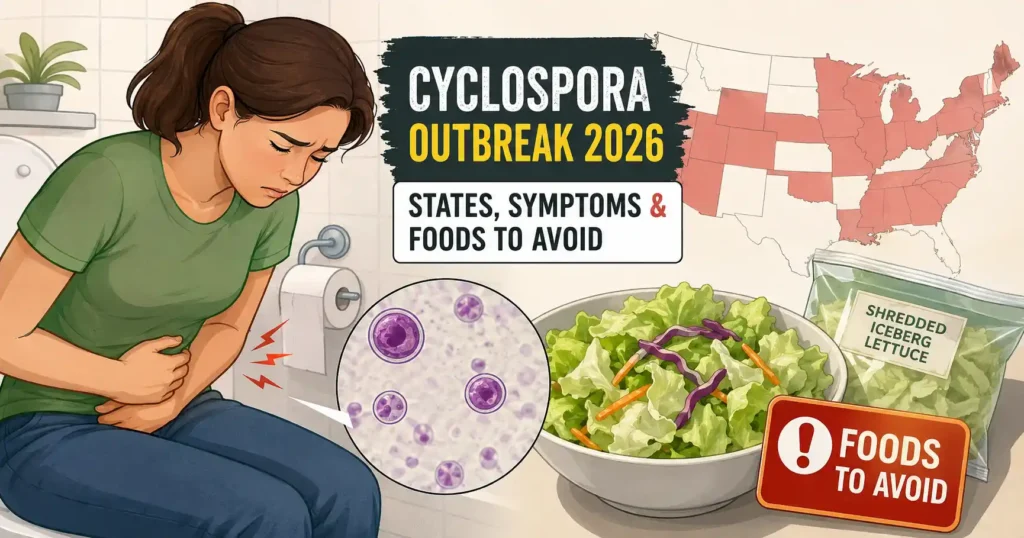
Cyclospora is a microscopic parasite that causes an intestinal illness called cyclosporiasis. In 2026, the United States is experiencing its largest cyclosporiasis outbreak on record, with more than 11,500 confirmed and probable cases reported across 41 states as of late July 2026.
Part of this surge — nearly 2,000 cases across 9 states — has been traced to shredded iceberg lettuce supplied by Taylor Farms de Mexico and served at Taco Bell locations, which triggered a nationwide recall on July 17, 2026. A separate, unrelated cluster of 72+ cases is also under federal investigation with no identified source yet.
What Is Cyclospora?
Cyclospora cayetanensis is a microscopic, single-celled parasite that infects the small intestine and causes an illness called cyclosporiasis. It is not a bacterium or a virus — it’s a parasite, which is part of why it behaves so differently from illnesses like E. coli or Salmonella.
Key facts:
- It spreads through food or water that has come into contact with human feces.
- It is common in tropical and subtropical regions with limited access to clean water and sanitation.
- In the U.S., most historical cases came from travel to endemic countries or from eating imported raw produce. Domestically grown produce is a much rarer source, though it has happened.
- Cyclosporiasis season in the U.S. typically runs from May through August.
Cyclospora Outbreak 2026 Data Sheet
| Metric | Figure |
|---|---|
| States with confirmed domestic cases | 41 states |
| National confirmed/probable cases (2026 season) | 11,500+ (some tallies exceed 12,000) |
| Comparison — total 2025 cases | ~2,700 |
| Comparison — typical yearly average | ~3,000 |
| Hospitalizations (national) | 300+ |
| Deaths reported | None |
| Cases tied to the Taylor Farms lettuce outbreak specifically | 1,947 across 9 states |
| Hospitalizations in the lettuce-linked outbreak | 98 |
| Second, unrelated FDA-tracked cluster | 72 cases, source unknown |
Why the numbers vary by source: Different organizations report different snapshots — CDC’s national surveillance total, the CDC’s lettuce-specific outbreak count, and state health department tallies are all separate figures updated on different days. For the most current number, always check the CDC’s official Cyclospora outbreak page, which is being updated in real time.
Which States Are Affected?
41 states have reported at least one domestically acquired cyclosporiasis case in 2026. Officials note that California and New Jersey, despite reporting cases, say their numbers are within a typical seasonal range.
The 9 states officially linked to the Taylor Farms iceberg lettuce outbreak are:
- Illinois
- Indiana
- Kansas
- Kentucky
- Michigan
- Ohio
- Oklahoma
- Pennsylvania
- West Virginia
States reporting notably high case counts outside the confirmed lettuce outbreak (as of mid-to-late July 2026) include:
- Ohio — 1,274 cases in 2026
- New York — 600+ cases since May
- North Carolina — 500+ cases since May
- Illinois — 277 cases (23 hospitalizations)
- Indiana — 206+ cases since May 1
Officials caution that the true number of infections nationwide is almost certainly higher than reported, because many people recover without seeking medical care and are never tested.
(See the map on the CDC’s official case locations page for the latest state-by-state breakdown.)


Outbreak Timeline
- May 2026: Cyclosporiasis cases begin climbing above normal seasonal levels, especially in Michigan and the Midwest.
- Early–Mid July 2026: FDA and CDC trace a cluster of illnesses to shredded iceberg lettuce served at Taco Bell locations in 5 states (Michigan, Ohio, Indiana, Kentucky, West Virginia).
- July 17, 2026: Taylor Farms de México voluntarily recalls all iceberg lettuce sourced from central Mexico.
- July 18–19, 2026: An initial lab test reportedly detects Cyclospora on a lettuce sample; the FDA later confirms this result was a false positive. No product sample has since tested positive.
- July 22–23, 2026: FDA announces a second, separate Cyclospora outbreak involving 72 people, source unidentified.
- July 24, 2026: CDC expands the lettuce-linked outbreak from 5 to 9 states, adding Illinois, Kansas, Oklahoma, and Pennsylvania. Case count reaches 1,947.
- July 27–28, 2026: National case count surpasses 11,500 across 41 states; investigations continue on multiple fronts.
The Taylor Farms Iceberg Lettuce Recall
What was recalled?
On July 17, 2026, Taylor Farms de Mexico (based in Guanajuato, Mexico) voluntarily pulled all iceberg lettuce sourced from central Mexico from the U.S. market, “out of an abundance of caution.”
What products does this include?
Most of the recalled lettuce went to food-service distributors (including Taco Bell restaurants). Only two consumer retail products were affected, sold at Walmart under the Marketside brand:
- Marketside Iceberg Salad — 12 oz. and 24 oz.
- Marketside Shredded Lettuce — 8 oz. and 16 oz.
- Best if Used By dates: July 18, 2026 – August 3, 2026
Important: No Taylor Farms-branded retail products are part of this recall.
Where was it distributed?
The recalled lettuce was shipped between June 29 and July 16, 2026, to at least 27 states: Alabama, Arkansas, Connecticut, Florida, Georgia, Iowa, Illinois, Indiana, Kansas, Kentucky, Louisiana, Massachusetts, Maryland, Michigan, Missouri, Mississippi, North Carolina, New Hampshire, New Jersey, Ohio, Oklahoma, Pennsylvania, South Carolina, Tennessee, Texas, Virginia, and Wisconsin.
What should you do if you have it?
- Do not eat it.
- Throw it away, or return it to the place of purchase for a refund.
- Clean and sanitize any containers or surfaces the lettuce touched.
What has Taylor Farms done since the recall?
- Suspended all iceberg lettuce sourcing and production from central Mexico for the rest of the growing season.
- Temporarily suspended all production at its central Mexico facility (as of July 18, 2026) pending an independent food-safety review.
- As of July 24, 2026, the company states there are still no confirmed-positive product test results for Cyclospora, even though it remains linked to the outbreak through epidemiological (interview-based) evidence.
(Full recall notice: FDA Cyclospora Outbreak Investigation and Taylor Farms’ official statement.)
Is This the Only Outbreak?
No. It’s important to understand that 2026 involves multiple, separate cyclospora outbreaks happening at the same time, not one single event:
- The Taylor Farms/Taco Bell iceberg lettuce outbreak — 1,947 cases across 9 states, the only cluster with an identified likely source so far.
- A second FDA-tracked outbreak — 72 cases, location and food source not yet disclosed (as of late July 2026), officially separate from the lettuce cluster.
- Several smaller clusters — the FDA’s public outbreak table lists additional Cyclospora investigations (some involving fewer than 10 cases), a few of which have already been marked as resolved.
- The broader national total (41 states, 11,500+ cases) includes all of the above plus thousands of cases not yet tied to any specific confirmed outbreak.
This is one reason officials repeatedly stress that there is currently no evidence supporting a blanket avoidance of fruits and vegetables — the recall applies to a specific product from a specific supplier, not produce in general.
Symptoms of Cyclosporiasis
Symptoms typically begin about one week after exposure, though the range can be anywhere from 2 days to 2 weeks or more.
Common symptoms include:
- Watery diarrhea (often described as frequent, and sometimes “explosive”)
- Loss of appetite
- Unintended weight loss
- Stomach/abdominal cramping
- Bloating
- Nausea
- Fatigue
Less commonly, people may also experience low-grade fever and vomiting.
Without treatment, symptoms can last for several weeks and, in some cases, up to a month, and may go away and come back (relapse).
How Does Cyclospora Spread?
- Cyclospora spreads when people eat food or drink water that has been contaminated with human feces containing the parasite.
- It most commonly enters the food supply through contaminated irrigation or wash water used on fresh produce.
- It does not spread directly from person to person — you cannot catch it just by being near or caring for someone who is infected, and it’s unlikely to spread through routine food handling.
- Historically implicated foods include: fresh raspberries, basil, cilantro, green onions, snow peas, lettuce and other leafy greens, and mesclun/salad mixes.
How Is Cyclospora Diagnosed?
This is one of the trickiest parts of managing a Cyclospora outbreak: routine stool/GI tests do not automatically screen for Cyclospora. A doctor or lab must specifically order a Cyclospora test (often called an ova and parasite exam with special staining) for it to be detected.
Diagnosis is also complicated because:
- The long incubation period (up to 2 weeks) means people often can’t clearly remember what they ate before symptoms started.
- Unlike bacteria such as E. coli or Salmonella, Cyclospora cannot currently be analyzed using whole-genome sequencing, which makes it much harder for investigators to conclusively link cases to one specific product.
If you have persistent watery diarrhea lasting more than a few days — especially if you recently ate iceberg lettuce, ate at Taco Bell in an affected state, or traveled to a region where Cyclospora is common — tell your doctor and specifically ask about Cyclospora testing.
How Is Cyclospora Treated?
- The standard treatment is a prescription antibiotic called trimethoprim-sulfamethoxazole (TMP-SMX), sold under brand names like Bactrim or Septra.
- There is currently no equally effective alternative for patients who are allergic to sulfa drugs, according to the CDC.
- Most people recover fully with appropriate treatment. Without it, the illness can drag on for weeks or longer.
- As with any prolonged diarrheal illness, staying hydrated is important — seek medical care promptly if you notice signs of dehydration (dizziness, very dark urine, reduced urination).
Foods to Avoid vs. Safe Foods
Currently under recall / avoid:
- Any iceberg lettuce or shredded lettuce from Taylor Farms de Mexico, especially Walmart Marketside Iceberg Salad or Shredded Lettuce with Best-If-Used-By dates between July 18 and August 3, 2026.
Historically higher-risk foods (not necessarily linked to this specific outbreak, but linked to past Cyclospora outbreaks):
- Fresh raspberries
- Basil and cilantro
- Green onions
- Snow peas
- Pre-packaged lettuce, mesclun, and salad mixes
- Occasionally: blackberries, watercress, mango, and vegetable trays
Considered safe:
- Frozen fruits and vegetables — freezing is not known to preserve the parasite in a way that causes illness in these outbreak contexts, and frozen produce has not been implicated.
- Cooked produce heated to at least 158°F (70°C) — this temperature kills Cyclospora.
- Produce grown in a home garden, as long as it hasn’t been in contact with contaminated water or human waste.
- Fruits and vegetables in general — health officials are explicit that there is no current evidence supporting avoidance of produce as a category. The concern is specific to the recalled lettuce and other unidentified contaminated batches, not fresh produce overall.
How to Prevent Cyclospora Infection
Because Cyclospora is resistant to routine washing and chemical sanitizers, prevention focuses on food-handling basics and awareness of recalls:
- Wash your hands with soap and water before and after handling or preparing raw fruits and vegetables.
- Wash all fresh produce thoroughly under running water before eating, cutting, or cooking it — even if it’s labeled “pre-washed” (in that case, you don’t need to re-wash it).
- Scrub firm produce like melons and cucumbers with a clean produce brush.
- Cut away any bruised or damaged areas before eating or preparing produce.
- Refrigerate cut, peeled, or cooked produce within 2 hours.
- Cook produce to 158°F (70°C) or higher when possible — this is the one method proven to kill the parasite.
- Understand that washing alone cannot guarantee removal of Cyclospora, particularly from leafy greens, herbs, and delicate berries.
- If traveling to a tropical or subtropical country where Cyclospora is common, avoid raw, unpeeled produce and don’t drink untreated/unfiltered water.
- Stay alert to food recalls — check the FDA’s recall page regularly during outbreak season (May–August).
Frequently Asked Questions
What is causing the 2026 Cyclospora outbreak?
Part of the surge has been traced to shredded iceberg lettuce from Taylor Farms de Mexico, served at Taco Bell locations in 9 states. However, thousands of other cases across 41 states — including a separate 72-case cluster — have not yet been linked to a confirmed source, so more than one cause is likely at play.
How many states are affected by the Cyclospora outbreak in 2026?
At least 41 U.S. states have reported domestically acquired cyclosporiasis cases as of late July 2026.
Is it safe to eat lettuce right now?
Only the specific recalled Taylor Farms de Mexico iceberg lettuce (including Walmart Marketside Iceberg Salad/Shredded Lettuce, Best-If-Used-By 7/18–8/3/2026) should be avoided. Health officials say there is no evidence supporting avoidance of lettuce or produce in general.
Is Taco Bell safe to eat at now?
Taco Bell removed the implicated Taylor Farms lettuce from its restaurants and supply chain after the recall. As of the latest updates, the company has taken corrective action, though the investigation into the broader outbreak remains ongoing.
Is Cyclospora contagious? Can I catch it from another person?
No. Cyclospora spreads through contaminated food or water, not through person-to-person contact.
What are the main symptoms of Cyclospora infection?
Watery diarrhea (sometimes described as “explosive”), stomach cramps, bloating, nausea, fatigue, loss of appetite, and weight loss. Symptoms usually start about a week after exposure.
How long does Cyclospora last?
Without treatment, symptoms can last for several weeks, and in some cases up to a month, with possible relapses. Treatment with antibiotics generally shortens the illness.
How is Cyclospora treated?
With the prescription antibiotic trimethoprim-sulfamethoxazole (TMP-SMX). There’s currently no strong alternative for people allergic to sulfa drugs.
How do you get tested for Cyclospora?
You need a stool test that specifically screens for Cyclospora — it is not included in standard gastrointestinal test panels, so you must ask your doctor to request it directly.
Does washing lettuce remove Cyclospora?
Washing helps but cannot guarantee full removal, especially from leafy greens and herbs. Cooking produce to 158°F (70°C) or higher is the only method confirmed to kill the parasite.
Has anyone died from the 2026 Cyclospora outbreak?
As of the most recent reporting (late July 2026), no deaths have been reported, though hundreds of hospitalizations have occurred nationwide.
What is the difference between this and a typical foodborne illness like E. coli or Salmonella?
Cyclospora is a parasite, not a bacterium. It has a much longer incubation period (up to two weeks), cannot be traced using the same whole-genome-sequencing tools used for bacterial outbreaks, and is not part of routine stool testing — all of which make it significantly harder and slower to investigate.
Sources
- CDC — Cyclospora Outbreak Investigation, July 2026
- CDC — Cyclospora Outbreak Case Locations Map
- CDC — Preventing Cyclosporiasis
- CDC — Cyclosporiasis Surveillance Data
- FDA — Investigation of 9-State Outbreak of Cyclospora Illnesses (Iceberg Lettuce)
- FDA — All Active Foodborne Illness Outbreak Investigations
- Taylor Farms — Official Statement on the Cyclospora Outbreak
- CNN — Tracking the Largest Cyclosporiasis Outbreak in the US
- Consumer Reports — Cyclospora-Linked Lettuce Reached 28 States
This article is for general information only and is not a substitute for medical advice. If you’re experiencing persistent diarrhea or other symptoms of cyclosporiasis, contact a healthcare provider.
