
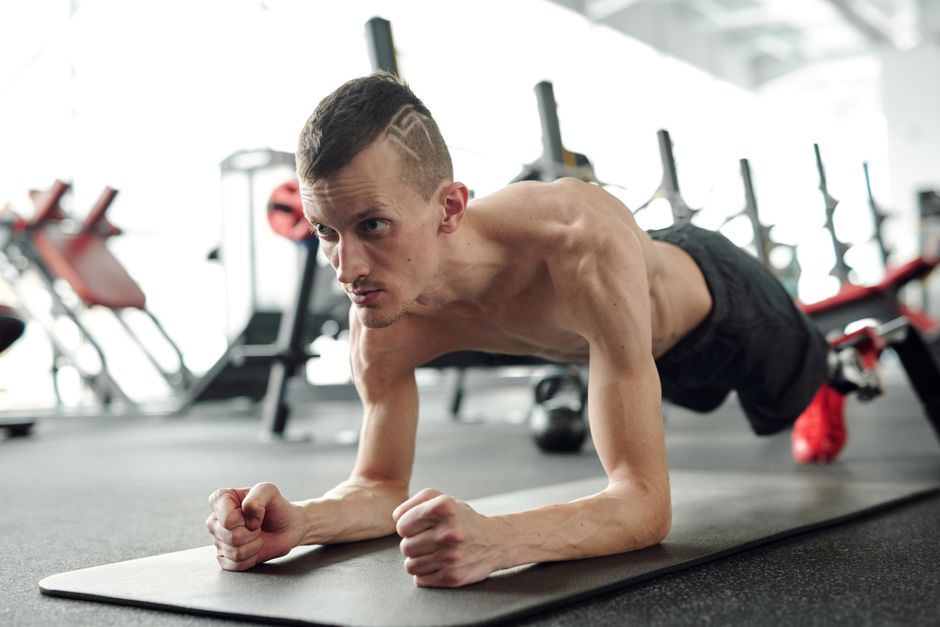
Planks are one of the most effective bodyweight exercises for building core strength, but they are not a magic bullet for visible six-pack abs. They build the deep abdominal muscles that stabilize your spine and improve posture, yet they do little to burn the layer of fat covering your abdominal wall. To get visible abs, you need to combine planks with a calorie-controlled diet and exercises that work the entire body.
What Muscles Do Planks Actually Work?
Planks primarily target the transversus abdominis, the deepest layer of your abdominal wall. This muscle wraps around your torso like a corset. When it contracts, it compresses your internal organs and stabilizes your spine and pelvis.
The exercise also engages the rectus abdominis (the “six-pack” muscle), the obliques on the sides of your waist, and the muscles of your lower back, hips, shoulders, and glutes. A standard front plank is an isometric exercise, meaning the muscle contracts but the joint angle does not change. You hold a position rather than moving through a range of motion.
Because the plank requires your entire body to stay rigid, it trains your core to work as a single unit. This is why it is so valuable for everyday movements and for protecting your lower back during activities like lifting, running, and even sitting for long periods.
Do Planks Burn Belly Fat?
No exercise specifically burns fat from the area you are working. This concept is called “spot reduction,” and research has consistently shown it does not work. When you exercise, your body draws energy from fat stores throughout your body, not just from the muscles being used.
Planks burn calories, but not many compared to other exercises. Holding a plank for one minute might burn a handful of calories, while a brisk 30-minute walk or a session of jumping jacks burns significantly more. To reduce belly fat, you need to create a calorie deficit, which means burning more calories than you consume.
Visible abs require a low enough body fat percentage that the abdominal muscles show through the skin. For most people, this requires dietary changes more than any specific exercise. The phrase “abs are made in the kitchen” is an oversimplification, but the underlying message is accurate. You cannot out-exercise a diet that provides more calories than your body needs.
Are Planks Better Than Crunches?
Planks and crunches work the core differently, and neither is universally “better.” They serve different purposes.
Crunches are a dynamic exercise that primarily targets the rectus abdominis. They involve spinal flexion, which means curling your torso toward your pelvis. Crunches can be effective for building the visible six-pack muscles, but they place repeated stress on the spine and can aggravate lower back issues if performed with poor form.
Planks train stability rather than movement. They teach your core to resist extension, which is how your spine actually needs to function during most daily activities. A strong plank translates to better posture, reduced back pain risk, and improved performance in sports and lifting.
For most people, a balanced core routine includes both types of exercise. Include planks for stability and crunches or other flexion exercises for the superficial abdominal muscles. If you have back problems, planks are generally the safer choice because they do not involve repeated spinal flexion.



How Long Should You Hold a Plank?
Holding a plank for two minutes is a common fitness benchmark, but research does not support extremely long holds for most people. Studies have found that after about 60 seconds, the additional benefit of holding a plank diminishes significantly. The quality of the hold matters more than the duration.
Aim for three to five sets of 30 to 60 seconds each with proper form. If you can hold a plank for 60 seconds with perfect alignment, you are getting the core stability benefit. Holding for five or ten minutes does not build more muscle; it simply tests endurance.
If you want a greater challenge, add variation rather than extending the time. Try a side plank, a plank with leg lifts, or a plank on an unstable surface like a balance board. These variations increase the demand on your obliques and other stabilizer muscles without requiring a marathon hold.
Common Plank Mistakes That Reduce Effectiveness
Form is everything with planks. A sloppy plank is not just less effective; it can strain your lower back and shoulders.
The most common mistake is letting your hips sag toward the floor. This happens when your core and glutes fatigue, and it places excessive compression on the lumbar spine. The fix is to end the set before your hips drop, not to push through the discomfort.
- Sagging hips: Your body should form a straight line from head to heels. If your hips drop, your lower back takes the load.
- Piking hips upward: Pushing your hips too high shifts the work away from your core and onto your shoulders.
- Dropping your head: Your neck should stay neutral, with your gaze at the floor. Dropping your head strains the cervical spine.
- Holding your breath: Breathe steadily throughout the hold. Holding your breath spikes blood pressure and reduces the oxygen available to your muscles.
- Flaring your elbows: Keep your elbows directly under your shoulders. Flaring them out stresses the shoulder joint.
If you cannot maintain perfect alignment, drop to your knees or shorten the hold. A 20-second perfect plank is more valuable than a 60-second sloppy one.
Can Planks Cause Injury?
Planks are generally safe for healthy individuals, but they are not risk-free. The most common injuries involve the lower back, shoulders, and wrists.
People with pre-existing shoulder problems may find planks painful because the position requires significant shoulder stability. Wrist pain is also common, especially for people who spend hours typing or have weak wrist extensors. If your wrists hurt during a forearm plank, try performing the exercise on your fists or use push-up handles to keep your wrists neutral.
People with herniated discs or significant lower back conditions should consult a healthcare provider before adding planks to their routine. While planks are often prescribed as part of back rehabilitation, the position can aggravate certain spinal conditions. This is not a reason to avoid planks entirely, but it is a reason to get individual guidance.
Pregnant women should be cautious with planks, especially in the later stages of pregnancy. The abdominal muscles stretch and separate during pregnancy, a condition called diastasis recti. Some clinicians recommend avoiding traditional planks during pregnancy and the postpartum period, but there is no universal guideline. If you are pregnant or recently gave birth, talk to your doctor or a pelvic health physical therapist before doing core work.
What Is the Best Way to Build Visible Abs?
Visible abs require two things: developed abdominal muscles and a low body fat percentage. Planks build the muscles, but they do little for the fat layer.
To lower body fat, you need a sustainable calorie deficit. This means eating slightly fewer calories than your body burns each day. The deficit does not need to be extreme. A modest reduction of 300 to 500 calories per day typically leads to steady fat loss without sacrificing muscle mass.
Protein intake matters for preserving muscle while losing fat. Most research suggests that people who are actively losing weight benefit from a higher protein intake than the general recommendation. This is a general guideline, not a prescription. Individual needs vary based on body size, activity level, and overall health.
Cardiovascular exercise and full-body strength training support fat loss by increasing your daily calorie expenditure. Planks can be part of this routine, but they should not be your only exercise. A balanced program that includes squats, deadlifts, push-ups, rows, and some form of cardio will build more muscle and burn more calories than planks alone.
Genetics also play a role. Some people store more fat in their midsection than others, and the rate at which you lose belly fat depends partly on factors you cannot control. This is not an excuse to give up; it is a reason to focus on what you can control, which is consistent training and a sensible diet.
Frequently Asked Questions
How often should I do planks?
Three to four times per week is sufficient for building core strength. Your core muscles need recovery time just like any other muscle group.
Will planks give me a six-pack?
Planks build the deep core muscles, but visible six-pack abs depend on having a low body fat percentage. You need both core training and a calorie-controlled diet to see results.
Are planks safe for people with back pain?
Planks are often recommended for back pain because they strengthen the muscles that support the spine, but some spinal conditions can be aggravated by the position. Consult a healthcare provider if you have a diagnosed back condition.
What is better: planks or sit-ups?
Planks are safer for the spine and better for overall core stability. Sit-ups target the rectus abdominis more directly but place repeated stress on the lower back.
