
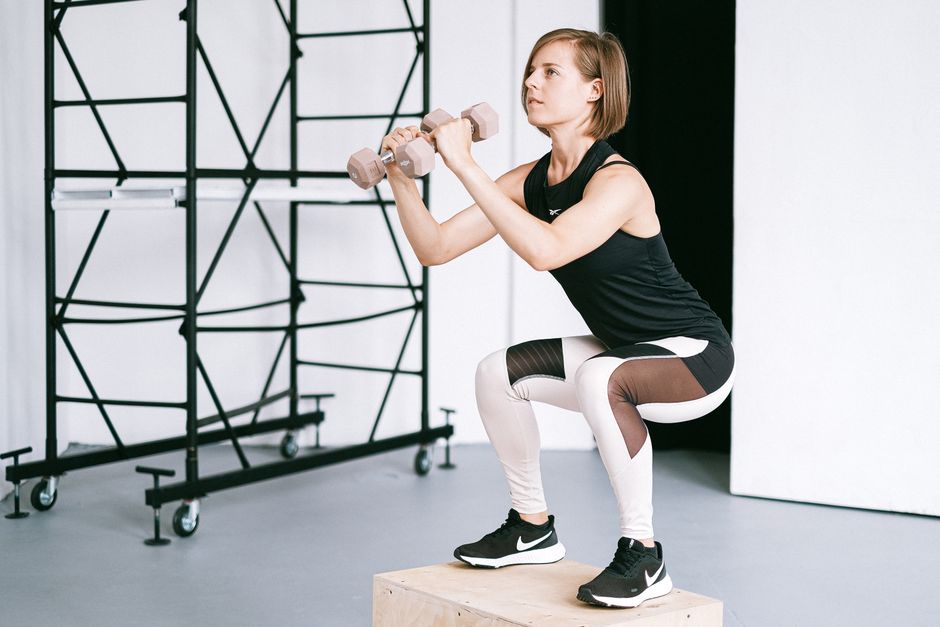
The Bulgarian split squat is a single-leg exercise where your back foot rests on an elevated surface behind you—like a bench or a chair—while your front leg does most of the work. You lower your body straight down until your front thigh is roughly parallel to the floor, then push back up through your front heel. It is a demanding lower-body movement that builds strength and stability in the quadriceps, glutes, and hamstrings, one leg at a time.
What Is A Bulgarian Split Squat and How Does It Differ From a Regular Lunge?
The Bulgarian split squat is often confused with a lunge, but they are not the same movement. In a standard lunge, you step forward or backward, and both feet remain on the ground throughout the motion. In the Bulgarian split squat, your rear foot is fixed on an elevated surface. This changes your center of gravity and forces your front leg to handle nearly all of the workload.
Because your back foot is elevated, your front leg’s range of motion increases. You can lower your hips deeper than you typically can in a lunge. This deeper position places a strong stretch on the front thigh muscles and the glutes, which is one reason the exercise is so effective for building leg strength.
The movement also demands more balance than a standard squat. Your front foot is the only point of contact with the ground, so your core and hip stabilizers must work continuously to keep you steady. Over time, this improves coordination and single-leg control, which carries over to everyday activities like climbing stairs or walking on uneven ground.
Which Muscles Does the Bulgarian Split Squat Work?
The Bulgarian split squat primarily targets the quadriceps, which are the four muscles on the front of your thigh. The front leg’s quadriceps control the lowering phase and drive the upward push. This makes the exercise one of the most effective movements for quad development without using a barbell.
The gluteus maximus on the front leg also works hard. As you push your hips forward and upward at the top of the movement, the glutes contract forcefully. The hamstrings on the front leg assist in controlling the descent and stabilizing the knee.
Your rear leg plays a different role. Its hip flexors are stretched in the bottom position, and its quadriceps and glutes provide some support, but it does not produce the main force. Your core muscles, including the obliques and transverse abdominis, activate to prevent your torso from twisting or leaning sideways.
This muscle pattern makes the Bulgarian split squat a compound exercise. It works multiple joints—hip, knee, and ankle—at the same time. Compound movements are generally more efficient for building strength than isolation exercises because they recruit more muscle tissue per rep.
What Are the Main Benefits of the Bulgarian Split Squat?
The most obvious benefit is strength. Because each leg works independently, you cannot rely on your stronger side to compensate for your weaker side. Many people have a noticeable strength imbalance between their left and right legs without realizing it. This exercise exposes that imbalance directly, allowing you to correct it over time.
Single-leg training also improves balance and joint stability. Your ankle, knee, and hip must work together to keep your body aligned through the movement. Research consistently shows that unilateral training—exercises done one leg at a time—improves balance more effectively than bilateral training like the back squat.
The Bulgarian split squat is also practical for people with lower back sensitivity. Because you are not loading a barbell across your shoulders, your spine experiences less compressive force. Many lifters find they can train their legs hard with this movement when traditional back squats cause discomfort.
The exercise requires minimal equipment. A bench, a sturdy chair, or even a low step is enough. This makes it an excellent choice for home workouts, hotel gyms, or any setting where a full squat rack is not available.


How Do You Perform the Bulgarian Split Squat With Correct Form?
Start by standing about two feet in front of a bench or chair, facing away from it. Place the top of your rear foot on the bench behind you. Your front foot should be far enough forward that your shin is nearly vertical when you lower into the bottom position. Adjust your stance until you find a position where you can descend without your knee traveling far past your toes.
Keep your torso upright and your chest proud. Brace your core as if you are about to be lightly punched in the stomach. Begin the movement by bending your front knee and lowering your hips straight down. Your rear knee should bend naturally and travel toward the floor. Lower yourself until your front thigh is parallel to the ground, or as deep as your mobility comfortably allows.
Pause briefly at the bottom, then push through your front foot’s heel to return to the starting position. Do not push off the floor with your rear foot. The rear leg is only there for balance, not for power. Exhale as you push up, and keep your weight distributed through the middle and heel of your front foot.
Common mistakes include leaning too far forward, letting the front knee cave inward, and placing the front foot too close to the bench. Leaning forward shifts work from the quads to the glutes and increases strain on the lower back. A knee that caves inward places unnecessary stress on the knee joint. If your front foot is too close, your knee will travel too far forward, which can cause discomfort.
Start with just your body weight to learn the pattern. Once you can perform three sets of ten reps on each leg with steady balance, you can add weight. Hold a dumbbell in each hand at your sides, or hold one dumbbell against your chest. Keep the weight moderate and prioritize control over load.
What Is the Difference Between the Bulgarian Split Squat and the Rear-Foot-Elevated Split Squat?
They are the same exercise. The terms are used interchangeably in fitness settings. “Bulgarian split squat” is the common name, and “rear-foot-elevated split squat” is the descriptive technical name. Some coaches prefer the technical name because it describes exactly what the movement involves. You will see both terms used in workout programs, and they refer to the identical movement pattern.
The name “Bulgarian” is commonly attributed to Bulgarian weightlifting coaches who used the exercise to develop leg strength in their athletes. The historical record is not entirely clear on the exact origin, but the association with Bulgarian training methods is widely accepted in strength coaching circles.
How Often Should You Do Bulgarian Split Squats?
Most people benefit from performing the Bulgarian split squat one to two times per week. Because the exercise is demanding, your muscles need time to recover and grow. Training the same muscle group more than twice per week with high intensity can lead to excessive soreness and reduced performance over time.
If your goal is general strength and muscle growth, two sessions per week with two to three working sets per leg is a reasonable starting point. Each set should be challenging but not to the point of complete failure. Leave one to two reps in reserve on most sets.
If you are new to the movement, begin with one session per week for the first two to three weeks. This allows your joints, tendons, and nervous system to adapt to the new demands. You can progress to two sessions per week once the movement feels smooth and controlled.
Muscle soreness is common when you first start, especially in the glutes and front thighs. This is normal and typically peaks about 48 hours after exercise. If soreness interferes with your daily activities, reduce the volume or intensity in your next session.
Are There Any Risks or Precautions to Consider?
The Bulgarian split squat is generally safe for healthy individuals, but it is not without risk. The most common issues involve the knee and the hip. If you have a history of knee pain, particularly around the kneecap, you should approach this exercise with caution. The deep knee bend can aggravate certain knee conditions.
Ankle mobility is another limiting factor. The front ankle must dorsiflex—bend upward—sufficiently to allow the knee to travel forward over the foot. If your ankle mobility is limited, you may compensate by leaning forward or lifting your heel. Both compensations reduce the exercise’s effectiveness and increase injury risk.
If you feel sharp pain in the front of your knee, the back of your knee, or your hip joint during the movement, stop. Mild muscle fatigue is expected. Sharp or pinching pain is not normal. Consider reducing your range of motion or having your form assessed by a qualified professional.
Pregnant individuals should consult their healthcare provider before performing this exercise, particularly in the later stages of pregnancy. The balance demands and deep single-leg positioning may not be appropriate as the center of gravity shifts. No clinical guidelines currently exist specifically for this exercise during pregnancy, so individual medical advice is essential.
How Does the Bulgarian Split Squat Compare to Other Leg Exercises?
The Bulgarian split squat is often compared to the back squat, front squat, and walking lunge. Each exercise has strengths, and the best choice depends on your goals and circumstances.
- Back squat: Allows you to load the heaviest weight and build total lower-body mass. Requires a barbell, a rack, and adequate mobility in the hips and ankles.
- Front squat: Emphasizes the quads more than the back squat and places less stress on the lower back. Requires significant wrist and shoulder mobility to hold the bar.
- Walking lunge: Improves dynamic balance and coordination. Less stable than the Bulgarian split squat, which means you cannot load it as heavily.
- Leg press: Provides stable, isolated quad work. Does not challenge balance or core stability.
For most people, the Bulgarian split squat is not a replacement for the back squat. It is a complement. Many strength programs include both movements—a bilateral squat for heavy loading and the Bulgarian split squat for unilateral strength and balance. If you can only choose one leg exercise for a home workout, the Bulgarian split squat is a strong choice because of its minimal equipment needs and high muscle activation.
Frequently Asked Questions
How deep should I go in a Bulgarian split squat?
Lower yourself until your front thigh is parallel to the floor or slightly below if your mobility allows. Going deeper than parallel increases glute activation but requires good hip and ankle mobility to do safely.
Is the Bulgarian split squat harder than a regular squat?
Yes, because each leg works independently, so your entire body weight plus any added load is supported by a single front leg. This makes it more demanding on balance and stability than a bilateral squat with the same external weight.
Can I do Bulgarian split squats every day?
Training the same muscles daily does not allow adequate recovery and increases injury risk. One to two sessions per week is enough to build strength and muscle.
What weight should I start with for Bulgarian split squats?
Start with body weight only until you can perform three sets of ten controlled reps on each leg. Then add light dumbbells, beginning with five to ten pounds per hand, and increase gradually as strength improves.
