
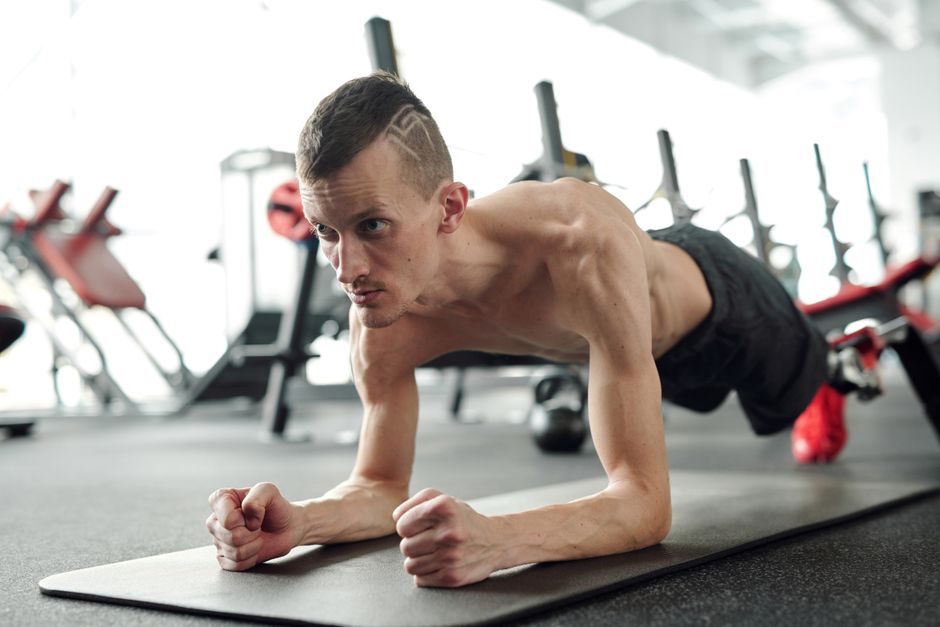
Planks are one of the most popular core exercises in the world, and for good reason. Yes, planks build abdominal muscle and strength, but they do not work the same way crunches do. If your goal is a visible six-pack, planks alone will not get you there because no exercise can spot-reduce belly fat. Planks build the muscle underneath, but your diet determines whether that muscle becomes visible.
Do Planks Build Abs?
Planks build the muscles of your core, including the rectus abdominis — the “six-pack” muscle. However, they primarily work the deeper core stabilizers like the transverse abdominis and the obliques. The rectus abdominis gets activated, but not through the shortening contraction that crunches provide. Planks create tension through isometric contraction, meaning the muscle works hard without changing length.
Research using electromyography (EMG) consistently shows planks activate the core muscles effectively. Studies have found that the standard forearm plank produces strong activation in the transverse abdominis and internal obliques. The rectus abdominis activation is moderate compared to exercises like the crunch or hanging leg raise.
So the direct answer is yes — planks build abdominal muscle and core endurance. But they build a specific type of strength. You will develop a solid, stable midsection that supports your spine and improves posture. You may not develop the thick, blocky six-pack that heavy, loaded flexion exercises produce.
What Muscles Do Planks Actually Work?
The plank is a full-core exercise, not just an ab exercise. Understanding exactly which muscles fire helps you know what to expect from the movement.
- Transverse abdominis — the deepest abdominal layer, wraps around your torso like a corset. This is the primary muscle worked in a plank.
- Rectus abdominis — the superficial six-pack muscle. It works isometrically to prevent your hips from sagging.
- Internal and external obliques — the muscles on the sides of your waist that resist rotation and keep your pelvis stable.
- Erector spinae — the muscles along your spine that keep your torso straight.
- Glutes and quadriceps — these fire to keep your legs straight and your body in alignment.
- Shoulders and serratus anterior — your arms and shoulder blades work to support your upper body weight.
Because the plank works so many muscles at once, it is an efficient exercise. A single plank holds more total muscular demand than a single crunch. But that demand is spread across many muscles, so the abdominal muscles receive less focused work than they would in a dedicated ab exercise.
Planks vs. Crunches: Which Builds More Visible Abs?
Crunches and other spinal flexion exercises build the rectus abdominis more directly. When you curl your ribcage toward your pelvis, you shorten the six-pack muscle through a full range of motion. This repeated shortening and lengthening stimulates muscle growth in that specific muscle.
Planks do not shorten the rectus abdominis. They hold it in a fixed position under tension. Isometric training does build muscle, but research suggests it builds strength and endurance more than muscle size compared to dynamic training. If your primary goal is a thicker, more prominent six-pack, you need some form of spinal flexion exercise.
That does not mean you should drop planks. The best approach combines both. Use crunches or other flexion exercises to build the rectus abdominis, and use planks to build the deep stabilizers that crunches barely touch. A strong transverse abdominis pulls your waistline in and supports your spine during heavy lifts.
One important clarification: planks are far safer for your lower back than crunches. Repeated spinal flexion under load can aggravate disc issues. Planks train the core without compressing the spine, making them a better choice for people with back pain or those who sit all day.



How Long Should You Hold a Plank to Build Abs?
Holding a plank for several minutes is not necessary — and it may not be the best way to build muscle. Research indicates that shorter holds with more tension build strength more effectively than long endurance holds.
Quality beats duration. A 20-second plank with perfect form builds more core strength than a 90-second plank with sagging hips. Once you can hold a proper plank for 30 to 60 seconds, you should make the exercise harder rather than holding it longer.
Progressive overload applies to planks just like any other exercise. To keep building muscle, you must increase the challenge over time. Ways to progress a plank include:
- Lifting one leg off the ground
- Extending one arm forward
- Adding weight to your upper back
- Using a stability ball for your forearms
- Performing plank variations like the side plank or reverse plank
If you can comfortably hold a standard plank for 60 seconds, you have built a solid foundation. Continuing to hold it for three minutes will build endurance, not significantly more muscle. Switch to harder variations to keep stimulating growth.
Why Your Abs Are Not Visible Even With Planks
Visible abs require two things: developed abdominal muscle and low enough body fat to see it. Planks address the first. Only your diet and overall fat loss address the second.
Body fat percentage determines abdominal visibility. For men, abs typically become visible around 10-15% body fat. For women, it is usually around 18-24%. These ranges vary by individual, and genetics play a significant role in where your body stores fat.
No exercise burns fat from a specific area. Spot reduction is a myth. When you lose weight, your body decides where the fat comes from based on genetics and hormones. You cannot plank your way to a slimmer waistline if your diet is not creating a calorie deficit.
Core exercises like planks do burn calories, but the amount is modest. A 10-minute plank session burns nowhere near enough calories to create meaningful fat loss on its own. The calorie deficit required for visible abs comes primarily from nutrition.
This is why many people do hundreds of planks and never see a six-pack. The muscle is there, hidden under a layer of fat. The plank built the foundation, but the kitchen revealed it.
Best Plank Variations for Targeting Different Ab Muscles
Different plank variations shift the emphasis to different core muscles. Rotating through these variations builds a more complete midsection than doing the same plank every day.
Standard forearm plank — the foundation. Works the transverse abdominis and obliques evenly. Keep your body in a straight line from head to heels.
Side plank — emphasizes the obliques on the side you are lifting. This variation strongly activates the quadratus lumborum as well, which stabilizes your lower back.
Plank with leg lift — increases demand on the glutes and lower abs while challenging your balance. The anti-rotation requirement fires the obliques harder.
Plank with arm reach — reaches one arm forward, increasing the load on the opposite side of the core. This builds anti-rotation strength that carries over to sports and daily movement.
Reverse plank — flips your body over, facing the ceiling. This shifts emphasis to the posterior chain — your glutes, hamstrings, and lower back — while still working the abs isometrically.
For most people, 2-3 plank variations per session, 2-3 times per week, is enough. The core recovers quickly, but it still needs rest days to rebuild stronger.
How to Add Planks to Your Routine
Planks work best as part of a complete core program rather than the only core exercise you do. A balanced routine includes anti-extension (planks), anti-rotation (Pallof press), and flexion (crunches or leg raises) movements.
A simple effective approach: start each workout with 3 sets of 30-45 second planks. Follow with 2-3 sets of a flexion exercise like crunches or hanging knee raises. Finish with a side plank on each side for 20-30 seconds.
Do this 2-3 times per week. More frequent core training is not necessarily better — the muscles need recovery time to grow, just like any other muscle group.
If you have back pain or a history of spinal issues, consult a healthcare professional before starting a core program. Planks are generally safe, but form matters. A sagging lower back during a plank can strain the lumbar spine. If you cannot maintain a straight line, drop to your knees or shorten the hold.
Frequently Asked Questions
How long should I hold a plank to see results?
Hold a plank with perfect form for 30-60 seconds per set. Once you can reach 60 seconds easily, progress to harder variations rather than holding longer.
Will planks give me a six-pack?
Planks build the abdominal muscle, but visible abs require low body fat. You need a calorie-controlled diet to reveal the muscle that planks build.
Are planks better than crunches?
Neither is better overall — they build different types of core strength. Planks are safer for your spine and build deep stabilizers, while crunches build the superficial six-pack muscle more directly.
How often should I do planks?
Two to three times per week is sufficient for most people. The core muscles need rest days to recover and grow stronger.
