
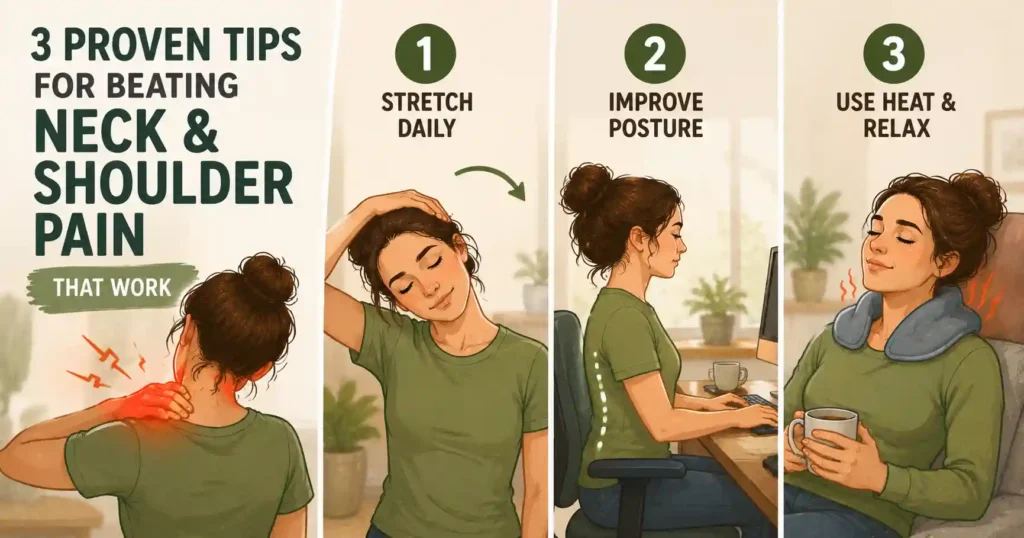
Three strategies consistently beat neck and shoulder pain: correcting your posture and workstation setup, doing specific daily stretches that target the muscles most likely causing your pain, and using heat or ice correctly based on whether your pain is acute or chronic. Most neck and shoulder pain improves significantly within 4–6 weeks when these three approaches are used together.
Neck and shoulder pain is one of the most common complaints adults deal with. Studies estimate that up to 70% of people experience significant neck pain at some point in their lives.[1] For most people it starts gradually — a stiff morning, tightness after sitting too long, a dull ache that just won’t fully go away.
The frustrating part is that most neck and shoulder pain does not come from a single injury. It builds slowly from daily habits most people don’t notice. That’s actually good news — the same habits that caused the problem can often fix it.
This guide covers three evidence-backed strategies that work for the majority of non-traumatic neck and shoulder pain. These approaches are also relevant if you experience dietary or inflammatory factors that worsen joint and muscle pain, since systemic inflammation often amplifies musculoskeletal symptoms.
Why Neck and Shoulder Pain Happens
The neck supports the weight of the head — roughly 10 to 12 pounds — and connects directly to the shoulder girdle through several muscle groups. When any of these muscles are overloaded, overstretched, or held in a poor position for extended periods, they respond with tightness, spasm, and pain.
The most common contributors to neck and shoulder pain in adults:
- Forward head posture — Every inch your head moves forward from its neutral position adds roughly 10 pounds of effective load on your cervical spine.[2] Most people using phones or computers carry their head 2–3 inches forward.
- Prolonged static postures — Sitting still for hours is harder on muscles than many forms of physical labor, because muscles are never fully loaded or unloaded.
- Weak deep neck flexors — The muscles that hold the neck in neutral position become inhibited when the head stays forward for too long.
- Rounded shoulders — Tight chest muscles and weak lower trapezius muscles pull the shoulders forward, creating compression at the shoulder top and tension in the neck.
- Poor sleep position — Sleeping on your stomach, or with a pillow too high or too low, keeps the neck rotated or side-bent for hours. If you notice pain getting significantly worse at night, sleep positioning is usually a major factor.
- Systemic inflammation — Conditions affecting joint health throughout the body can make neck and shoulder muscles more reactive and slow to recover.
Fix Your Posture and Workstation — Before Anything Else
You cannot stretch or massage your way out of pain that you recreate for 8 hours every day. Posture and workstation setup must come first. If your screen is too low, your chair is wrong, or you are holding your phone chin-down for hours, your muscles will keep tightening no matter what else you do.
What to Fix at Your Desk
- Screen height: The top of your monitor should be at eye level or just below. If it is lower, your head drops forward to see it. Even 2–3 inches too low causes significant neck stress over a full workday.
- Screen distance: Arm’s length is the starting point. If you are leaning forward to see the screen, move it closer rather than leaning in.
- Chair height: Feet flat on the floor. Hips slightly above knee level. Lumbar support in the low back keeps the upper spine from collapsing forward.
- Keyboard and mouse: Elbows at roughly 90 degrees. Shoulders relaxed, not shrugged or raised.
- Phone use: Bring the phone to eye level rather than looking down. The “text neck” posture creates the equivalent of 49–60 pounds of force on the cervical spine.[2]
The Movement Rule That Matters Most
No posture is perfect if you hold it too long. Research consistently shows that movement breaks every 30–45 minutes are more protective than any single “correct” posture.[3] Set a timer. Stand up. Roll your shoulders back. Do a few neck rolls. 60 seconds every 30–40 minutes is enough to interrupt the tension cycle.
Do These Specific Stretches and Exercises Every Day
Not all neck exercises are equally useful. Generic “neck stretches” often address surface-level tightness without targeting the deeper muscles actually causing the problem. The exercises below target the specific muscle groups most commonly involved in chronic neck and shoulder pain.
If you already follow a routine like the structured approach used for nerve-related pain relief, adding these neck-specific moves takes the same disciplined approach. Do these once or twice daily — gentle and consistent beats aggressive and occasional every time.
Gently draw your chin straight back, creating a “double chin.” Hold 5 seconds. 10 reps. Directly strengthens the deep neck flexors that forward head posture weakens.
Tilt your head forward and to one side at 45 degrees. Gently apply hand pressure on top of the head. Hold 30 seconds each side. Targets the muscle running from neck to shoulder blade — usually the primary pain source.
Stand in a doorway with arms at 90 degrees on the frame. Step through gently until you feel a stretch across your chest and front shoulders. Hold 30 seconds. Counteracts the rounded-shoulder pattern.
Sit or stand upright. Pull shoulder blades together and slightly downward, as if holding a pencil between them. Hold 5 seconds. 15 reps. Activates lower trapezius — the most commonly inhibited muscle in desk workers.
Tilt your right ear toward your right shoulder. Place your right hand gently on the left side of your head for light added stretch. Hold 30 seconds. Repeat left. Relieves the most common area of tension.
Stand with back flat against a wall, arms at 90 degrees. Slowly slide arms overhead while keeping back and arms touching the wall. 10 reps. Trains the full shoulder girdle into better positioning.
Nutritional Support for Muscle Recovery
Exercise alone does more when your body has the right raw materials to repair tissue. Deficiencies in key vitamins and minerals that support joint and muscle health — particularly magnesium, vitamin D, and omega-3 fatty acids — can slow recovery and increase muscle cramping. If your pain is persistent despite consistent exercise, nutritional gaps are worth evaluating.
How Long Before You Feel a Difference?
Most people notice reduced tightness within 1–2 weeks of consistent daily practice. Pain reduction typically becomes meaningful by 3–4 weeks. A 2017 systematic review found that exercise therapy — particularly strengthening of deep cervical flexors combined with scapular stabilization — produced significant pain reduction compared to no treatment or passive care alone.[4]
-
 How to Relieve Nerve Pain in Shoulder and Arm? Tips You Can Try
 -
Arialief Reviews 2026: Does It Really Work For Nerve Pain?
-
Best Thing For Sciatic Nerve Pain: At Home What Really Work?
-
Sciatic Nerve Pain Relief Stretches: 7 That Work
-
Nerve Calm Reviews, Customer Complaints, & Scam-Checked Reports 2025 Update.





Use Heat and Ice Correctly — Most People Get This Wrong
Heat and ice are both effective for neck and shoulder pain — but they work through different mechanisms. Using the wrong one at the wrong time can slow recovery. This is also worth understanding if you deal with pain that radiates or has a nerve component, where the approach may differ from pure muscle pain.
| Situation | Use This | Why It Works | How Long |
|---|---|---|---|
| New acute pain (first 48–72 hours), recent strain, swelling or inflammation | Ice / Cold Pack | Reduces inflammation and numbs acute pain signals | 15–20 min with cloth barrier, every 2–3 hours |
| Chronic tightness, stiffness on waking, ongoing muscle tension, pain lasting more than 3 days | Heat / Warm Compress | Increases blood flow, relaxes muscle spasm, improves tissue extensibility before stretching | 15–20 min before stretching or movement |
| Pain during or after physical activity | Ice after activity | Reduces post-activity soreness and any microinflammation | 10–15 min post-activity |
The Heat-Before-Stretch Strategy
Applying heat for 15–20 minutes immediately before your stretching routine significantly increases the effectiveness of the stretches. Warm muscle tissue is more extensible — it lengthens more easily with less discomfort. This combination is one of the most practical and well-supported approaches for chronic neck and shoulder tightness.[5]
What About Massage?
Massage therapy offers real, documented benefits for muscle pain — particularly for breaking up trigger points and improving local circulation in the neck and upper back. It works best as a complement to the exercise and posture strategies above, not as a standalone fix. The improvement from massage alone tends to be temporary without addressing the root causes.
What Not to Do
- Never apply ice or heat directly to bare skin — always use a cloth or towel as a barrier
- Don’t use heat on fresh injuries or swollen areas — it will increase inflammation
- Don’t apply either for longer than 20 minutes at a time
- Don’t sleep with a heating pad — burn risk is significant during sleep
One More Factor Most People Overlook: Sleep Position
You spend 7–9 hours in your sleeping position every night. A poor setup can undo all the progress made during the day with stretching and posture work. Pain that gets significantly worse at night is often closely tied to sleeping position and pillow height.
- Best position for neck pain: On your back with a pillow that supports the natural curve of your neck — not so high that your chin is pushed toward your chest, not so flat that your head falls back
- Side sleeping: Generally acceptable, but use a pillow thick enough to keep your head level with your spine. A pillow between the knees also reduces shoulder strain
- Stomach sleeping: The most harmful position for neck and shoulder pain. It requires rotating the head fully to one side for the entire night, creating prolonged compression. If you cannot stop, try a very thin pillow or no pillow
- Pain radiating down one or both arms, especially with numbness or tingling in hands or fingers — this may indicate nerve involvement requiring professional evaluation
- Pain that is severe, getting progressively worse, or not improving after 2–3 weeks of home care
- Neck pain following a fall, accident, or impact to the head or neck
- Pain accompanied by headaches at the base of the skull, vision changes, or dizziness
- Muscle weakness in the arms or difficulty with coordination
- Pain that wakes you repeatedly from sleep with no relief
These symptoms can indicate nerve compression, cervical disc problems, or other conditions requiring professional evaluation and imaging.
Bottom Line
Most neck and shoulder pain in adults responds well to three things done consistently: fixing the posture and environment that keeps recreating the problem, performing targeted daily exercises that address the actual muscles involved, and using heat and ice intelligently to support recovery. None of these require expensive equipment or specialist visits to start. Most people see meaningful improvement within 3–4 weeks when all three are applied together. If your pain is severe, worsening, or radiating into your arms, see a doctor before self-treating.
Frequently Asked Questions
How long does neck and shoulder pain usually last?
Is massage helpful for neck and shoulder pain?
Can sleeping on the wrong pillow cause neck pain?
Should I use a neck brace for neck pain?
What is the fastest way to relieve neck pain at home?
Is neck and shoulder pain a sign of something serious?
References & Sources
- Binder AI. Cervical spondylosis and neck pain. BMJ. 2007;334(7592):527-531. PubMed: 17347239
- Hansraj KK. Assessment of stresses in the cervical spine caused by posture and position of the head. Surg Technol Int. 2014;25:277-9. PubMed: 24697969
- Kay TM, et al. Exercises for mechanical neck disorders. Cochrane Database Syst Rev. 2012;8:CD004250. PubMed: 22696362
- Gross A, et al. Exercises for mechanical neck disorders. Cochrane Database Syst Rev. 2015. PubMed: 28490267
- Nadler SF, et al. Continuous low-level heat wrap therapy provides more efficacy than ibuprofen and acetaminophen for acute low back pain. Spine. 2002. PubMed: 15123480
