
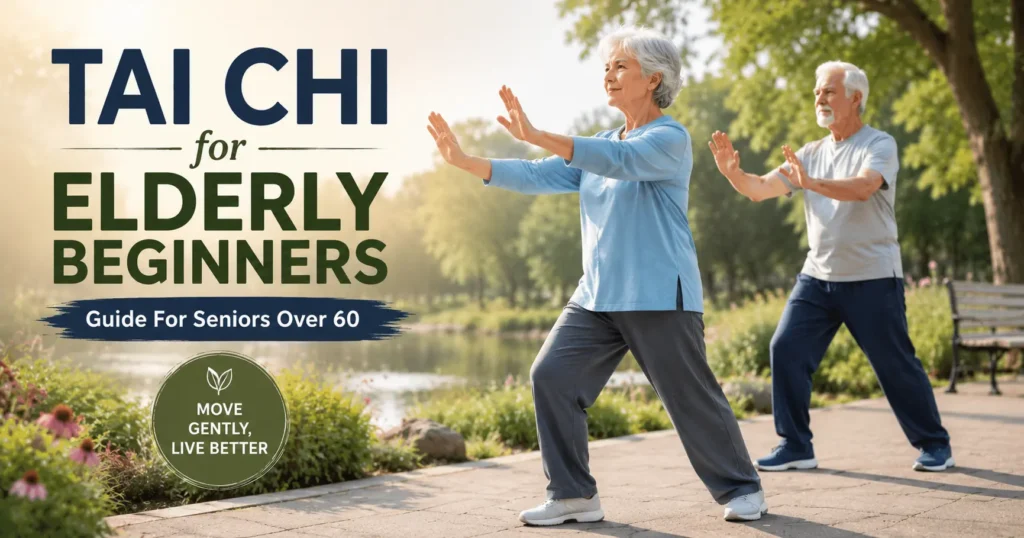
Tai chi for elderly beginners is a slow, low-impact movement practice that helps older adults improve balance, coordination, flexibility, and confidence while moving. It combines controlled weight shifting, posture awareness, breathing, and gentle stepping patterns that are easier on joints than many traditional workouts. For adults over 60, tai chi is often used to support mobility and reduce fall risk without high-impact strain.
A strange thing happens once you read enough senior fitness articles on this topic. Almost all of them say tai chi “improves balance,” but very few explain what that actually means physically. That matters because older adults do not lose balance for one single reason.
They lose it through slower reaction speed, weaker stabilizing muscles, reduced ankle control, and less awareness of body position. Tai chi addresses several of those at the same time. That is why researchers keep studying it.
As of 2026, tai chi remains one of the most consistently recommended movement practices for older adults by aging and rehabilitation researchers. But some online articles oversell it badly. Tai chi is helpful. It is not magic. It will not rebuild knees destroyed by severe arthritis. It will not replace strength training completely. And it will not fix balance problems overnight.
Still, for many adults over 60, it may be one of the few forms of exercise they actually continue doing long-term. That part matters more than wellness marketing usually admits.
What Is Tai Chi for Elderly Beginners?
Tai chi for elderly beginners is a simplified version of tai chi focused on slow movement, stability, posture control, and safe mobility for older adults.
Traditional tai chi started as a martial art.1Tai Chi: What You Need To Know, NIH. Beginner senior programs strip away most of the martial complexity and focus on practical movement patterns instead. That usually means:
- slow stepping
- controlled weight transfer
- upright posture
- gentle arm movements
- rhythmic breathing
- reduced joint stress
The “slow” part is not just for relaxation. Slower movement forces the body to stabilize itself more carefully. That is one reason tai chi may help balance better than people expect.
A lot of beginners assume tai chi is mostly arm waving. It is not. The lower body does most of the work. Proper tai chi training teaches the hips, ankles, knees, and core muscles to coordinate while shifting weight gradually from one side to the other. Older adults often lose this coordination before they lose strength completely.
Researchers from the Journal of the American Geriatrics Society have repeatedly linked tai chi practice with improved balance confidence and lower fall risk in older adults. Some studies suggest measurable improvements after 12 to 24 weeks of consistent practice, although study quality varies and many participants were relatively healthy to begin with.
One thing many beginners misunderstand: Tai chi should not hurt the knees sharply. Mild muscle fatigue is normal. Joint pain is not. Poor stance depth is often the problem.
Why Does Tai Chi Help Older Adults Stay Balanced?
Tai chi improves balance by training slow weight shifting, posture control, lower-body stability, and movement awareness.
Most people think balance comes from the ears alone. It does not. Balance depends on multiple systems working together:
- Vision
- Inner ear function
- Muscle strength
- Joint awareness
- Reaction timing
- Nervous system coordination
Tai chi trains several of those simultaneously.
When an older adult slowly shifts weight from one foot to the other, the body must constantly make tiny adjustments to stay stable. Those adjustments strengthen neuromuscular coordination over time. Fast exercises sometimes skip this because momentum hides instability.
This is also why beginners wobble during tai chi at first. That wobbling is not failure. It exposes weaknesses the body has been compensating for for years.
Researchers from Harvard Medical School have described tai chi as “medication in motion” for older adults because of its effects on balance, mobility, and movement confidence. The phrase gets quoted too much online, honestly, but the underlying reasoning is valid. Tai chi combines mild strength work, movement sequencing, and cognitive attention at the same time.
What Tai Chi Specifically Trains
| Tai Chi Movement Pattern | What It Helps |
|---|---|
| Slow weight shifting | Stability and coordination |
| Controlled stepping | Fall prevention skills |
| Upright posture | Spinal alignment awareness |
| Single-leg loading | Hip and ankle stability |
| Rhythmic breathing | Relaxation and pacing |
| Repeated sequences | Memory and motor control |
Some evidence also suggests that tai chi may help older adults feel less fearful of falling. That matters more than it sounds. Fear changes how people walk. It often makes movement stiffer and less stable.
What Is Tai Chi Walking and How Is It Different?
Tai chi walking is a slower, more deliberate walking style that combines tai chi weight shifting with controlled stepping patterns.
This is where many articles become confusing because they blur together:
- tai chi forms
- tai chi walking
- qigong
- gentle mobility exercises
They are related, but not identical.
Traditional tai chi forms involve flowing movement sequences. Tai chi walking isolates the stepping and balance mechanics instead. That makes it easier for many seniors to learn first.
The key difference is intentional movement transfer.
Normal walking often becomes rushed and uneven with age. Tai chi walking slows each step enough that the body fully transfers weight before moving again. That sounds simple. It is surprisingly difficult at first.
A beginner tai chi walking sequence usually includes:
- standing posture setup
- soft knee bend
- heel-to-toe stepping
- slow forward weight transfer
- controlled arm motion
- upright head position
Many YouTube videos skip posture explanation entirely and jump straight into movement copying. That is one reason beginners struggle. If posture is unstable, the walking pattern feels awkward immediately.
The Tai Chi for Health Institute describes tai chi walking as a way to improve functional mobility and movement awareness rather than simply exercising harder. That distinction matters.
Tai Chi Walking vs Regular Walking
| Feature | Tai Chi Walking | Regular Walking |
|---|---|---|
| Speed | Slow | Moderate/Fast |
| Weight Transfer | Deliberate | Automatic |
| Balance Focus | High | Moderate |
| Coordination Demand | Higher | Lower |
| Joint Impact | Low | Low to Moderate |
| Learning Curve | Moderate | Minimal |
Some older adults actually find tai chi walking mentally tiring at first. That is normal. The brain is learning unfamiliar movement sequencing.




How Should Beginners Over 60 Start Tai Chi Safely?
Beginners over 60 should start with short sessions, upright posture, shallow stances, and slow movement rather than trying advanced forms immediately.
The biggest mistake older beginners make is trying to imitate experienced instructors perfectly on day one. Tai chi is not supposed to feel rushed.
A safer starting structure usually looks like this:
- 10–15 minute sessions
- 2–4 days weekly
- stable flooring
- supportive shoes
- slow stance transitions
- shallow knee bending
Deep stances are one of the worst trends in online beginner videos. They look impressive. They are unnecessary for most seniors.
A Realistic Beginner Progression
| Week | Main Focus |
|---|---|
| 1 | Posture and breathing |
| 2 | Basic stepping patterns |
| 3 | Weight shifting |
| 4 | Linking simple movements |
| 5–8 | Building rhythm and consistency |
Many beginners over 60 struggle more with coordination than flexibility. Nobody mentions that enough. Memorizing movement sequences can feel frustrating early on. That improves with repetition.
The safest approach is consistency over intensity.
People with severe balance problems, recent falls, advanced neuropathy, or major joint instability should talk with a healthcare professional before starting any new exercise routine. That is not legal disclaimer fluff. Tai chi still involves dynamic movement and shifting balance demands.
What Mistakes Do Seniors Make When Starting Tai Chi?
Most beginner mistakes come from moving too fast, bending too deeply, copying advanced instructors, or misunderstanding posture.
This section is usually missing from competitor articles, which is strange because beginner frustration is extremely common.
Common Mistakes
- 1. Trying to move beautifully too early: Tai chi is awkward initially. That is normal. Coordination develops gradually.
- 2. Locking the knees: Beginners often stiffen their legs while trying to stay balanced. That reduces stability instead of improving it.
- 3. Leaning forward while stepping: Many adults shift their head forward before their body weight transfers properly.
- 4. Going too low: Deep knee bends create unnecessary strain for many seniors.
- 5. Treating tai chi like stretching: Tai chi is controlled movement training, not passive flexibility work.
There is also another issue rarely discussed online: some seniors become overly cautious while practicing. Excessive tension actually makes balance worse because the body stops adapting naturally.
That does not mean people should move recklessly. It means controlled movement matters more than frozen movement.
Can Tai Chi Walking Help With Weight Loss?
Tai chi walking may support weight management, but it is not a high-calorie-burning workout compared with brisk walking or strength training.
This topic gets exaggerated constantly online.
Tai chi generally burns fewer calories than:
- jogging
- cycling
- swimming laps
- faster-paced walking
But that does not automatically make it ineffective.
Older adults often stop exercising because workouts feel painful, intimidating, or exhausting. Tai chi may solve adherence problems better than aggressive exercise plans. A lower-intensity activity done consistently usually beats an intense plan abandoned after two weeks.
Research from BMJ Open and other aging-related exercise studies suggests tai chi may help:
- daily movement levels
- mobility confidence
- stress management
- physical function
Indirectly, those may support healthier weight patterns over time. Still, anyone claiming tai chi walking alone causes dramatic fat loss is overselling it.
What Tai Chi Can Realistically Do for Weight Management
| Realistic Benefit | Less Realistic Claim |
|---|---|
| Supports regular movement | Rapid fat burning |
| Encourages consistency | Fast weight loss |
| Improves mobility | “Melts belly fat” |
| May reduce stress eating | Replaces all exercises |
How Often Should Seniors Practice Tai Chi?
Most beginners over 60 benefit from practicing tai chi 2–5 times weekly in shorter sessions rather than infrequent long sessions.
Frequency matters more than marathon practice sessions.
Research patterns suggest older adults often improve balance and movement confidence through regular repetition rather than exercise intensity. Even 15–20 minutes consistently may help more than occasional one-hour classes.
Many instructors recommend:
- beginners: 2–3 sessions weekly
- intermediate learners: 4–5 sessions weekly
- short home practice between classes
Fatigue matters. Tai chi should leave most beginners feeling lightly worked, not exhausted.
One interesting thing researchers keep noticing: adherence rates for tai chi are often relatively good in older adults because the exercise feels manageable. That may partly explain why its health effects keep appearing in aging research.
What Type of Tai Chi Is Best for Beginners Over 60?
Simplified Yang-style tai chi is usually the easiest starting point for adults over 60 because it uses slower, smoother, more upright movements.
Different tai chi styles exist:
- Yang
- Chen
- Wu
- Sun
Most beginners do not need to obsess over this immediately. But style differences affect accessibility.
Beginner-Friendly Tai Chi Styles
| Style | Beginner Difficulty | Notes |
|---|---|---|
| Yang | Easiest | Slow, flowing, upright |
| Sun | Easy | Smaller steps, gentle transitions |
| Wu | Moderate | Narrow stance control |
| Chen | Harder | Faster changes and lower stances |
Some “tai chi for seniors” programs are really modified mobility classes with tai chi influence. That is not necessarily bad. For many older adults, safety and consistency matter more than strict martial authenticity.
Where Can Beginners Learn Tai Chi Walking for Free?
Many seniors start with free beginner videos online, local community programs, senior centers, or hospital wellness classes.
YouTube has thousands of tai chi videos, but quality varies wildly.
A common problem: Advanced instructors demonstrate movements beautifully without explaining beginner mechanics. Older adults then copy motions without understanding posture or balance transfer.
Better beginner instruction usually includes:
- slow pacing
- verbal posture cues
- seated modifications
- side-angle demonstrations
- repetition without rushing
Community centers and senior wellness programs sometimes provide better supervision than random online videos.
The irony is that free tai chi videos are often more useful when they are less flashy.
Scientific References
- 1
