
The word “plasma” has been used in medicine for over a century, but its origin has nothing to do with blood at first. The term was borrowed from physics, where it describes an ionized gas. A Czech medical scientist named Jan Janský is generally credited with applying the term to the liquid part of blood in the early 1900s, drawing a direct comparison between the way blood cells float in the fluid and the way charged particles move in a physical plasma state.
Where Did the Word “Plasma” Actually Come From?
The root of the word is ancient Greek. “Plasma” in Greek means “something molded” or “something formed.” The ancient Greeks used related words to describe the act of shaping clay or wax into a figure. You can see the same root in modern words like “plastic” and “plastic surgery,” which involve shaping or molding.
In the late 1800s, a German physicist named Gustav Kirchhoff used the term to describe the glowing gas in a discharge tube. Later, the American chemist Irving Langmuir coined the modern physical definition of plasma as an ionized gas. But the jump from physics to biology happened because of a visual similarity. In a physical plasma, particles are suspended and moving within a sea of energy. In blood, the cells are suspended and moving within a fluid. The structural resemblance was enough for the term to stick.
Why Is Blood Plasma Called Plasma Word Origins in Medicine?
The specific application of the word to blood is tied to the work of Jan Janský, a Czech serologist. He was studying blood types and needed a precise term for the liquid component of blood after the cells were removed. He chose “plasma” because the fluid acts as the medium in which the blood cells are “molded” or carried. The name reflects the role of the fluid as the carrier and shaper of the blood’s cellular elements.
Before this, the liquid part of blood was often called “liquor sanguinis,” which is Latin for “liquid of the blood.” That term was descriptive but clunky. Janský’s use of “plasma” was shorter and caught on quickly across Europe and then in the United States. By the 1920s, the term was standard in medical textbooks and clinical practice.
It is important to distinguish plasma from serum. Plasma is the liquid part of blood that still contains clotting factors. Serum is the liquid left after the blood has clotted, meaning the clotting factors have been used up. Both come from the same Greek root, but they are not the same substance. Plasma is collected before clotting occurs, while serum is collected after.
What Exactly Is Blood Plasma Made Of?
Blood plasma is about 92 percent water. The remaining 8 percent is a mix of dissolved substances that the body depends on. These include proteins like albumin and globulins, electrolytes like sodium and potassium, hormones, glucose, and waste products like urea and creatinine.
The proteins in plasma do heavy lifting. Albumin helps maintain the pressure that keeps fluid inside the blood vessels. Globulins include antibodies that fight infection and transport proteins that carry iron and other substances. Fibrinogen is the clotting protein that turns into fibrin when you bleed, forming the mesh that stops the bleeding.
Plasma also carries nutrients from the digestive system to the cells and carries waste products to the kidneys and liver for removal. It is the transport system of the body. Every cell in your body is bathed in fluid that was once part of your plasma, leaking out of the capillaries to deliver oxygen and nutrients directly to the tissues.





How Is Plasma Different From Whole Blood and Serum?
Whole blood is the complete fluid that runs through your veins. It contains the liquid plasma plus the formed elements: red blood cells, white blood cells, and platelets. When you donate blood, the bag you fill contains whole blood unless it is processed further.
Plasma is what remains when you remove all the cells. You can get plasma by spinning whole blood in a centrifuge. The cells are heavier and sink to the bottom, leaving the lighter plasma on top. This is called centrifugation.
Serum is a different product. To get serum, you let whole blood clot on its own. The clot traps the cells and the clotting proteins. The liquid that remains is serum. Serum lacks fibrinogen and the other clotting factors. This distinction matters in laboratory testing because some tests require serum and others require plasma.
Why Does the Physical Definition of Plasma Matter Here?
The physical definition of plasma as an ionized gas is the fourth state of matter, alongside solid, liquid, and gas. Stars are made of plasma. Lightning is plasma. Neon signs contain plasma. When Langmuir coined the term in 1928, he was describing the behavior of ionized gas in a vacuum tube, and he noted that the electrons and ions seemed to be carried along by the electric field like blood cells carried by blood plasma.
That comparison was not accidental. Langmuir explicitly referenced the biological term when he named the physical state. So the word traveled in a full circle. It started in ancient Greek as “something molded.” It moved into physics to describe a malleable, shape-shifting gas. Then it moved into medicine to describe the fluid that carries blood cells. Then physics borrowed it back, referencing the blood fluid directly.
This circular history is why the word appears in two very different scientific fields today. A physicist and a hematologist use the same word, and both are technically correct. The connection is not a coincidence. It is a shared intellectual history that most people never notice.
Is Plasma the Same as the Fluid in Your Cells?
No. Plasma is the extracellular fluid that circulates in the blood vessels. The fluid inside your cells is called intracellular fluid, and it has a very different composition. Intracellular fluid is high in potassium and low in sodium. Plasma is the opposite, high in sodium and low in potassium.
The fluid that surrounds your cells outside the blood vessels is called interstitial fluid. Plasma leaks out of the capillaries to become interstitial fluid, delivering nutrients and picking up waste. Then the lymphatic system collects much of this fluid and returns it to the bloodstream. So plasma is constantly becoming interstitial fluid, and interstitial fluid is constantly becoming plasma again.
This continuous exchange is why the body can maintain stable conditions inside the blood even when you eat, drink, or sweat. The plasma composition shifts slightly, but the kidneys and lungs correct it quickly. If plasma loses too much water, the blood becomes thicker and the heart works harder. If plasma gains too much water, the blood thins and fluid leaks into tissues, causing swelling.
Why Do Doctors Use Plasma in Transfusions?
Plasma transfusions are used when a person has a clotting problem or has lost a large volume of blood. Because plasma contains the clotting factors, it can help stop bleeding in patients with liver disease, severe trauma, or certain inherited conditions. It is also used to reverse the effects of blood-thinning medications in emergencies.
Plasma can be frozen and stored for up to a year. This is called fresh frozen plasma, and it is a standard product in hospital blood banks. The frozen plasma is thawed before use and given through an IV line. It is not the same as a whole blood transfusion, which also replaces red blood cells and platelets.
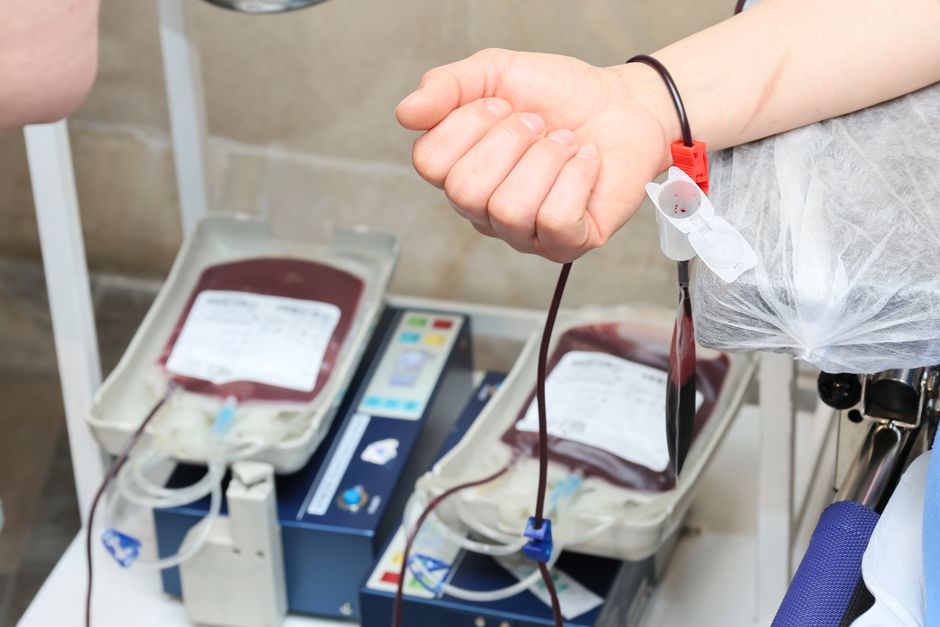
Some people donate plasma regularly for manufacturing purposes. The plasma is used to make medications called plasma derivatives, such as albumin, immune globulin, and clotting factor concentrates. These products treat a wide range of conditions, from immune deficiencies to hemophilia. The donation process is different from whole blood donation because the plasma is separated from the cells, and the cells are returned to the donor.
Frequently Asked Questions
Who first called blood plasma “plasma”?
Jan Janský, a Czech medical scientist, is credited with applying the term to the liquid part of blood in the early 1900s. He chose the word because blood cells are carried in the fluid much like particles are carried in a physical plasma.
What is the literal meaning of the Greek word plasma?
The Greek word “plasma” means “something molded” or “something formed.” It originally described the act of shaping clay or wax, which is why the same root appears in the word “plastic.”
Is blood plasma the same as blood serum?
No. Plasma contains clotting factors, while serum does not. Serum is the liquid left after blood has clotted, meaning the clotting proteins have already been used up.
Why does physics also use the word plasma?
Physicist Irving Langmuir coined the physical term in 1928 to describe ionized gas. He explicitly compared the movement of charged particles in the gas to blood cells carried in blood plasma.
