
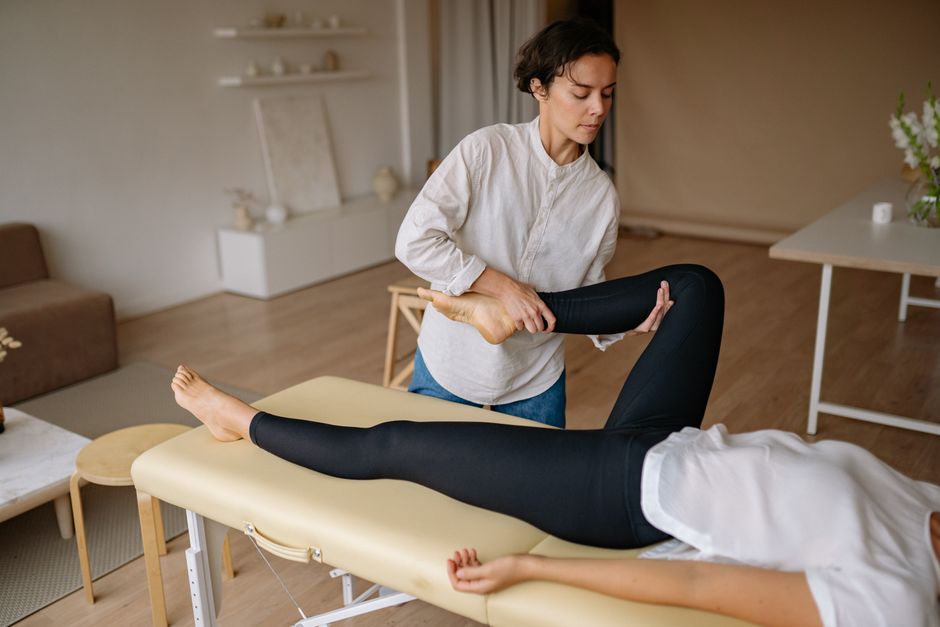
Pressing on the area between your legs can quiet a sudden poop urge because that spot sits right on top of the pudendal nerve and the pelvic floor muscles that control your anal sphincter. Pressure there sends a competing signal up the same nerve pathway that is telling your body to go. The brain reads the new signal, the sphincter tightens, and the urge fades for a moment. It is a real reflex, not a placebo.
That is the short answer. The longer answer involves nerve anatomy, muscle tone, and the difference between calming an urge and treating a bowel problem. Those are two different things, and mixing them up is where people get into trouble.
Why Does Massaging Between Your Legs Stop Poop Urges?
The area between your legs — the perineum — is densely packed with nerve endings and sits at the crossroads of the pelvic floor. The pudendal nerve runs through here and branches out to control the external anal sphincter, the ring of muscle you squeeze voluntarily to hold stool in.
When stool moves into the rectum, stretch receptors there fire a signal up to the brain: time to find a bathroom. That signal travels through the pelvic nerves and the pudendal nerve. If you press or massage the perineum, you stimulate the same pudendal nerve from the outside.
The brain receives this new input and does something called gating. Competing sensory signals can partially cancel each other out at the spinal cord level. This is the same principle behind rubbing your elbow after you bang it. The pressure signal crowds out some of the urge signal.
There is a second mechanism too. Direct pressure on the perineum can trigger a reflex contraction of the external anal sphincter and the surrounding pelvic floor muscles. A tighter sphincter means better mechanical holding, at least briefly.
Neither effect is permanent. You are buying time, not fixing the underlying reason the urge showed up.
What Is Actually Happening in the Pelvic Floor?
The pelvic floor is a hammock of muscle that stretches from your pubic bone to your tailbone. It holds up your bladder and bowel and wraps around the openings where urine and stool leave the body.
Two muscle groups matter most for holding stool:
- The internal anal sphincter — smooth muscle you cannot control consciously. It stays closed most of the time.
- The external anal sphincter — skeletal muscle you can squeeze on purpose. This is the one you use when you clench to hold it in.
The external sphincter is under voluntary control, but it also responds to reflexes. Sudden pressure on the perineum can set off a contraction without you consciously deciding to squeeze. This is why the effect can feel almost automatic.
Pelvic floor physical therapists use this principle in treatment. They teach patients to identify and gently contract the pelvic floor in response to urgency. The technique is sometimes described as a “quick flick” — a brief, gentle squeeze rather than a long hard clench. A long hard clench can backfire by tiring the muscle and increasing tension.
That distinction matters. Pressing hard and holding for a long time is not the same as a light, brief pressure. One can help. The other can make pelvic floor tension worse over time.
Does This Work for Everyone?
No. The reflex is real, but how much it helps depends heavily on why you are having the urge in the first place.
If the urge comes from a normal rectum filling with stool, pressure or a gentle squeeze can reliably buy you a minute or two. That is usually enough to reach a bathroom.
If the urge comes from an irritated or inflamed rectum, the signal is stronger and the reflex may not override it. Conditions that cause rectal inflammation — infections, inflammatory bowel disease, and others — tend to produce urges that are harder to suppress with pressure alone.
If the urge comes from nerve damage, the reflex pathway itself may be impaired. Pudendal nerve damage can happen from childbirth, prolonged sitting, cycling, or surgery in the pelvic area. When the nerve is not working properly, stimulating it may not produce the expected response.
If the urge comes from pelvic floor dysfunction — muscles that are too tight, too weak, or uncoordinated — the response varies. Some people find the pressure calming. Others find that any touch in that area increases tension and makes things worse.
There is no single answer here. The technique is a tool, not a treatment.





Is Pressing Between Your Legs a Treatment for Incontinence?
No. Using pressure or a squeeze to delay a bowel movement is a coping strategy, not a cure. It does not strengthen the pelvic floor, repair a damaged sphincter, or resolve the reason urges are happening.
The evidence for pelvic floor muscle training as a treatment is much stronger than the evidence for emergency perineal pressure. Pelvic floor muscle training — supervised by a physical therapist — is a well-established approach for certain types of fecal incontinence and urgency. It involves a structured program of exercises over weeks to months, not a quick press in the moment.
If you are relying on perineal pressure several times a day to avoid accidents, that is a sign something needs proper evaluation. It is not a sign that you need to press harder.
Some clinicians also teach patients to use the technique as a bridge while they build strength through training. In that context it has a clear role. As a standalone fix, it does not.
What Else Can Cause Sudden Poop Urges?
Urgency that shows up often, wakes you at night, or comes with other symptoms has a cause worth identifying. Common ones include:
- Irritable bowel syndrome — a common functional disorder that causes urgency, often with cramping and changes in stool pattern.
- Rectal inflammation — from infection, inflammatory bowel disease, or other causes.
- Pelvic floor dysfunction — muscles that are too tight, too weak, or not coordinating properly.
- Nerve damage — affecting the pudendal nerve or the nerves that control the sphincter.
- Diarrhea from any cause — liquid stool is harder to hold than solid stool.
- Medications — some can loosen stool or affect nerve signaling.
- Pelvic surgery or childbirth — can change the mechanics of the sphincter and pelvic floor.
This is not a complete list. The point is that urgency is a symptom, not a diagnosis. The same sensation can come from very different problems, and they do not all respond to the same approach.
When Should You See a Doctor About Urgency?
Talk to a clinician if any of the following apply:
- You are having accidents or leaking stool without meaning to.
- The urgency is new, getting worse, or happening most days.
- You wake up at night needing to have a bowel movement.
- There is blood in your stool or on toilet paper.
- You have unexplained weight loss, fever, or pain.
- You are avoiding activities because you are worried about finding a bathroom.
These signs do not automatically mean something serious. But they do mean the symptom deserves a proper look rather than a home remedy.
A clinician can assess sphincter function, pelvic floor coordination, and nerve signaling. Some of these tests are simple. Others are more specialized. The right path depends on what they find.
Pelvic floor physical therapy is often part of the answer. It is not the same as doing Kegels from a handout. A trained therapist assesses which muscles are weak, which are tight, and how they coordinate — then builds a program around that.
Does the Technique Have Any Risks?
Light, brief pressure is generally considered low risk for most people. Pressing hard, pressing often, or holding a clench for a long time is where problems can start.
Chronic over-squeezing can contribute to pelvic floor tension. Muscles that stay tight can cause pain, make it harder to relax when you actually need to go, and worsen urgency over time. This is a real pattern that pelvic floor therapists see.
If you have a known pelvic floor condition, recent pelvic surgery, or you are pregnant or recently gave birth, ask a clinician before using this technique. The pelvic floor changes significantly during and after pregnancy, and what helps in one situation may not help in another.
No clinical guidelines currently exist for using perineal pressure specifically to suppress bowel urgency. The technique is taught in some pelvic floor therapy settings as a coping tool, but it is not a standardized recommendation with formal dosing. That means there is no established rule for how hard, how long, or how often.
What Actually Helps With Urgency Long Term?
Managing urgency long term means addressing the cause, not just the moment. What that looks like depends on the diagnosis.
For many people, pelvic floor muscle training is the foundation. Research consistently shows it can improve symptoms for certain types of fecal incontinence and urgency, particularly when supervised by a trained therapist rather than done alone from a handout.
Diet and stool consistency matter too. Stool that is well-formed and soft is easier to hold than stool that is loose or hard. Fiber and fluid intake can influence this, though the right amount varies by person and by condition.
For some causes, medication or other medical treatment is appropriate. For others, treating the underlying condition — infection, inflammation, or a medication side effect — resolves the urgency entirely.
The technique of pressing between your legs is a useful bridge. It is not a substitute for finding out why the urge is happening.
Frequently Asked Questions
Why does pressing between my legs stop the urge to poop?
Pressure on the perineum stimulates the pudendal nerve, which competes with the urge signal traveling the same pathway and can trigger a reflex tightening of the anal sphincter. The effect is temporary and buys time rather than fixing the cause.
Is it safe to press on the perineum to hold in a bowel movement?
Light, brief pressure is generally considered low risk for most people, but pressing hard or clenching for long periods can increase pelvic floor tension over time. If you are pregnant, recently gave birth, or have a known pelvic floor condition, ask a clinician first.
Does this technique treat fecal incontinence?
No. It is a coping strategy for delaying a bowel movement, not a treatment for incontinence. Pelvic floor muscle training supervised by a physical therapist is the better-established approach for fecal incontinence and urgency.
When should I see a doctor about sudden poop urges?
See a clinician if you are having accidents, if urgency is new or getting worse, if you wake at night needing to go, or if there is blood in your stool. These signs mean the symptom needs proper evaluation rather than a home remedy.
