
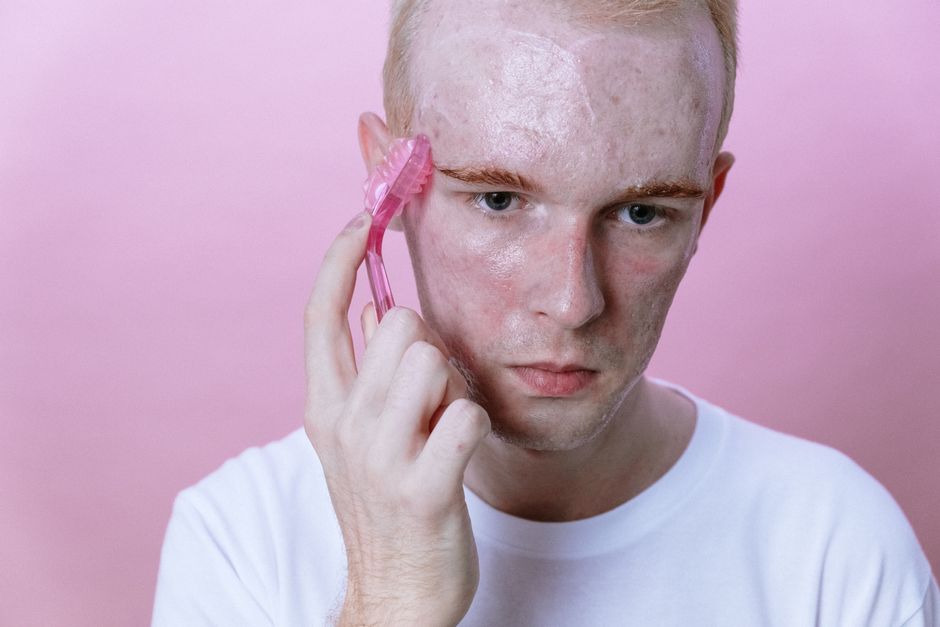
Forehead acne happens when pores in the skin above your eyebrows get blocked by oil, dead skin cells, and bacteria. That area has a high density of sebaceous glands, which are the oil-producing glands in your skin. When those glands produce more oil — usually driven by hormones — and the oil can’t escape, a pimple forms. Hair products, sweat, hats, and touching your face can make it worse.
Why Do I Get Forehead Acne Causes Explained
Acne is not a cleanliness problem. It is a condition of the pilosebaceous unit — the hair follicle plus its attached oil gland. Four things have to come together for a pimple to form.
First, your sebaceous glands produce more oil (sebum). Second, dead skin cells inside the follicle don’t shed normally and clump together. Third, the combination of oil and trapped cells plugs the pore. Fourth, a bacterium called Cutibacterium acnes — which lives on everyone’s skin — multiplies inside that blocked follicle. Your immune system responds with inflammation, which is what you see as redness, swelling, and pus.
All four steps are well established in dermatology. What varies from person to person is which step dominates. That’s why two people with similar forehead breakouts can respond differently to the same product.
The forehead has a lot of sebaceous glands compared to, say, your forearms. It’s also part of the T-zone — the forehead, nose, and chin — which tends to be oilier than the cheeks. That anatomy alone explains why the forehead is a common spot for breakouts.
Is Forehead Acne Caused by Hormones?
Yes, hormones are the single biggest driver of acne for most people. Androgens — hormones like testosterone that everyone produces, regardless of sex — stimulate sebaceous glands to make more oil. More oil means more raw material for a blocked pore.
This is why acne clusters around predictable life stages. It typically appears during puberty when androgen levels rise. It can flare around the menstrual cycle. It can also show up or worsen in adulthood, particularly during perimenopause, when hormone levels shift in ways that aren’t always predictable.
One detail worth knowing: hormonal acne isn’t limited to the jawline the way it’s often described online. Hormones affect oil production across the whole face, including the forehead. The jawline pattern is common but not exclusive.
If your breakouts are deep, painful, and cyclical, that pattern is more consistent with a hormonal component. A dermatologist can assess whether that’s what’s happening. Hormonal acne often needs different treatment than surface-level clogged pores.
Can Hair Products Cause Forehead Breakouts?
Yes, and this is one of the most overlooked causes. It has a name: pomade acne.
Hair oils, gels, pomades, leave-in conditioners, and even some shampoos contain ingredients that can clog pores. When those products migrate from your hairline onto your forehead — through sweat, through your pillow, or just through daily movement — they can trigger breakouts along the edge of your scalp and down onto your forehead.
The pattern is telling. If your acne is concentrated right at the hairline and the upper forehead, and it appeared or worsened after you started using a new hair product, the product is a reasonable suspect. Fragrances and heavy oils are common culprits.
The fix is straightforward: switch to products labeled non-comedogenic, which means they’re formulated to be less likely to clog pores. Wash your face after applying hair products, and try to keep them off your skin. If the breakouts clear within a few weeks of changing products, you’ve found your answer.


Does Sweat and Headwear Make Forehead Acne Worse?
Sweat and friction both contribute. This is called acne mechanica.
When you sweat, oil and dead skin cells mix with moisture on the skin surface. If that mixture sits under a hat, helmet, headband, or tight clothing, it has more time to work its way into pores. The friction itself also irritates hair follicles, which can trigger or worsen breakouts.
This is common in athletes, people who wear helmets for work, and anyone who wears hats or headbands regularly. It’s also why breakouts often show up along the forehead where a hat band sits.
Practical steps that make a difference:
- Shower and wash your face soon after heavy sweating, rather than letting sweat dry on your skin.
- Wash hats, headbands, and pillowcases regularly — they collect oil and bacteria.
- Choose breathable fabrics and loosen headwear when you can.
- Avoid touching or wiping your forehead with dirty hands or towels during workouts.
None of this is exotic advice, but the effect is real. Removing the friction and the trapped sweat removes two triggers at once.
Does Diet Cause Forehead Acne?
The evidence here is more mixed than most headlines suggest, but it isn’t zero.
For years, dermatologists said diet had nothing to do with acne. That position has softened. Some studies suggest that high-glycemic diets — diets heavy in refined sugars and quickly digested carbohydrates — may be associated with more acne. Other research points to possible links with certain dairy products, particularly skim milk.
What this does not mean: that a specific food causes your forehead breakout, or that cutting one food will clear your skin. The relationship appears to be modest and varies between people. No single dietary change has been shown to reliably treat acne on its own.
If you want to test whether diet matters for you, changes are more informative when made one at a time and given several weeks. A dermatologist or registered dietitian can help you do this without cutting out foods you need.
What Else Triggers Forehead Breakouts?
Several everyday factors can push a borderline situation into a breakout.
Stress is a genuine trigger, not just a folk belief. Stress raises cortisol and other hormones that can increase oil production and inflammation. It also tends to increase the behaviors that worsen acne — touching your face, skipping your routine, sleeping poorly.
Picking and squeezing makes acne worse and can leave scars. It pushes bacteria and inflammation deeper into the skin.
Comedogenic skincare and makeup can clog pores just like hair products. Heavy foundations, thick moisturizers, and products with certain oils are common offenders.
Medications can cause acne as a side effect. Some steroids, lithium, and certain other drugs are known to trigger or worsen acne. If breakouts started after a new medication, that’s worth mentioning to your prescriber.
Friction from phone screens, hands, and glasses adds up over a day. Your forehead touches more surfaces than you probably realize.
One clarification worth making: forehead acne is not a sign that your liver, gut, or “toxins” are the problem. That idea circulates widely online, but it isn’t supported by clinical evidence. Acne is a skin condition with well-understood local causes.
When Should You See a Doctor About Forehead Acne?
Most mild forehead acne responds to consistent over-the-counter care. But some situations call for a professional.
See a dermatologist if:
- You have deep, painful nodules or cysts, not just surface pimples.
- Over-the-counter products haven’t helped after about two to three months of consistent use.
- You’re developing scars or dark marks that don’t fade.
- The acne is affecting your confidence or mental health.
- You have signs of a hormonal cause, such as irregular periods or excess hair growth.
Acne that leaves scars is worth treating earlier rather than later. Scarring is often permanent, while active acne usually is not. A dermatologist can recommend treatments based on what type of acne you have.
Treatments range from topical retinoids and benzoyl peroxide to prescription options for more stubborn cases. Which one fits depends on whether your acne is mostly clogged pores, inflammatory, or hormonal. That’s a clinical judgment, not something to guess at from a product label.
Frequently Asked Questions
Why is my forehead breaking out all of a sudden?
A sudden change usually points to a new trigger — a hair product, a new medication, increased sweating, or a shift in hormones. Look at what changed in the weeks before the breakouts started.
Does forehead acne mean something is wrong internally?
No. Forehead acne is caused by local factors in the skin — oil, blocked pores, bacteria, and inflammation — not by an internal organ problem. Claims linking face maps to organ health are not supported by clinical evidence.
Can washing my face more often clear forehead acne?
No, and over-washing can make it worse by irritating the skin and stripping its barrier. Washing twice a day with a gentle cleanser is generally enough for most people.
Is forehead acne different from acne on the rest of my face?
The underlying cause is the same, but the forehead has more oil glands and is more exposed to hair products, sweat, and headwear. That’s why the triggers can look different even though the mechanism is identical.
