
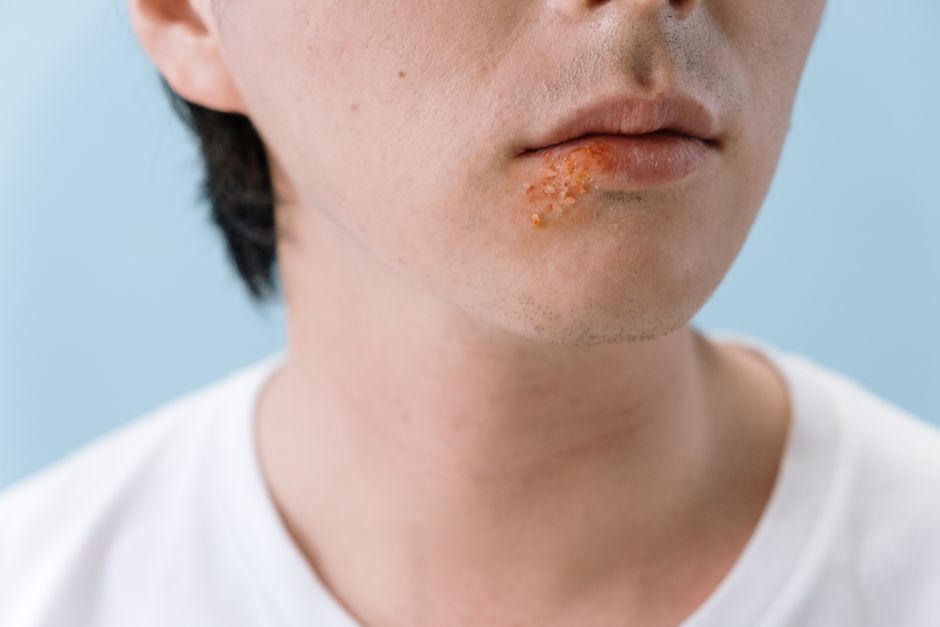
A cold sore is a small, fluid-filled blister that usually appears on or around the lips. It is caused by the herpes simplex virus, most often type 1 (HSV-1). The virus stays in the body for life, and cold sores tend to come back when the immune system is under stress. Cold sores are very common, and they are not the same thing as canker sores, which form inside the mouth and are not caused by a virus.
Whats A Cold Sore and What Causes It?
Cold sores are caused by the herpes simplex virus. HSV-1 is the usual culprit, though HSV-2 — the type more often linked to genital herpes — can also cause sores around the mouth through oral contact.
Once the virus enters the body, it does not leave. It travels along nerve endings and settles into a cluster of nerve cells called a ganglion, where it stays quiet. The immune system keeps it in check most of the time. When that control weakens, the virus can travel back down the nerve and cause a new sore in roughly the same spot as before.
This is why cold sores recur. The virus is not gone between outbreaks. It is inactive.
HSV-1 spreads through direct skin-to-skin contact. Kissing, sharing utensils, sharing lip balm, or touching a sore and then touching another person can pass it on. The virus can spread even when no sore is visible, though this is less common than spreading during an active outbreak.
How Do You Know If It Is a Cold Sore?
Most people feel a cold sore coming before they see it. A tingling, itching, or burning feeling shows up at the spot, usually a few hours to a day before the blister appears. Clinicians call this the prodrome.
Then a small, raised, fluid-filled blister forms. It often sits at the edge of the lip, where the lip meets the skin. The blister can be painful. Over the next few days it breaks open, weeps clear fluid, and forms a yellowish crust. It usually heals within about one to two weeks without leaving a scar.
First-time infections can be worse than later ones. Some people get a fever, swollen lymph nodes, and several sores at once. Many people, though, catch HSV-1 as children and never notice any symptoms at all.
Cold sores are not the same as canker sores. Canker sores form inside the mouth on the soft tissue, have a white or yellow center with a red border, and are not contagious. Cold sores form on or near the lips, are caused by a virus, and can spread to other people.
What Triggers a Cold Sore Outbreak?
The virus reactivates when something weakens the immune system’s hold on it. Common triggers include:
- Physical or emotional stress
- Fever or another illness, which is where the name “cold sore” comes from
- Sun exposure and windburn on the lips
- Hormonal changes, including around menstruation
- Fatigue and lack of sleep
- Skin injury or trauma to the lip area
These triggers are widely reported by people who get cold sores, but the research on exactly how each one flips the virus back on is not fully settled. What is clear is that reactivation is tied to the immune system’s ability to keep the virus suppressed, and anything that taxes that system can open the door.
Some people get cold sores many times a year. Others get one or two in a lifetime. The pattern varies a lot from person to person, and there is no reliable way to predict how often someone will get them.




Are Cold Sores Contagious?
Yes. Cold sores are contagious, and the virus spreads most easily when a blister is present. The fluid inside the blister carries a high load of virus.
The virus can spread through:
- Kissing or other direct lip-to-skin contact
- Sharing eating utensils, cups, or water bottles
- Sharing lip balm, lipstick, or towels
- Touching a sore and then touching another person
Spread can also happen when no sore is visible. This is called asymptomatic shedding, and it is one reason the virus is so widespread. You cannot tell by looking at someone whether they can pass it on.
The highest-risk time is from when the tingling starts until the sore has fully crusted over and healed. During that window, avoiding close contact with the affected area and not sharing personal items lowers the chance of passing it on.
Who Is Most at Risk From Cold Sores?
For most healthy adults and children, cold sores are uncomfortable but not dangerous. The main concern is a rare but serious situation: newborns and people with weakened immune systems.
A newborn who catches HSV-1 can develop a severe infection affecting the skin, eyes, brain, or whole body. This is uncommon, but it is a medical emergency when it happens. Anyone with an active cold sore should avoid kissing a newborn and should wash their hands before holding one. This is established guidance from pediatric and obstetric sources, and it is not a matter of caution for caution’s sake.
People with weakened immune systems — from certain illnesses or from medications that suppress the immune system — can also have more severe and longer-lasting outbreaks. The same applies to people with eczema, whose skin can be more vulnerable to widespread viral infection.
If a cold sore spreads widely, appears near the eye, or comes with a high fever, that warrants prompt medical attention. Sores near the eye are a specific concern because HSV can infect the eye and, in rare cases, affect vision.
How Are Cold Sores Treated?
There is no cure for the virus, and no treatment removes it from the body. What treatment can do is shorten an outbreak and ease symptoms, especially when started early.
Over-the-counter options include topical creams and ointments. Some contain a mild antiviral, and some are soothing agents that help with pain and dryness. Their benefit is generally modest.
Prescription antivirals — available as creams, pills, or both — can reduce how long an outbreak lasts and how severe it is. They tend to work best when started at the first tingle, before the blister fully forms. This is common clinical practice, and the evidence supports early use for shortening outbreaks.
For people who get frequent outbreaks, some clinicians prescribe daily antiviral medication to reduce how often they happen. This is a recognized approach, though whether it is the right choice depends on how often someone gets outbreaks and other health factors.
Simple comfort measures help too. Cold compresses can ease pain. Lip balm with sun protection can help if sun exposure is a trigger. Drinking enough fluids and getting rest supports the immune system generally.
Do not pick at or squeeze a cold sore. It can spread the virus to nearby skin, to your fingers, or to your eyes.
Can You Prevent Cold Sores?
You cannot prevent a virus you already carry from ever reactivating. But you can lower the odds of outbreaks and reduce spread to others.
- Use lip balm with sunscreen, and protect your lips from sun and wind
- Manage stress and get enough sleep, since both affect immune function
- Do not share utensils, drinks, lip products, or towels during an outbreak
- Wash your hands often, especially after touching a sore
- Avoid kissing or close contact with the affected area until it heals
- Keep your hands away from your eyes after touching your face
For people with frequent outbreaks, talking with a clinician about preventive antiviral medication is a reasonable step. The decision depends on how often outbreaks happen and how much they interfere with daily life.
Frequently Asked Questions
Whats a cold sore look like?
A cold sore usually starts as a small, raised, fluid-filled blister at the edge of the lip. It then breaks open, weeps, and forms a yellowish crust before healing over about one to two weeks.
Are cold sores herpes?
Yes. Cold sores are caused by the herpes simplex virus, usually type 1 (HSV-1). The virus stays in the body for life, which is why cold sores can come back.
How long do cold sores last?
Most cold sores heal within about one to two weeks. Antiviral treatment started at the first tingle may shorten how long an outbreak lasts.
Can you get a cold sore from kissing?
Yes. HSV-1 spreads through direct skin-to-skin contact, including kissing. The virus spreads most easily when a blister is present, but it can also spread when no sore is visible.
