
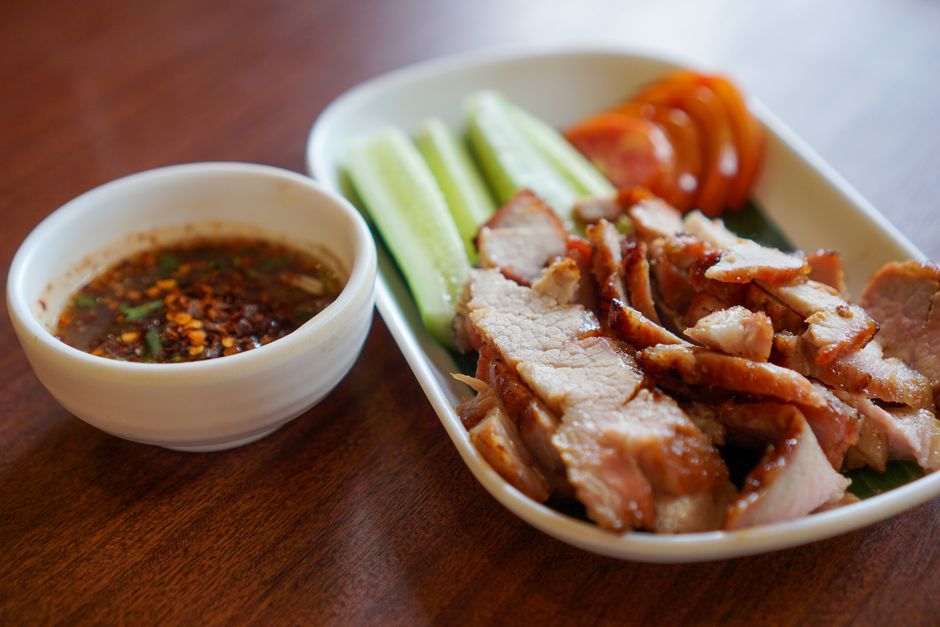
Pork is safe to eat when it reaches an internal temperature of 145°F (63°C), followed by a three-minute rest. This single number applies to pork chops, pork loin, pork tenderloin, and fresh ham roasts. Ground pork is the exception: it must reach 160°F (71°C).
That guidance comes from the USDA, and it has been in place since 2011. Before then, the recommended target was 160°F, which is why so many people still cook pork until it is gray and dry. The change followed years of data showing that modern pork production had dramatically reduced the risk of the parasite that once made higher temperatures necessary.
Getting this right matters for two reasons. Cook pork to 145°F and you get meat that is juicy and slightly pink in the center — and still safe. Cook it further and you lose quality without gaining meaningful safety.
Why Did the Recommended Pork Temperature Change?
The old 160°F standard was not arbitrary. It was a response to a real problem.
For much of the 20th century, pork carried a risk of Trichinella, a parasitic roundworm. Humans get trichinellosis by eating undercooked meat containing the larvae. The illness causes fever, muscle pain, and gastrointestinal symptoms, and in severe cases it can affect the heart and nervous system. Cooking pork to 160°F was a reliable way to kill the parasite.
What changed was the pig, not the parasite. Changes in commercial pig farming — including indoor housing that limits exposure to rodents and wildlife, and regulations against feeding raw garbage to pigs — broke the transmission cycle. Trichinella in commercial US pork became rare. Most US cases now trace to wild game meat or to pork from non-commercial or backyard settings, not to supermarket pork.
Once the parasite risk dropped, food safety authorities re-evaluated the temperature needed to kill the bacteria that actually matter in pork today, mainly Salmonella, Listeria, and E. coli. Those organisms are destroyed at lower temperatures than Trichinella larvae. The USDA lowered its recommendation to 145°F with a three-minute rest in 2011.
What Does the Three-Minute Rest Actually Do?
The rest is not about letting the meat relax. It is a food safety step.
When you pull pork off the heat at 145°F, the temperature continues to rise slightly as heat moves from the exterior to the center. During the rest, the meat holds at or above 145°F for at least three minutes. That combination — reaching 145°F and staying there for three minutes — is what delivers the same pathogen kill that a higher peak temperature would achieve instantly.
Practically, this means a few things:
- Use a digital instant-read thermometer. Color and juice clarity are unreliable indicators.
- Measure at the thickest part, avoiding bone, fat, and gristle, which conduct heat differently and give false readings.
- Start checking a few degrees before your target, since temperature climbs fast near the end.
- Let the meat rest on a cutting board or plate for at least three minutes before slicing. Five minutes is fine and helps with juiciness too.
Tent it loosely with foil if you like. Just do not skip the rest or cut immediately.
Is Pink Pork Actually Safe?
Yes. Pink pork at 145°F is safe, and the color is expected.
The long-standing belief that pink pork is undercooked comes from the era when 160°F was the standard. At 160°F, pork is uniformly pale. At 145°F, the center retains a blush of pink — sometimes quite noticeable — because the myoglobin pigment in the muscle has not fully denatured.
Here is the part that trips people up: color is a poor safety indicator in both directions. Pork can look pink even when it has reached a safe temperature, and modern pork can occasionally look pale gray before it hits 145°F. The USDA notes that color and texture are not reliable ways to judge doneness. The thermometer is.
The same logic applies to juice color. Clear or pinkish juices do not tell you whether the meat is safe. Only the internal temperature does.




What About Ground Pork and Sausage?
Ground pork needs 160°F (71°C), not 145°F. This is a different standard for a specific reason.
When meat is ground, surface bacteria get mixed throughout the entire mass. On a whole cut like a pork chop, contamination sits mostly on the outside, where it is exposed to the hottest part of the pan. Once ground, bacteria are distributed inside, so the interior must reach a temperature that kills them directly.
That 160°F target applies to:
- Ground pork and pork burgers
- Fresh pork sausage
- Meatloaf and meatballs made with ground pork
- Any dish where raw ground pork is blended into a mixture
The same 160°F rule applies to ground meat of any kind — beef, veal, lamb, and pork alike. It is one of the few places where pork and beef guidance match exactly.
Pork Temperature Chart
Different cuts and preparations have different targets. Here is the reference:
| Pork Type | Safe Internal Temperature | Rest Time |
|---|---|---|
| Pork chops, loin, tenderloin, fresh ham roast | 145°F (63°C) | 3 minutes |
| Ground pork, pork burgers, fresh sausage | 160°F (71°C) | None required |
| Pre-cooked ham (to reheat) | 140°F (60°C) | None required |
| Fully cooked ham, ready to eat | Cold or heated to preference | None required |
The ham distinction matters. A fully cooked, ready-to-eat ham is already safe straight from the package — reheating is about taste, not safety. A ham labeled “cook before eating” is raw or partially cooked and needs to reach 145°F like any other fresh pork roast.
Does the Cut Change the Target Temperature?
No. The 145°F target applies to all whole-muscle pork cuts, regardless of how you cook them.
What changes is how you get there. A pork tenderloin is thin and cooks quickly. A bone-in pork shoulder is thick and full of connective tissue, and it needs long, slow cooking to become tender. That is a texture issue, not a safety one. Once any of these cuts hits 145°F, it is safe to eat.
Some traditional recipes call for cooking pork shoulder or ribs to 195-205°F. That is not a safety requirement. It is the temperature range where collagen breaks down and the meat becomes pull-apart tender. You can safely eat pork shoulder at 145°F, though it will be tough. The higher temperature is about eating quality.
One practical note on carryover cooking: large roasts continue to rise in temperature after they come out of the oven, sometimes by 5-10°F. If you are roasting a large piece, pulling it at 140-142°F and letting it rest can land you right at 145°F. For thin cuts like chops, carryover is minimal.
What Are the Risks of Undercooked Pork?
Eating pork below 145°F carries a real risk of foodborne illness.
The main bacterial concerns in pork today are Salmonella, Listeria monocytogenes, E. coli, and Yersinia enterocolitica. Symptoms of infection typically appear within hours to a few days and include nausea, vomiting, diarrhea, abdominal cramps, and fever. Most healthy adults recover without treatment, but the illness can be serious — and occasionally life-threatening — for infants, older adults, pregnant women, and people with weakened immune systems.
Trichinella remains a concern in specific contexts. The CDC notes that most US trichinellosis cases in recent decades have been linked to eating undercooked wild game, particularly bear meat, and to pork from non-commercial sources. If you are cooking pork from a backyard pig, a hunted animal, or an unfamiliar source, treat 145°F with a three-minute rest as the minimum, not a suggestion.
Freezing does not reliably kill Trichinella larvae under typical home freezer conditions, so do not count on it as a substitute for proper cooking.
How Should You Measure Pork Temperature Accurately?
A digital instant-read thermometer is the only reliable tool. Pop-up timers and color checks are not accurate enough.
A few habits make the reading trustworthy:
- Insert the probe into the thickest part of the meat, away from bone, fat, and any stuffing.
- For thin cuts like chops, insert from the side rather than the top to reach the center.
- Wait for the reading to stabilize — most digital thermometers take 5-15 seconds.
- Check more than one spot on larger roasts, since heat distributes unevenly.
- Calibrate your thermometer periodically using ice water (32°F) and boiling water (212°F at sea level).
If you are cooking a stuffed pork roast, the stuffing must also reach 165°F. That is a separate standard because stuffing is dense and heats more slowly than the meat around it.
The short version: 145°F with a three-minute rest for whole cuts, 160°F for ground pork, and a working thermometer every time. That covers almost everything that matters.
Frequently Asked Questions
Is pork safe at 145°F?
Yes. The USDA recommends 145°F (63°C) as the safe minimum internal temperature for whole cuts of pork, followed by a three-minute rest. This applies to pork chops, loin, tenderloin, and fresh ham roasts.
Can you eat pork slightly pink in the middle?
Yes, if it reached 145°F and rested for three minutes. Pink color in pork is normal at that temperature and is not a sign of unsafe meat.
Why does ground pork need a higher temperature than pork chops?
Grinding mixes surface bacteria throughout the meat, so the interior must reach a temperature that kills them directly. Ground pork must reach 160°F (71°C), compared with 145°F for whole cuts.
Does freezing pork kill Trichinella?
Not reliably under typical home freezer conditions. Proper cooking to 145°F with a three-minute rest is the dependable way to eliminate the parasite.
