
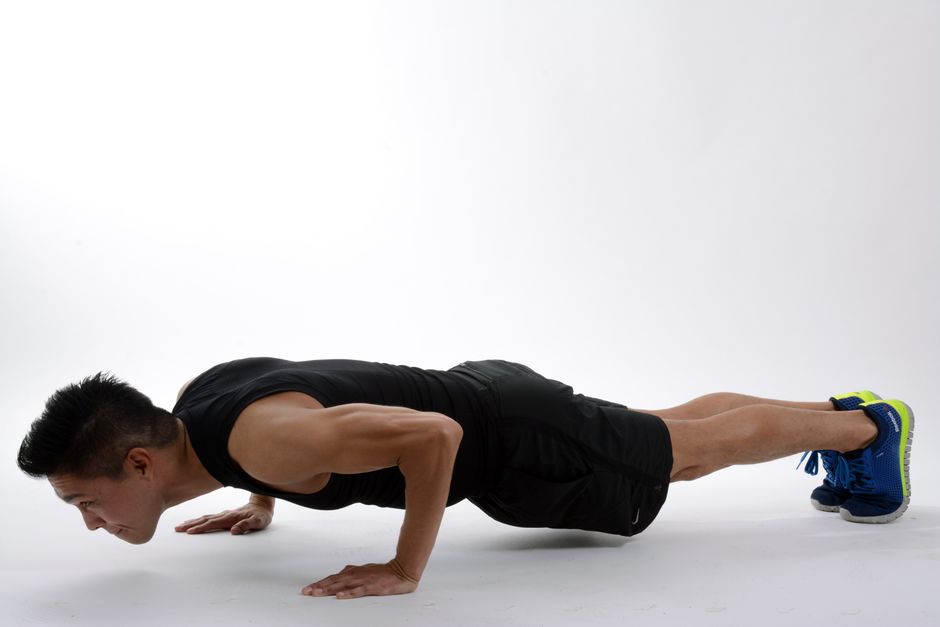
A pushup is a full-body movement, but its primary job is to work the muscles of your chest, shoulders, and triceps. While your arms and chest do the heavy lifting, your core, back, and legs must work as stabilizers to keep your body in a straight line. You cannot do a proper pushup without engaging muscles from your head to your heels, making it one of the most efficient upper-body exercises available.
What Muscles Does a Pushup Require for the Pressing Motion?
The actual pushing phase of the pushup relies on three main muscle groups. These are the prime movers, meaning they generate the force required to lift and lower your body weight.
The pectoralis major, or the chest muscle, is the largest and strongest muscle used in the pushup. It works to bring your arms together and across your body, which is the horizontal pressing motion. The upper portion of the chest is heavily recruited when your hands are positioned below your shoulders, while the lower chest fibers become more active when your hands are placed further forward.
The anterior deltoid, located at the front of your shoulder, is the second major mover. It assists the chest in lifting your body by raising your arms forward. This muscle is particularly active during the initial push-off from the bottom position.
The triceps brachii, located on the back of your upper arm, is responsible for straightening your elbow. As you press your body away from the floor, your triceps contract to lock out your arms. The closer your hands are together, the more work your triceps must do relative to your chest.
What Role Do the Core Muscles Play in a Pushup?
Your core is not a secondary player in the pushup; it is essential for maintaining proper form. Without a strong core, your hips will sag, and your lower back will bear an unsafe amount of stress.
The rectus abdominis, the muscle running down the front of your abdomen, contracts to prevent your spine from arching. The transverse abdominis, the deepest abdominal muscle, acts like a corset, bracing your midsection to create intra-abdominal pressure. This pressure stabilizes your spine and transfers force from your upper body to your lower body.
Your obliques, located on the sides of your waist, work to prevent your hips from rotating or shifting side to side. If you have ever felt your body twist during a pushup, it is your obliques failing to hold you in alignment. The erector spinae muscles along your spine also activate to keep your torso rigid, working against gravity’s pull on your lower back.
How Do the Legs and Back Contribute to Stability?
Your legs and upper back do not move during a standard pushup, but they are actively working to keep your body rigid. This isometric contraction is what separates a good pushup from a sloppy one.
The gluteus maximus, or your buttock muscle, contracts to keep your hips level. If your glutes are not engaged, your hips will drop toward the floor, placing excessive strain on your lower back. Squeezing your glutes at the top of the pushup is a common cue to ensure they are active.
The quadriceps, the muscles on the front of your thighs, contract to keep your knees straight. This locks your legs into a rigid line that extends from your shoulders to your ankles. Your calf muscles also activate to maintain tension through your toes, which are the only point of contact with the floor at your lower body.
Your upper back muscles, including the rhomboids and serratus anterior, work to stabilize your shoulder blades. The serratus anterior, which wraps around your ribs, is particularly important. It pulls your shoulder blades forward and keeps them pressed against your ribcage, preventing your shoulders from collapsing inward.





Do Different Pushup Variations Change the Muscles Used?
Yes. Adjusting your hand position or the angle of your body shifts the emphasis between the chest, shoulders, and triceps. The movement pattern stays the same, but the load distribution changes.
Wide-grip pushups place your hands further than shoulder-width apart. This increases the stretch and activation of the pectoralis major while reducing the workload on your triceps. The wider your hands, the more your chest must work to bring your arms together.
Close-grip pushups place your hands directly under your shoulders or closer together. This shifts the emphasis to your triceps and the inner portion of your chest. Your shoulders also work harder because the movement requires more elbow extension and less horizontal adduction.
Incline pushups, performed with your hands on a bench or wall, are easier because they reduce the percentage of body weight you must lift. They primarily target the lower portion of the chest. Decline pushups, performed with your feet elevated, increase the load on your upper chest and shoulders while requiring more core strength to maintain your body position.
How Many Pushups Should You Do to Build Muscle?
The number of repetitions depends on your current strength level and your goal. For muscle growth, you need to challenge your muscles to the point of fatigue within a specific rep range.
For most people, performing 8 to 12 repetitions per set is effective for building muscle size, known as hypertrophy. If you can perform more than 20 pushups with perfect form, you are primarily building muscular endurance rather than size. To continue building strength, you must make the exercise harder by adding weight, elevating your feet, or slowing down the tempo.
Performing 3 to 4 sets with adequate rest between sets is a standard approach. Rest periods of 60 to 90 seconds allow your muscles to recover enough to maintain intensity on the next set. If you can only perform 5 pushups, that is fine. Start there and gradually increase your repetitions each week.
What Are Common Mistakes That Reduce Muscle Activation?
Poor form reduces the effectiveness of the pushup and increases your risk of injury. The most common mistake is allowing your hips to sag, which shifts the work away from your chest and onto your lower back.
Another frequent error is flaring your elbows out to the sides at a 90-degree angle to your torso. This position places excessive stress on the shoulder joint and reduces triceps activation. Keeping your elbows at a 45-degree angle to your body is safer and more effective.
Half reps are also a problem. Lowering your body only halfway reduces the range of motion and decreases the amount of muscle fiber recruitment. To get the full benefit, lower your chest until it is just above the floor, then press back up until your arms are fully extended.
Moving too quickly is the final common error. Fast, jerky repetitions rely on momentum rather than muscle contraction. Slowing down the lowering phase to a two-second count increases the time your muscles spend under tension, which is a key driver of muscle growth.
Frequently Asked Questions
Do pushups build a bigger chest?
Yes, pushups can build chest muscle, especially for beginners. As you get stronger, you will need to add resistance or perform harder variations to continue seeing growth.
Are pushups enough to build upper body strength?
Pushups are excellent for building pushing strength, but they do not work the pulling muscles of your back and biceps. You need to include pulling exercises like rows or pull-ups for balanced upper body strength.
How often should you do pushups?
You can do pushups 3 to 4 times per week with at least one rest day between sessions. Your muscles need time to recover and repair before they grow stronger.
Can pushups hurt your wrists?
Pushups can strain your wrists if you lack mobility or have weak wrists. Performing pushups on your fists or using pushup handles can reduce wrist extension and relieve discomfort.
