
Your digestive system is a long tube that runs from your mouth to your anus, and its main purpose is to break food down into molecules small enough to enter your bloodstream. Every cell in your body depends on that supply of fuel and building material. The system also keeps what you swallow out of your internal tissues, which is why most of the tube is lined with cells sealed tightly together. What most people don’t know is that digestion is mostly not about stomach acid. It is about a chain of controlled steps, each timed to the next, and most of the work happens before food ever reaches your stomach.
What is the main purpose of the digestive system?
The main purpose of the digestive system is to convert food into usable energy and raw materials while keeping the inside of your body separate from the outside world. It does this through four linked jobs: movement, secretion, digestion, and absorption.
Movement means pushing food along the tract at the right speed. Secretion means releasing enzymes, acid, bile, and water at the right places. Digestion means breaking large molecules into small ones. Absorption means pulling those small molecules through the intestinal wall into the blood or lymph.
There is a fifth job people rarely think about: defense. Your gut is the largest surface your body presents to the outside world. The lining has to let nutrients through while keeping bacteria, toxins, and undigested proteins out. That selective barrier is one of the most important functions of the whole system.
Every one of these jobs is regulated by nerves and hormones. The digestive tract has its own network of nerve cells embedded in its walls, sometimes called the enteric nervous system. It can run much of digestion on its own, which is why your gut keeps working even when you are not consciously thinking about it.
What happens to food before it reaches your stomach?
Most of the early work of digestion happens in your mouth and is easy to overlook. Chewing breaks food into smaller pieces and mixes it with saliva. Saliva contains an enzyme called amylase that begins breaking down starch into sugars.
Swallowing triggers a reflex that pushes food into your esophagus, a muscular tube that moves it to your stomach through waves of contraction called peristalsis. This is not gravity doing the work. The esophagus pushes food down even if you are lying flat.
At the bottom of the esophagus is a ring of muscle called the lower esophageal sphincter. It opens to let food through and then closes to keep stomach contents from moving back up. When it relaxes at the wrong time, you get reflux.
One clarification worth making: saliva’s starch-digesting enzyme does not finish the job. Stomach acid quickly shuts it down. The idea that you can “digest carbohydrates in your mouth” is true only in a small, early sense.
What does the stomach actually do?
The stomach’s main jobs are to store food, churn it into a semi-liquid mixture, and start protein digestion. It is a muscular bag that holds what you eat and releases it into the small intestine in a slow, controlled trickle.
Stomach cells release hydrochloric acid, which makes the contents highly acidic. This acidity kills many bacteria and activates an enzyme called pepsin, which begins breaking proteins apart. The stomach also releases a substance called intrinsic factor, which your body needs to absorb vitamin B12 from food.
Contrary to common belief, very little absorption happens in the stomach. Water, some medications, and a small amount of alcohol can cross the stomach lining, but the vast majority of nutrient absorption happens later, in the small intestine.
The stomach lining protects itself from its own acid with a layer of mucus and rapid cell replacement. When that protection fails, ulcers can form. Most ulcers are linked to a bacterium called Helicobacter pylori or to long-term use of certain pain medications, not to spicy food or stress as many people assume.




Where does most nutrient absorption happen?
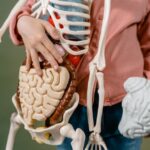
Most nutrient absorption happens in the small intestine, a coiled tube roughly 20 feet long in adults. Its inner surface is folded and covered in tiny finger-like projections called villi, and each villus is covered in even smaller projections called microvilli.
This structure creates an enormous surface area for absorption. If you could flatten out the absorptive surface of the small intestine, it would cover a large area — far more than the outside of the tube suggests. That surface is where sugars, amino acids, fatty acids, vitamins, and minerals cross into the body.
The small intestine has three sections. The first, the duodenum, receives partly digested food from the stomach along with bile from the liver and enzymes from the pancreas. The middle and final sections, the jejunum and ileum, do most of the absorbing.
Bile matters more than many people realize. It is made in the liver, stored in the gallbladder, and released into the small intestine, where it breaks large fat droplets into smaller ones so enzymes can act on them. Bile is not an enzyme. It is a detergent-like substance that makes fat digestion possible.
What does the large intestine do that people overlook?
The large intestine absorbs water and salts and turns what is left into stool. It is shorter than the small intestine but wider, and it does far more than store waste.
By the time material reaches the large intestine, most nutrients are already gone. What remains is mostly fiber, water, and undigested material. The large intestine reclaims much of that water, which is why stool becomes solid.
The large intestine also houses a dense community of bacteria, often called the gut microbiome. These bacteria ferment some of the fiber you cannot digest and produce short-chain fatty acids that the colon lining uses for energy. The microbiome is a genuinely active area of research, and its full role in health is still being worked out. Claims that specific foods or supplements “fix” the microbiome are ahead of the evidence.
Why does digestion involve so many organs?
Digestion involves many organs because each step needs the right conditions, and the body cannot do them all in one place. The liver, gallbladder, and pancreas are not part of the tube itself, but they supply essential substances at the right moment.
The pancreas releases enzymes that break down proteins, fats, and carbohydrates, plus a substance that neutralizes stomach acid so those enzymes can work. The liver processes absorbed nutrients and makes bile. The gallbladder stores and concentrates bile until fat arrives.
Timing is the point. Enzymes that work in the small intestine would be destroyed by stomach acid. Fat-digesting enzymes need bile present at the same time. The system coordinates through hormones and nerve signals so each substance arrives when it can do its job.
How long does digestion take?
Digestion takes roughly a day or more from the moment you swallow to the moment waste leaves your body, though the range varies widely between people and between meals. The stomach typically empties within a few hours, and the small intestine takes several more. The large intestine can hold material for a day or longer.
These are general figures, not fixed rules. Meal size, fat content, fiber, hydration, physical activity, medications, and individual physiology all shift the timeline. There is no single “normal” transit time that applies to everyone.
What most people get wrong about digestion
Several common beliefs about digestion do not hold up. The most widespread is that digestion happens mainly in the stomach. In reality, the stomach is mostly a holding and mixing chamber, and the small intestine does the heavy lifting of absorption.
Another common belief is that you should wait an hour after eating before swimming. There is no good evidence that this prevents cramps or drowning. The idea that chewing gum stays in your body for seven years is also false. And the notion that your stomach lining is replaced entirely every few days is an oversimplification — some cells turn over quickly, but the process is more complex than that.
Digestive problems are common, and most are manageable, but persistent symptoms like blood in the stool, unexplained weight loss, severe pain, or lasting changes in bowel habits deserve medical attention rather than self-treatment.
Frequently Asked Questions
What is the main purpose of the digestive system?
Its main purpose is to break food down into molecules your body can absorb and use for energy and repair. It also acts as a barrier that keeps harmful substances out of your internal tissues.
Where does most nutrient absorption take place?
Most absorption happens in the small intestine, especially its middle and final sections. The stomach absorbs very little.
How long does food take to digest?
Roughly a day or more from swallowing to elimination, though the range varies widely between people. There is no single normal transit time.
Does digestion mostly happen in the stomach?
No. The stomach mainly stores and mixes food and starts protein digestion. Most chemical digestion and nearly all nutrient absorption happen in the small intestine.
