
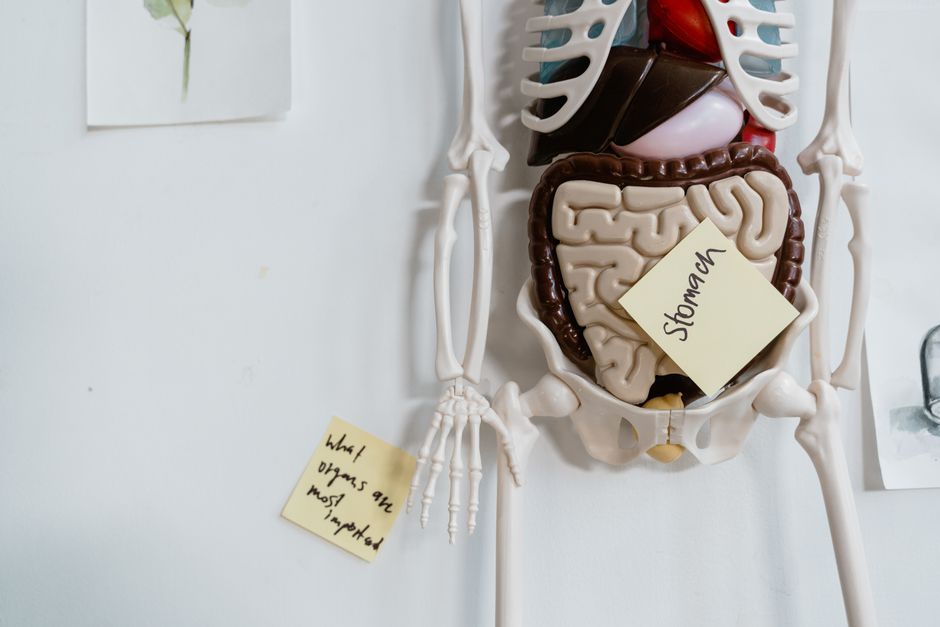
The digestive system is a long, coordinated tube from your mouth to your anus, with a few extra organs attached that help break down food. The main organs are the mouth, esophagus, stomach, small intestine, large intestine, rectum, and anus. The liver, pancreas, and gallbladder are also essential, though food does not pass through them.
What Are the Main Organs for the Digestive System in Order?
The digestive tract works in a clear sequence. Food enters at the mouth and exits at the anus. Here is the correct order of the main organs:
- Mouth – Chewing starts mechanical breakdown. Saliva contains enzymes that begin digesting starch.
- Esophagus – A muscular tube that pushes food down to the stomach using wave-like contractions called peristalsis.
- Stomach – Churns food and mixes it with acid and enzymes. This turns solid food into a liquid called chyme.
- Small intestine – The longest organ at about 20 feet. Most digestion and almost all nutrient absorption happen here.
- Large intestine – Absorbs water and electrolytes. Turns liquid waste into solid stool.
- Rectum – Stores stool until it is time to go.
- Anus – The exit point.
The liver, pancreas, and gallbladder connect to the small intestine. The liver makes bile, which helps break down fat. The gallbladder stores bile until it is needed. The pancreas produces digestive enzymes that break down proteins, fats, and carbohydrates.
How Do the Accessory Organs Help Digestion?
Three organs outside the digestive tube are just as important as the ones food passes through. The liver performs over 500 functions, but for digestion its main job is making bile. Bile is not an enzyme. It works like soap to break fat globules into smaller droplets so enzymes can reach them.
The gallbladder sits under the liver and stores bile. When you eat a fatty meal, the gallbladder squeezes bile into the small intestine. People who have their gallbladder removed can still digest fat, but bile drips continuously instead of being released in one strong burst. Some people report looser stools after gallbladder removal.
The pancreas is perhaps the most underrated organ in digestion. It produces a full set of enzymes that digest proteins, carbohydrates, and fats. It also releases bicarbonate to neutralize stomach acid when chyme enters the small intestine. Research published in Gastroenterology shows that pancreatic enzyme insufficiency is more common than doctors once thought, especially in people with chronic digestive complaints.
What Does the Small Intestine Actually Do?
The small intestine has three sections: the duodenum, jejunum, and ileum. Most people think the stomach does the heavy lifting, but the small intestine is where the real work happens. About 90 percent of nutrient absorption occurs here.
The inner lining of the small intestine is not smooth. It is covered in tiny finger-like projections called villi. Each villus is covered in even smaller microvilli. This structure increases the surface area to about the size of a tennis court. If the small intestine were a smooth tube, you would not absorb enough nutrients to survive.
Digestion in the small intestine depends on enzymes from the pancreas and bile from the liver. The intestinal wall itself also produces enzymes that finish breaking down sugars and proteins. The villi absorb individual nutrients — sugars, amino acids, fatty acids, vitamins, and minerals — and pass them into the bloodstream or lymphatic system.
Conditions like celiac disease damage the villi. When the villi flatten, absorption drops. The CDC reports that about 1 in 141 Americans have celiac disease, though many are undiagnosed. This is why some people feel better on a gluten-free diet even without a formal diagnosis — their villi may be damaged and need time to heal.




How Long Does Food Take to Travel Through the Digestive System?
Total transit time varies widely between people. Research shows it can range from 24 to 72 hours in healthy adults. The mouth-to-stomach part is fast — about 5 to 10 seconds for liquids and 30 seconds to a few minutes for solid food.
Food stays in the stomach for 2 to 5 hours depending on what you ate. High-fat meals take longer. Protein also slows stomach emptying. Carbohydrates leave the stomach fastest.
The small intestine processes food for 2 to 6 hours. The large intestine is the slowest section. Waste can sit there for 12 to 48 hours as water is absorbed and stool forms. This is why fiber matters. Soluble fiber slows digestion in the small intestine, which helps steady blood sugar. Insoluble fiber speeds things through the large intestine and prevents constipation.
One study from the Mayo Clinic found that people who eat a Western diet low in fiber have transit times closer to 40 hours or more. People who eat high-fiber diets often see transit times under 30 hours. Faster transit generally means less water is absorbed, which produces softer stool. Slower transit means harder stool and more strain during bowel movements.
What Are the Main Organs for the Digestive System and Their Common Problems?
Each organ has specific issues that can disrupt digestion. Here is a comparison of common problems by organ:
| Organ | Common Problem | What Happens |
|---|---|---|
| Mouth | Chewing difficulty | Poorly chewed food forces the stomach to work harder, leading to bloating and reflux. |
| Esophagus | GERD (acid reflux) | Stomach acid backs up into the esophagus, causing heartburn. Long-term damage can lead to Barrett’s esophagus. |
| Stomach | Gastritis or ulcers | Inflammation or open sores in the stomach lining. H. pylori infection is a common cause. |
| Small intestine | Celiac disease or SIBO | Villi damage from gluten or bacterial overgrowth. Both cause malabsorption and bloating. |
| Large intestine | Irritable bowel syndrome (IBS) | Abnormal muscle contractions cause cramping, diarrhea, or constipation. Affects 10 to 15 percent of US adults. |
| Liver | Fatty liver disease | Fat builds up in liver cells. Affects about 25 percent of Americans. Often linked to diet and alcohol. |
| Pancreas | Pancreatitis | Inflammation of the pancreas. Can be acute or chronic. Alcohol and gallstones are common triggers. |
| Gallbladder | Gallstones | Hard deposits form in the gallbladder. Can block bile flow and cause severe pain. |
Many digestive problems share symptoms like bloating, gas, and abdominal pain. This makes self-diagnosis unreliable. A doctor can test for specific conditions. For example, a breath test can detect SIBO. Blood tests can check for celiac disease. Imaging can find gallstones or fatty liver.
What Does Not Belong in the Digestive System?
Some organs are commonly mistaken as part of the digestive system. The kidneys filter blood and produce urine. They are part of the urinary system, not the digestive system. The spleen filters blood and helps fight infection. It sits near the stomach but has no role in digestion.
The appendix is a small pouch attached to the large intestine. For decades, doctors thought it was a useless leftover from evolution. Current research suggests it may serve as a reservoir for beneficial gut bacteria. If you lose your appendix, you digest food normally. It is not considered one of the main organs for the digestive system.
The tongue is part of the mouth and helps move food for chewing and swallowing. Some lists include it as a digestive organ. Strictly speaking, it is an accessory muscle that aids the mouth. It does not produce digestive enzymes or absorb nutrients.
Frequently Asked Questions
What is the largest organ in the digestive system?
The small intestine is the longest at about 20 feet. The liver is the heaviest digestive organ, weighing about 3 pounds in adults.
Does the stomach digest most of your food?
No. The stomach mainly breaks food into liquid and starts digesting protein. The small intestine does most of the actual digestion and almost all nutrient absorption.
Can you digest food without a gallbladder?
Yes. Bile still flows from the liver into the small intestine, just in a steady trickle instead of a large release. Most people adapt within a few months.
What organ produces digestive enzymes?
The pancreas produces the main digestive enzymes for breaking down proteins, fats, and carbohydrates. The small intestine also produces some enzymes on its inner surface.
