
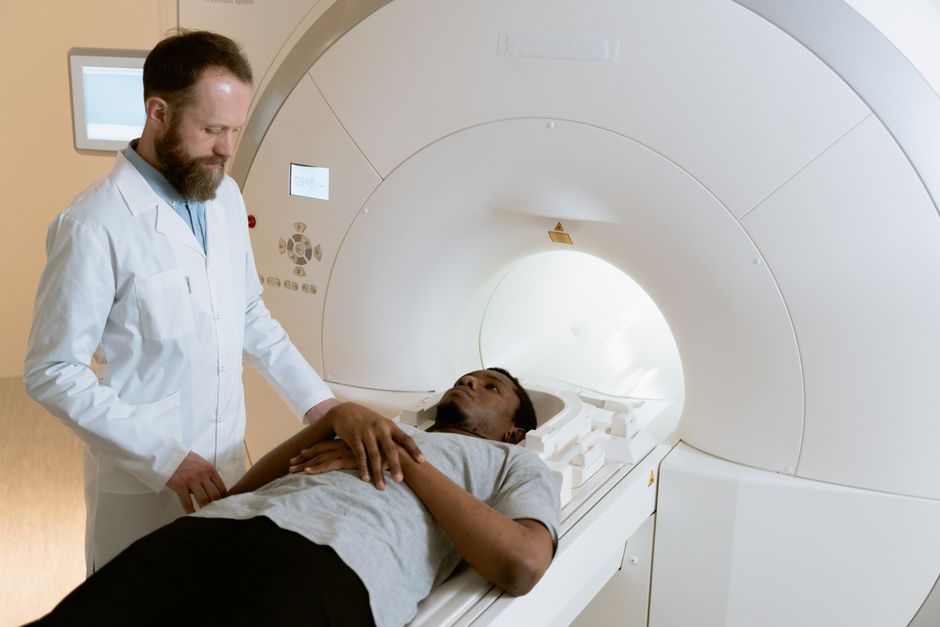
If you have ever been handed a drink, or told you would get an injection, before a CT scan, you may have wondered what that liquid actually is. The short answer: CT contrast is a substance — usually iodine-based for injections or barium- and iodine-based for drinks — that temporarily changes how X-rays pass through your body so certain tissues show up more clearly on the scan.
Contrast does not treat anything. It does not stay in your body. It is a viewing aid, and its only job is to make blood vessels, organs, and abnormal tissue easier for a radiologist to see. Most CT scans do not use contrast at all. When they do, the type chosen depends on what part of the body is being examined and what the doctor is looking for.
What Is In Contrast For CT Scan?
CT contrast contains elements that block X-rays more strongly than normal body tissue does. Iodine and barium are the two main ones, and both are heavy atoms that absorb X-rays well. That absorption difference is what creates the brighter areas on the final image.
There are three broad categories:
- Intravenous (IV) contrast — an iodine-based liquid injected into a vein, usually in the arm. It travels through the bloodstream and highlights blood vessels and organs.
- Oral contrast — a liquid you drink, typically containing barium or a water-soluble iodine compound. It outlines the stomach and intestines.
- Rectal contrast — a liquid given as an enema, used less often, to outline the lower colon.
Some scans use more than one type at once. A CT of the abdomen and pelvis, for example, might use both oral and IV contrast so the bowel and the organs around it can be told apart.
What Is the Difference Between Iodine and Barium Contrast?
Iodine and barium are both X-ray blockers, but they behave differently in the body and are used for different purposes. The choice is not arbitrary. It depends on the body part, the clinical question, and whether there is any concern about a tear or leak in the bowel.
| Feature | Iodine-based | Barium-based |
|---|---|---|
| Main use | IV injection; some oral and rectal | Oral and rectal only |
| Route | Vein, mouth, or rectum | Mouth or rectum |
| Appearance on scan | Bright white | Bright white |
| Key safety concern | Allergic reaction; kidney effects in some patients | Leakage into the abdominal cavity if the bowel is perforated |
Iodine is the only one of the two that can be given intravenously, because barium is not safe in the bloodstream. Barium is generally preferred for oral use when the bowel is intact because it coats the lining well and produces sharp images. If a perforation is suspected, a water-soluble iodine contrast is usually chosen instead, because barium leaking into the abdomen can cause serious inflammation.
Why Does Contrast Make a Difference on a CT Scan?
Without contrast, many soft tissues look similar to each other on a CT image. Muscle, lymph nodes, and some tumors can appear in roughly the same shade of gray. Contrast changes that by distributing differently through the body based on blood flow and tissue type.
Tumors often grow their own blood vessels, and those vessels tend to be abnormal. As a result, some tumors take up IV contrast differently than the surrounding healthy tissue does. That difference is what makes them visible. The same principle applies to inflammation, abscesses, and blood vessel problems like aneurysms or clots.
For the bowel, oral contrast does something simpler: it fills the space. An empty or collapsed loop of intestine is hard to evaluate. Filling it with a bright liquid separates the wall from everything around it.



What Does Contrast Feel Like During the Scan?
IV contrast is usually noticeable. Many people feel a sudden warmth spreading through the body, often described as a flush. Some feel a metallic taste in the mouth. A few feel a brief sensation like they might have urinated, even though they have not. These feelings pass within a minute or two and are not dangerous.
Oral contrast is different. Barium has a chalky texture and is often described as thick or mildly unpleasant to drink. Some facilities chill it or add flavoring. Water-soluble iodine oral contrast tends to taste salty or bitter. Neither is painful to swallow.
You may be asked to hold still and follow breath instructions during the scan. Movement blurs the image, and a blurred scan may need to be repeated.
Who Should Not Receive CT Contrast?
Not everyone should get contrast, and the decision is made case by case. The most important considerations are kidney function, prior reactions, and certain medical conditions.
IV iodine contrast is cleared by the kidneys. In people with significantly reduced kidney function, there is a risk of further kidney injury, though the magnitude of that risk has been debated and appears lower with modern contrast agents than older research suggested. Blood tests for kidney function are commonly checked before giving IV contrast, especially in people with diabetes, kidney disease, or those taking certain medications.
People who have had a prior allergic-like reaction to iodine contrast are at higher risk of another reaction. This does not always mean contrast must be avoided. Some radiologists use premedication with steroids and antihistamines, or choose a different agent. This is a clinical judgment, not a fixed rule.
Metformin, a common diabetes medication, has historically been a concern with IV contrast because of a rare condition called lactic acidosis. Current guidance from radiology organizations generally does not require stopping metformin for most patients with normal kidney function, but practice varies. If you take metformin, tell the imaging staff.
Pregnancy is another consideration. CT scans use ionizing radiation, and contrast may cross the placenta. If you are pregnant or think you might be, tell your doctor before the scan. Alternative imaging such as ultrasound or MRI may be considered.
People with a known allergy to barium, or with a suspected perforation of the bowel, should not receive barium by mouth or rectum.
What Are the Risks of CT Contrast?
The risks are real but generally uncommon. The most frequent issue is a mild reaction to IV iodine contrast: itching, a rash, or hives. These usually resolve on their own or with an antihistamine.
More serious reactions, including difficulty breathing, swelling of the throat, or a drop in blood pressure, are rare. Imaging centers keep emergency medications on hand and staff are trained to respond. If you have had a reaction before, say so clearly.
Kidney injury from IV contrast is a recognized risk, particularly in people with pre-existing kidney problems. The evidence on how often this occurs has shifted over time, and modern low-osmolar and iso-osmolar agents appear to carry lower risk than older ones. Some studies suggest the risk in people with normal kidneys is very low.
Barium that leaks into the abdominal cavity through a perforated bowel can cause severe inflammation. This is why water-soluble contrast is used when a perforation is suspected.
There is no evidence that CT contrast causes cancer, and it does not remain in the body. It is cleared within hours to a day or two, mostly through the kidneys or in stool.
How Should You Prepare for a CT Scan With Contrast?
Preparation depends on the type of contrast and the body part being scanned. Your imaging center will give you specific instructions, and those instructions should be followed exactly.
For oral contrast, you may be asked to arrive early and drink the liquid over a set period so it has time to move through the bowel. For IV contrast, you may be asked to avoid food for a few hours beforehand. You may also be asked for a recent blood test showing kidney function.
Tell the staff about:
- Any prior reaction to contrast
- Kidney disease or a single kidney
- Diabetes, especially if you take metformin
- Pregnancy or possible pregnancy
- Breastfeeding
- Thyroid conditions, particularly Graves’ disease or thyroid cancer treated with radioactive iodine
- Asthma or a history of severe allergies
If you are breastfeeding, ask your doctor about timing. Small amounts of IV contrast can pass into breast milk, but the amount is very small and absorption by the infant is limited. Many organizations no longer recommend interrupting breastfeeding after IV contrast, though guidance has changed over the years and practices differ. Ask your doctor for current advice.
Drinking plenty of water after the scan helps clear IV contrast from the body.
Does Everyone Need Contrast for a CT Scan?
No. Many CT scans are done without contrast, and adding it does not always improve the result. A CT for a kidney stone, for example, is often done without contrast because stones are already visible. A CT for a head injury or a sinus problem usually does not need contrast either.
Contrast is most useful when the question involves blood vessels, tumors, infection, inflammation, or the bowel. If your doctor orders a scan without contrast, it is not a lesser test. It is the right test for that specific question.
If you are unsure why contrast was or was not ordered, ask. Understanding the reason helps you prepare and helps you know what to expect.
Frequently Asked Questions
What is CT scan contrast made of?
Most CT contrast contains either iodine or barium, both of which block X-rays and appear bright on the scan. Iodine is used for IV injections and some oral and rectal preparations, while barium is used only by mouth or rectum.
Is CT contrast safe?
For most people, CT contrast is safe and the risks are low. Serious reactions are rare, but kidney injury and allergic reactions can occur, so tell your doctor about any kidney problems, prior reactions, or pregnancy before the scan.
How long does CT contrast stay in your body?
IV contrast is usually cleared by the kidneys within about 24 hours. Oral barium passes through the digestive system and is eliminated in stool, typically within a day or two.
Can I refuse contrast for a CT scan?
You can decline contrast, but the scan may not answer the question your doctor is asking. Talk with your doctor or the radiologist about why contrast was ordered and whether a different approach could work.
