
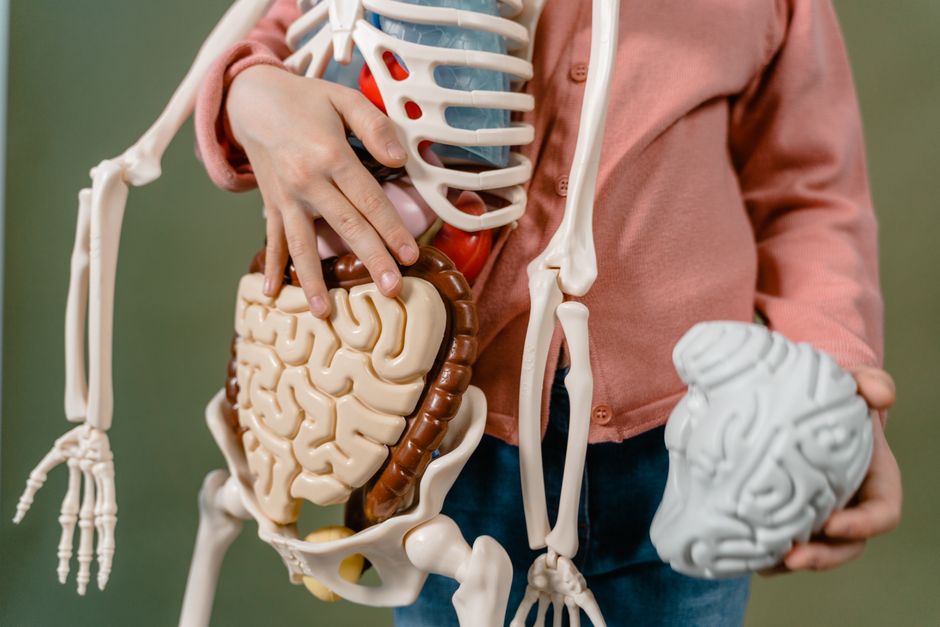
Chewing a bite of apple is mechanical digestion in action. Your teeth break the food into smaller pieces, and your tongue mixes it with saliva to form a soft ball you can swallow. No chemical bonds are broken in this step — the food simply gets smaller, which gives enzymes far more surface area to work on later.
That distinction matters. Mechanical digestion is physical breakdown. Chemical digestion is enzymatic breakdown. They happen together, but they are not the same process, and confusing them is one of the most common mix-ups in basic biology.
What Is an Example of Mechanical Digestion?
Chewing is the clearest example. Your incisors cut, your canines tear, and your molars grind. Each jaw movement reduces food into smaller fragments and mixes them with saliva, which contains the enzyme amylase. The amylase begins chemical digestion of starch, but the grinding itself is purely mechanical.
Other examples across the digestive tract include:
- Churning in the stomach — muscular contractions mix food with gastric juice and turn it into a semi-liquid called chyme.
- Segmentation in the small intestine — localized contractions slosh chyme back and forth, mixing it with digestive enzymes and bile.
- Peristalsis — wave-like muscle contractions that push contents forward through the esophagus, stomach, and intestines.
Peristalsis is worth separating from the others. It moves material along the tract rather than breaking it down, so some sources classify it as propulsion instead of mechanical digestion. Both descriptions appear in textbooks, and neither is wrong — it depends on whether the definition emphasizes mixing or movement.
How Is Mechanical Digestion Different From Chemical Digestion?
Mechanical digestion changes the size and shape of food. Chemical digestion changes its molecular structure. Your body needs both, and they overlap at almost every stage.
Consider a piece of bread. Chewing tears it into smaller pieces — mechanical. Salivary amylase starts breaking starch into shorter sugar chains — chemical. In the stomach, muscular contractions churn the bread into chyme — mechanical. Hydrochloric acid and pepsin begin breaking down protein — chemical. In the small intestine, segmentation mixes everything with pancreatic enzymes and bile — mechanical — while those enzymes split fats, proteins, and carbohydrates into molecules small enough to absorb — chemical.
One clarification that often gets lost: mechanical digestion does not make nutrients absorbable on its own. It makes them accessible. Without the enzymes, a finely ground meal would still pass through largely undigested. Without the grinding, enzymes would work only on the outer surface of each food piece, which would slow the whole process considerably.
Where Does Mechanical Digestion Happen in the Body?
Mechanical digestion starts in the mouth and continues through most of the digestive tract. Each region uses a different type of muscle movement for a different purpose.
| Location | Type of Movement | Main Job |
|---|---|---|
| Mouth | Chewing (mastication) | Break food into smaller pieces; mix with saliva |
| Esophagus | Peristalsis | Move swallowed food to the stomach |
| Stomach | Churning and grinding | Mix food with gastric juice; form chyme |
| Small intestine | Segmentation and peristalsis | Mix chyme with enzymes and bile; move it forward |
| Large intestine | Haustral contractions | Slow mixing; absorb water and electrolytes |
The stomach does more mechanical work than most people realize. Its muscular wall contracts roughly three times per minute when food is present, and the pylorus — the valve at the stomach’s exit — acts as a sieve, letting only small particles pass into the small intestine. Larger fragments get pushed back for more grinding.
-
 What is Special About an Owls Digestion? Explained Simply
 -
What Are the Functions in the Digestive System? Explained Simply
-
What Are the Symptoms of Stomach Inflammation? Explained Simply
-
What is Gut Health and Why is it Important? Explained Simply
-
Finessa Reviews & Complaints 2026: Helps In Gut & Digestion?



Why Does the Body Bother Breaking Food Down Physically?
Surface area is the reason. Enzymes work by contact, and contact happens at surfaces. A whole carrot has a small surface area relative to its volume. The same carrot chewed into dozens of pieces exposes far more surface to salivary amylase, stomach acid, and intestinal enzymes.
This is why chewing matters more than most people assume. Swallowing large chunks of food puts more strain on the stomach and slows the release of nutrients. It also raises the risk of choking, which is a mechanical problem with mechanical consequences.
There is a second reason that gets less attention. Mechanical digestion helps regulate how fast food leaves the stomach. The pylorus responds to particle size, so well-chewed food empties more smoothly than poorly chewed food. This is one reason eating quickly can feel uncomfortable — the stomach has to work harder to reach the particle size it needs.
Does Mechanical Digestion Happen Without Chewing?
Yes, but less efficiently. The stomach can break down food that arrives in large pieces, though it takes longer and the result is less thorough. People who lose their teeth or wear ill-fitting dentures often swallow larger fragments, and some research suggests this can affect how quickly and completely nutrients are absorbed.
Liquid and soft foods need almost no mechanical digestion in the mouth. They still get churned in the stomach, and segmentation still mixes them in the small intestine. The mechanical phase never disappears — it just requires less work when food arrives already broken down.
This is also why blended and pureed diets are used in clinical settings. They reduce the mechanical load on the upper digestive tract. The nutrients are the same. The work required to access them is not.
Can You Digest Food Without Mechanical Digestion?
Not fully. Chemical digestion depends on mechanical digestion to expose enough surface area for enzymes to act. Without it, digestion slows and absorption drops.
Some medical conditions affect mechanical digestion directly. Achalasia impairs peristalsis in the esophagus. Gastroparesis slows stomach emptying. Conditions that weaken the muscular wall of the gut can reduce segmentation and churning. In each case, the problem is mechanical — the muscles are not moving food the way they should — and the symptoms reflect that.
This is why clinicians sometimes describe digestive problems as either mechanical or chemical. The distinction helps narrow down what is going wrong and where.
What Happens to Food That Is Not Broken Down Mechanically?
It moves through more slowly and less completely. Large particles may reach the colon with nutrients still locked inside, where gut bacteria ferment them instead of your body absorbing them. This can cause gas, bloating, and loose stools.
It can also affect how well medications work. Some drugs are absorbed only in specific parts of the small intestine, and if food is moving through at the wrong pace or in the wrong form, absorption can change. This is one reason some medications come with instructions about taking them with food or on an empty stomach.
None of this means you need to chew a specific number of times per bite. No clinical guideline sets a target. The general principle is simple: the more thoroughly you chew, the less work the rest of your digestive tract has to do.
Frequently Asked Questions
What is an example of mechanical digestion?
Chewing food in your mouth is the clearest example. Your teeth physically break food into smaller pieces and your tongue mixes it with saliva to form a swallowable ball.
Is peristalsis an example of mechanical digestion?
It depends on the definition. Peristalsis moves food forward rather than breaking it down, so some sources classify it as propulsion instead of mechanical digestion. Both classifications appear in standard textbooks.
Where does mechanical digestion start?
It starts in the mouth with chewing. It continues in the stomach through churning and in the small intestine through segmentation.
Does mechanical digestion break chemical bonds?
No. Mechanical digestion only changes the physical size and shape of food. Chemical digestion, carried out by enzymes and acid, is what breaks molecular bonds.
