
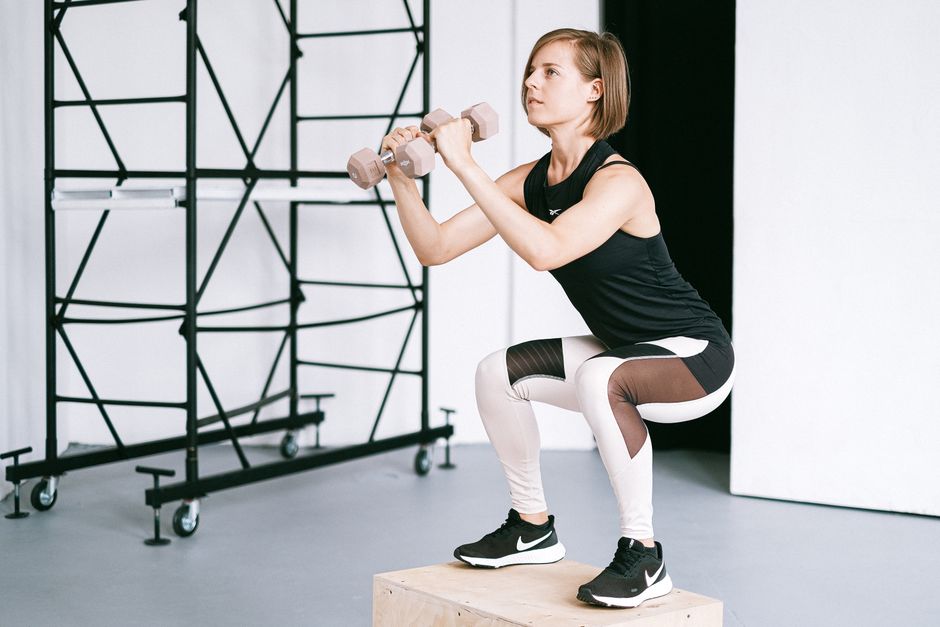
Bulgarian split squats are a single-leg exercise where your rear foot is elevated on a bench or similar surface behind you. You lower your body straight down until your front thigh is roughly parallel to the floor, then push back up through your front heel. This movement is a demanding lower-body strength exercise that primarily targets the quadriceps and glutes while demanding significant balance and stability from your entire core.
What Muscles Do Bulgarian Split Squats Work?
The Bulgarian split squat is a compound exercise, meaning it works multiple muscle groups and joints at the same time. The primary muscles doing the work are the quadriceps (front of the thigh) and the gluteus maximus (buttocks). These muscles control both the lowering (eccentric) phase and the pushing (concentric) phase of the movement.
The muscles of the rear leg play an important supporting role. The hip flexors of the rear leg are stretched, and the muscles of the rear calf and hamstring work to stabilize the position. Your core muscles, including the abdominals and obliques, activate continuously to keep your torso upright and prevent you from tipping over or rotating to one side. The muscles around your ankle and foot also work hard to maintain balance on the standing leg.
Because the movement is unilateral, or single-leg, it can help address muscle imbalances between your left and right sides. Many common exercises, like the traditional barbell back squat, are performed with both legs. If one leg is stronger, it can compensate for the other. With a Bulgarian split squat, each leg must work independently, which makes strength differences more obvious and allows you to correct them over time.
How Is It Different From a Regular Split Squat?
The key difference is the position of the rear foot. In a regular split squat, also called a stationary lunge, your rear foot stays flat on the floor in front of you. In a Bulgarian split squat, the rear foot rests on an elevated surface, like a bench, chair, or plyo box.
Elevating the rear foot changes the mechanics of the movement in a few ways. It places a greater emphasis on the front leg because it forces the front leg to handle a larger share of your body weight. The elevated position also increases the range of motion, allowing for a deeper stretch in the front leg’s hip and thigh. This combination of greater load on the front leg and a longer range of motion generally makes the Bulgarian split squat more demanding than a regular split squat.
The elevated rear foot also reduces the ability of the back leg to help push you up. In a regular split squat, the back leg can contribute force. In the Bulgarian version, the back leg is mainly there for balance and support, not for generating power. This forces the front leg to do nearly all of the work, which is why many people find it much more challenging than it looks.
What Are the Main Benefits of This Exercise?
The primary benefit is significant strength development in the front leg. Because each leg works independently, you can build substantial strength in the quadriceps and glutes. Studies have shown that this exercise can produce similar or even greater activation of these muscles compared to a traditional back squat, despite using less overall weight.
Improved balance and stability are another major benefit. Your ankle, knee, hip, and core must all work together to keep you stable on one leg over a moving base of support. This carries over to everyday activities that require balance, such as walking on uneven ground or climbing stairs.
The exercise is also a practical way to build single-leg strength without needing heavy equipment. You only need your body weight and a stable surface to elevate your foot. As you get stronger, you can hold dumbbells at your sides or a barbell across your back to add resistance. This makes it a versatile option for home workouts and gym settings alike.

How Do You Perform a Bulgarian Split Squat Correctly?
Correct form is essential to get the benefits and avoid injury. Start by standing about two feet in front of a bench or sturdy chair, facing away from it. Place the top of your rear foot on the bench behind you. Your feet should be about hip-width apart.
Here is the setup and movement sequence:
- Position your front foot far enough forward that when you lower yourself, your front knee stays in line with your toes and does not travel far past them.
- Keep your torso upright and engage your core. Your chest should be proud, and your shoulders should be back.
- Slowly bend your front knee and lower your hips straight down toward the floor. Your rear knee should bend and move toward the floor beneath you.
- Lower yourself until your front thigh is parallel to the ground, or as low as you can comfortably go while maintaining control.
- Pause briefly at the bottom, then push through your front heel to return to the starting position.
A common error is leaning too far forward. While some forward lean is normal, excessive leaning shifts the work away from the quads and onto the lower back. Another common mistake is using a front foot position that is too close to the bench, which can cause the knee to travel too far forward and place unnecessary stress on the joint. Start with a shallow range of motion and increase the depth as you build strength and confidence.
What Are Common Mistakes and How Do You Fix Them?
The most frequent mistake is not finding a stable starting position. If you are wobbling or unable to keep your foot planted, you cannot perform the movement safely. Take time to find a foot position that feels balanced before you begin the repetition.
Another mistake is rushing the movement. Lowering too quickly means you are not controlling the weight, and you will likely use momentum to bounce back up. This reduces the tension on the target muscles and increases the risk of injury. Lower yourself under control for a count of two to three seconds, and drive up smoothly without jerking.
A third issue is letting the front knee cave inward. This is often a sign of weakness in the glute muscles. If you notice your knee collapsing inward, focus on pushing your knee outward to track over your second toe. You may also need to reduce the weight or depth until your strength improves.
Finally, some people hold their breath during the movement. This can cause a dangerous rise in blood pressure. Breathe in as you lower yourself, and breathe out forcefully as you push back up to the starting position.
Who Should and Should Not Do This Exercise?
This exercise is an excellent choice for most healthy adults looking to build lower-body strength, improve balance, or enhance athletic performance. It is particularly useful for runners, as it strengthens the muscles and stabilizers needed for single-leg support during a stride.
People with knee problems should approach this exercise with caution. The deep knee bend required can aggravate certain conditions, such as patellofemoral pain syndrome. If you have a history of knee issues, consult a physical therapist or doctor before adding this to your routine. They can help you determine if the exercise is appropriate and what modifications you might need.
People with significant balance problems should also be careful. Because the movement is performed on one leg, a fall is possible if you lose your balance. If you are new to the exercise, have a wall or sturdy object nearby to hold onto for support. You can also use a lighter range of motion until your balance improves. No clinical guidelines currently exist for specific populations with severe balance disorders, so individual assessment by a professional is recommended.
How Often Should You Do Bulgarian Split Squats?
For most people, performing this exercise two to three times per week is sufficient for building strength. Because it is a demanding exercise, your muscles need time to recover between sessions. A common approach is to perform three to four sets of eight to twelve repetitions per leg.
The amount of weight you use is important. The last few repetitions of each set should be challenging, but you should still be able to maintain perfect form. If you can complete all repetitions with ease, it is time to increase the weight. If your form breaks down before you finish the set, the weight is too heavy.
Listen to your body. Muscle soreness that appears a day or two after your workout is normal, especially when you are new to the exercise. However, sharp pain during the movement or joint pain that persists is a sign that something is wrong. In that case, stop the exercise and seek advice from a qualified healthcare professional.
Frequently Asked Questions
Are Bulgarian split squats better than regular squats?
They are not necessarily better, but they are different. Bulgarian split squats work each leg independently, which can correct strength imbalances, while regular squats allow you to lift heavier total weight with both legs together.
How heavy should the weight be for Bulgarian split squats?
Choose a weight that allows you to complete all repetitions with perfect form, where the last two or three reps are challenging. If you are new to the exercise, start with just your body weight to master the movement pattern.
Can Bulgarian split squats help with knee pain?
Strengthening the quadriceps and glutes can support the knee joint, but this exercise may aggravate certain knee conditions. If you have existing knee pain, you should get a professional assessment before attempting this movement.
How long should I hold the bottom position of a Bulgarian split squat?
You should only pause briefly for about one second at the bottom of the movement. A longer pause increases difficulty significantly, so only add it once you have mastered the basic movement with good control.
