
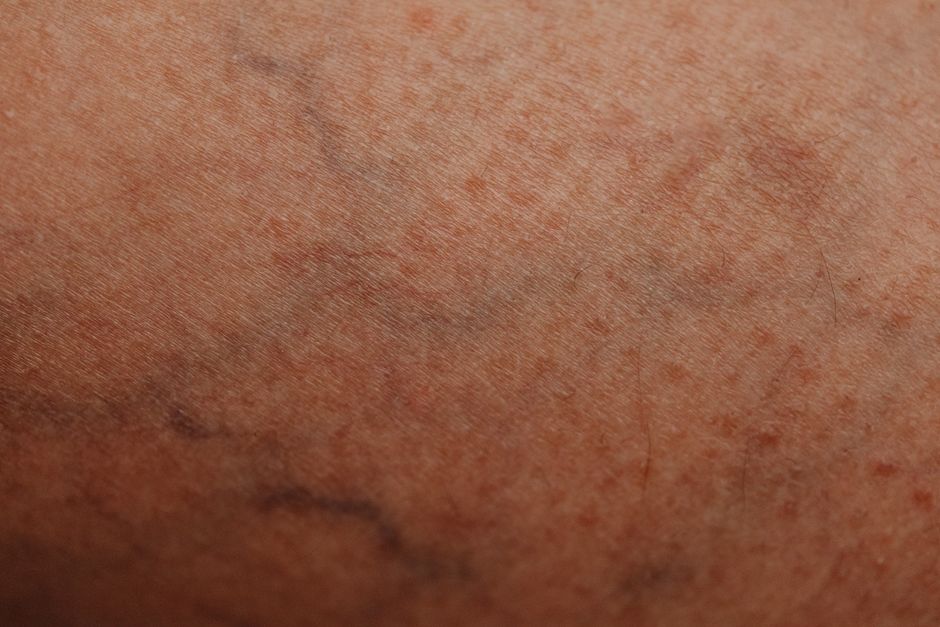
Varicose veins look like twisted, bulging, rope-like veins that sit close to the surface of the skin. They most often appear on the legs and feet, and they are usually blue, dark purple, or greenish in color. The affected vein is typically wider than 3 millimeters and visibly raised above the surrounding skin, which is what separates it from ordinary visible veins.
Many people first notice them as a cluster rather than a single line. They can look like a tangle of swollen cords running down the calf or thigh. Some are mild and barely noticeable. Others are large enough to press against clothing.
What Do Varicose Veins Look Like Compared to Normal Veins?
Normal surface veins are flat, thin, and often faintly visible through the skin. Varicose veins are not flat. They bulge outward, and the bulge does not disappear when you press on it the way a small surface vein might.
The key visual features are:
- Twisting or bulging that gives a snake-like or knotty appearance
- A blue, purple, or greenish tint
- Raised above the skin surface rather than lying flat
- Usually wider than 3 millimeters across
- Often grouped in clusters rather than appearing as one isolated vein
Size varies widely. Some are only slightly puffy. Others are thick enough to feel firm under the fingers. The appearance can change through the day. Veins often look more prominent after long periods of standing and less noticeable after lying down with the legs raised, because gravity affects how much blood pools in them.
What Do Varicose Veins Look Like on Different Parts of the Body?
The legs are by far the most common location, because standing and walking put the most pressure on the veins that carry blood back up to the heart. Within the legs, the inside of the calf and the back of the knee are frequent spots.
On the legs, they often follow the path of the large saphenous vein, running from the ankle up the inner calf and thigh. They can also branch into smaller clusters around the ankle, which sometimes signal a more advanced problem with circulation in that area.
Varicose veins can appear elsewhere, though this is less common:
- During pregnancy, they may show up on the vulva or around the vagina
- In the rectum or anus, a related condition produces hemorrhoids, which are essentially varicose veins in that area
- Rarely, they appear on the arms, though arm veins are under less pressure and less likely to enlarge this way
Where a vein sits matters for how it looks. Veins near the ankle have less surrounding tissue, so even modest enlargement can look pronounced. Veins buried in thicker muscle or fat may bulge less visibly even when they are significantly enlarged.
What Is the Difference Between Varicose Veins and Spider Veins?
Spider veins are much smaller and sit closer to the skin surface. They look like fine red, blue, or purple lines that branch out like a spider web or tree twigs. They are usually flat, not raised, and typically less than 1 millimeter wide.
Varicose veins are larger, raised, and more likely to cause symptoms like aching, heaviness, or swelling. Spider veins rarely cause discomfort beyond occasional mild itching or burning.
Both involve veins that are not working efficiently, but they differ in size and depth. Spider veins are often considered a cosmetic concern. Varicose veins can be cosmetic too, but they are more likely to be tied to underlying vein problems that a clinician may want to evaluate.





Can Varicose Veins Look Different From Person to Person?
Yes. The same underlying condition can look quite different depending on skin tone, body size, and how much fat sits under the skin.
On lighter skin, the blue or purple color stands out clearly. On darker skin, the color may be harder to see, and the bulging texture and raised shape become the main visual clue. This is one reason varicose veins are sometimes under-recognized in people with darker skin tones.
Body weight plays a role too. In people with more subcutaneous fat, a vein may bulge less obviously even when it is enlarged. In thinner people, the same vein can look much more prominent.
They also change over time. Early on, a varicose vein may look like a small, soft bump. Over months or years, it can become longer, thicker, and more twisted. Some develop a knotted, cluster-like appearance as more segments of the vein stretch.
What Other Skin Changes Can Appear Alongside Varicose Veins?
Varicose veins do not always appear alone. When vein problems are more advanced, the skin around them can change too. These changes are worth knowing because they can signal that the condition is progressing.
Possible skin findings include:
- Swelling in the ankle and lower leg, especially by the end of the day
- Brownish or reddish discoloration of the skin near the ankle, caused by blood pigment leaking into tissue
- Dry, itchy, or scaly skin over the affected area
- Thickened, hardened skin near the ankle
- Small sores or ulcers that are slow to heal, usually near the ankle
A skin ulcer near the ankle in someone with varicose veins is a sign to seek medical care. These ulcers can be slow to heal and are prone to infection. They are not something to manage at home without clinical guidance.
When Should You See a Doctor About Varicose Veins?
Many varicose veins are harmless beyond their appearance. But some visual and physical signs suggest it is time to have them checked.
See a clinician if you notice:
- A vein that suddenly becomes hard, hot, red, and painful
- Bleeding from a varicose vein
- A sore or ulcer near the ankle that is not healing
- Swelling in one leg only, especially if it comes on quickly
- Skin discoloration or thickening around the ankle
- Pain that limits your usual activity
A vein that becomes firm, tender, and warm may indicate a blood clot in a surface vein, a condition called superficial thrombophlebitis. A clot in a deep vein is a more serious problem, and sudden one-sided leg swelling or pain should be evaluated promptly. These are not visual quirks to wait out.
It is also worth noting that varicose veins are not just a cosmetic issue for everyone. For some people, they reflect a vein system that is not moving blood efficiently, and that can affect comfort, skin health, and in some cases circulation over time. A clinician can assess whether the veins are simply visible or whether they point to a condition worth treating.
Frequently Asked Questions
What do varicose veins look like in the early stages?
Early varicose veins often look like small, soft bulges or slightly raised, bluish lines under the skin. They may be easy to miss at first and become more twisted and prominent over time.
Are varicose veins always blue or purple?
They are most often blue, dark purple, or greenish, but the color can be harder to see on darker skin tones. On darker skin, the raised, twisted texture is often the more noticeable sign.
Can varicose veins look like something else?
Yes, they can be confused with spider veins, which are smaller and flat, or with simple visible veins that are not enlarged. The main difference is that varicose veins are raised and wider than 3 millimeters.
Do varicose veins always bulge out of the skin?
Not always. Some are enlarged but sit deeper under the skin and may look more like a shadow or a slight fullness than a clear bulge. A clinician can confirm what is happening with an exam or ultrasound.
