
Most people think color blindness means seeing the world in black and white. That is almost never true. True color blindness where someone sees no color at all is extremely rare affecting fewer than 1 in 30000 people. For the vast majority of the 300 million people worldwide with color vision deficiency the world looks nearly normal but certain colors blend together. Red and green may look the same. Blue and purple might be hard to tell apart. Traffic lights may all look like the same shade of grayish yellow. The experience varies by person and by type but it is almost always about confusion between specific colors not the absence of color.
What Exactly Does Color Blindness Look Like in Daily Life?
Think about a box of 64 crayons. Someone with typical vision sees 64 distinct colors. Someone with red-green color blindness the most common type sees maybe 30 to 40 distinct colors. The rest look like duplicates. That is the core experience. It is not that colors disappear. It is that the brain cannot tell certain color pairs apart.
Red and green are the most common confusion pair. A person with red-green color deficiency may see both as brownish or grayish. Purple which contains both red and blue can look like plain blue. Pink often looks gray or light blue. Green traffic lights look white or pale yellow to some people. Red lights look dark and dull.
Blue-yellow color blindness is less common but still affects about 1 in 10000 people. In this type blue looks green and yellow looks gray or pale pink. Total color blindness or achromatopsia is so rare that most eye doctors will never see a case in their entire career. People with this condition see only shades of gray brightness and darkness.
What Causes Someone to See Colors Differently?
The human eye has three types of cone cells in the retina. Each type detects a range of light wavelengths. One type picks up red light. One picks up green. One picks up blue. The brain combines signals from all three to create the full color spectrum you see.
Color blindness happens when one or more of these cone types does not work correctly. In most cases the cones are present but their light sensitivity is shifted. A person with red-green deficiency has red and green cones that are too similar to each other. The brain cannot tell which signal came from which cone. Red and green objects end up looking the same.
This is almost always genetic. The genes for red and green cones sit on the X chromosome. That is why color blindness is much more common in men. Men have one X chromosome. If that X carries the faulty gene they have no backup. Women have two X chromosomes so a working copy on the other X usually compensates. About 8 percent of men have some form of color blindness compared to less than 1 percent of women.
Some people develop color vision problems later in life. This can happen from cataracts which cloud the lens and yellow the vision. Certain medications like hydroxychloroquine can damage the retina over time. Diabetes and multiple sclerosis can also affect color perception. These acquired cases are different from genetic color blindness because they can progress or change over time.
How Do Doctors Test for Color Blindness?
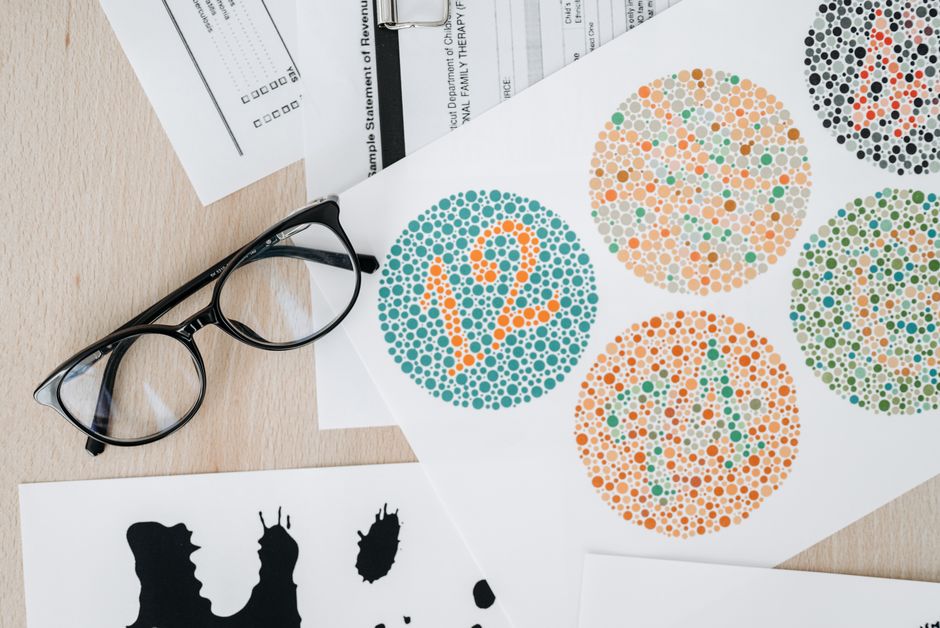
The most common test is the Ishihara color plate test. You have probably seen these in an eye doctor office. They are circles made of colored dots with a number hidden inside. People with normal color vision see the number clearly. People with color deficiency see a different number or no number at all.
These plates are good for screening but they are not perfect. They mainly test for red-green deficiency. They do not measure severity well. A person who misses two plates and a person who misses twelve plates both get the same label. The test also does not work well for blue-yellow deficiency.
More precise tests exist. The Farnsworth-Munsell 100 Hue Test asks you to arrange colored caps in order from one hue to the next. This measures how finely you can distinguish similar colors. The anomaloscope is a device that asks you to match a yellow light by mixing red and green lights. This gives exact numbers about how shifted your color perception is.
As of 2026 online color blindness tests are widely available but they are not reliable for diagnosis. Screen calibration lighting conditions and device type all affect the results. An online test might tell you that you have color blindness when you do not. If you suspect a color vision problem see an eye doctor for proper testing.




Can Color Blindness Be Treated or Corrected?
There is no cure for genetic color blindness. No medication surgery or therapy can fix the cone cells in your retina. That is the honest answer and it is important to know because many products claim otherwise.
Color blind glasses like EnChroma are the most famous option. These glasses use special filters to increase contrast between red and green light. Some people report seeing new colors when they put them on. The effect is real for some users. The glasses work best for people with mild to moderate red-green deficiency. They do not work for everyone and they do not give normal color vision. They shift what you see rather than fixing the underlying problem. They also cost several hundred dollars and do not help with blue-yellow deficiency.
Some studies suggest that these glasses improve performance on color vision tests. Whether they meaningfully change daily life is less clear. Some people report that colors look more vivid. Others say the effect is subtle or disappointing. If you are considering color blind glasses try before you buy. Many companies offer return windows for this reason.
Color blind apps for smartphones are a free or low-cost alternative. Apps like Color Blind Pal or Seeing AI can identify colors through your phone camera. They can tell you if a banana is ripe or if a shirt is blue or purple. These apps work well for practical tasks. They do not change how you see the world but they help you navigate it.
What Does Research on Color Blindness Actually Show?
Research shows that color blindness is usually a mild condition. Most people with it adapt without realizing they have it. Many are diagnosed in school or during a driver license eye exam. Some go their entire lives without knowing.
A large 2020 study in the journal Optometry and Vision Science found that about half of people with color vision deficiency report no significant problems in daily life. The other half report difficulties with specific tasks like matching clothes reading charts or identifying electrical wiring. The key finding is that color blindness is rarely disabling. It is a difference in perception not a loss of vision.
Some studies suggest that people with color blindness develop compensatory abilities. They may be better at detecting texture and brightness differences because they rely on those cues more. A 2022 study from the University of Cambridge found that people with red-green color blindness could see through certain types of camouflage better than people with normal vision. This makes evolutionary sense. If you cannot rely on color you get better at other visual cues.
The research is also clear about what does not work. There is no evidence that color blindness can be cured with eye exercises supplements or special diets. Claims about curing color blindness with lutein or bilberry extract are not supported by clinical trials. As of 2026 there is no clinical evidence that any dietary intervention changes cone cell function in genetic color blindness.
How Does Color Blindness Affect Children in School?
Children with color blindness often struggle in school without anyone understanding why. A child who cannot tell red from green may have trouble with color-coded worksheets. Math problems that use colored shapes become confusing. Maps that use color to show elevation or population can look like meaningless blobs.
Teachers may misinterpret these struggles. A child who colors a tree purple and the sky green might be labeled as creative or careless. In reality the child may simply be using the crayons that look different from each other. The purple crayon looks different from the brown crayon even if neither looks like the real color of a tree.
Screening for color blindness in schools is not standard practice in most US states. The American Academy of Pediatrics does not recommend universal screening. This means many children go undiagnosed. Parents who notice their child having trouble with color-based tasks should ask for a test. A simple Ishihara plate test at a pediatric eye exam can provide answers.
Simple accommodations make a big difference. Teachers can label crayons with words. They can avoid color-only instructions. They can use patterns or shapes alongside colors on charts and graphs. These changes help the child without singling them out.
What Are Common Misconceptions About Color Blindness?
The biggest myth is that color blind people see in black and white. This is almost never true. Only about 1 in 30000 people have complete achromatopsia. Everyone else with color deficiency sees color. They just see fewer distinct colors.
Another myth is that color blindness means you cannot see any red or any green. That is also false. People with red-green deficiency can see red and green. The problem is that certain shades of red and green look identical. A bright red apple and a bright green apple may look the same shade of brownish gray. But a dark red apple and a light green apple look different because of brightness not color.
Some people believe color blindness is a disability that prevents driving or certain jobs. This is partially true but overstated. Most people with color blindness can drive safely. They learn to use position and brightness to read traffic lights. The red light is on top. The green light is on the bottom. That works regardless of color perception. Some careers like pilot electrician or police officer do have color vision requirements. But many people with color deficiency work in these fields with accommodations.
Frequently Asked Questions
Can women be color blind?
Yes but it is much less common. About 0.5 percent of women have color blindness compared to 8 percent of men. Women need two faulty X chromosomes to have the condition while men only need one.
Do color blind glasses really work?
They work for some people with mild to moderate red-green deficiency. They do not cure color blindness and they do not work for everyone. The effect varies widely by person.
Is color blindness a sign of eye disease?
Not usually. Most color blindness is genetic and present from birth. But sudden changes in color vision can signal cataracts diabetes or retinal damage and should be checked by a doctor.
Can color blindness get worse over time?
Genetic color blindness stays stable throughout life. Acquired color vision loss from disease or medication can get worse. If your color vision changes see an eye doctor.
