
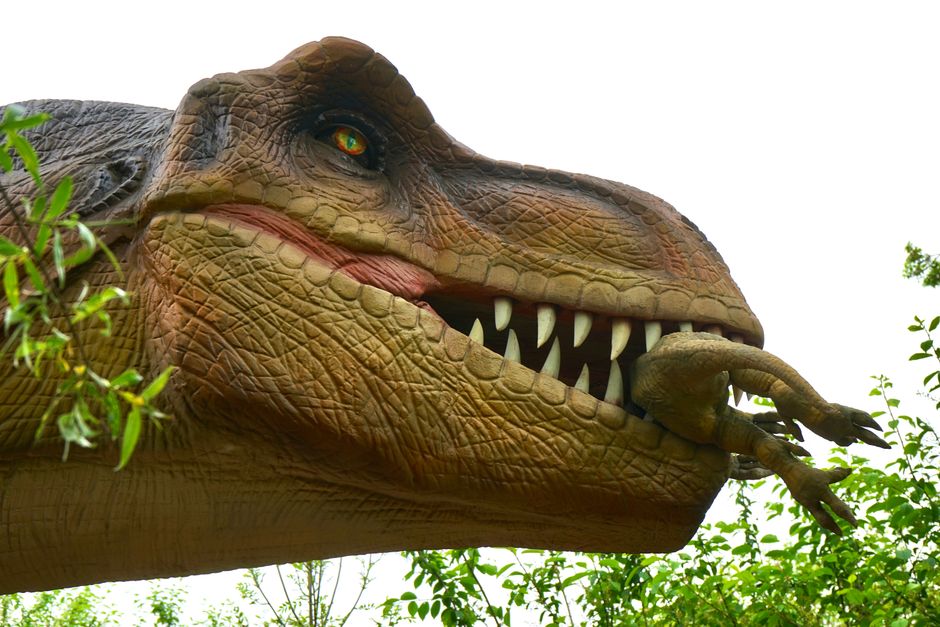
The top predator of the Mesozoic Era was the Tyrannosaurus rex. It sat at the very top of the food chain in its environment during the late Cretaceous Period. No other dinosaur regularly hunted adult T. rex. It was the apex predator of its time and place.
What Made T. rex the Top Predator?
T. rex had a combination of traits that no other dinosaur matched. Its bite force was the strongest of any land animal ever measured. Research published in the journal Biology Letters estimated that an adult T. rex could bite with about 8,000 pounds of force. That is enough to crush the bones of a Triceratops or another large dinosaur.
Its size was another major factor. A full-grown T. rex weighed between 11,000 and 15,500 pounds. It stood about 15 to 20 feet tall at the hips. This meant it could look over the top of most other dinosaurs. It also had binocular vision, which gave it excellent depth perception for tracking moving prey.
Its legs were built for power, not just speed. While T. rex could not run as fast as a car, it could likely move at 10 to 25 miles per hour in short bursts. That was fast enough to catch slower, larger prey. Its massive tail helped balance its heavy head and body, allowing it to turn quickly.
Were There Other Contenders for the Top Spot?
Yes, but they lived in different times and places. The title of “top predator” was not a single crown worn by one species for 150 million years. It changed over time. In the Jurassic Period, the top predator was likely Allosaurus. It was smaller than T. rex, weighing about 2,000 to 3,000 pounds, but it was still the largest meat-eater in its ecosystem.
In other parts of the world, different dinosaurs ruled. Giganotosaurus lived in South America during the early Cretaceous. Some estimates put it slightly longer than T. rex, but it was more lightly built. Spinosaurus was even larger, weighing perhaps 20,000 pounds, but it was a semi-aquatic fish-eater, not a land-based predator that hunted large dinosaurs regularly. It occupied a different niche.
The key point is that none of these dinosaurs overlapped in time or location with T. rex. There is no evidence that T. rex ever fought Spinosaurus. That is a movie invention. In the late Cretaceous of North America, T. rex was the undisputed top predator.
What Evidence Confirms T. rex Was at the Top?
Paleontologists look at several types of evidence. One is bite marks on the bones of other dinosaurs. Fossilized Triceratops and Edmontosaurus bones show deep, gouging bite marks that match T. rex teeth. Some of these bones show healed bite marks, meaning the prey survived an attack. Others show unhealed marks, indicating a successful kill.
Another line of evidence is coprolites — fossilized feces. Some coprolites found in Canada contain crushed bone fragments from herbivorous dinosaurs. The size and shape of these coprolites match what a large theropod like T. rex would produce. This directly shows that T. rex ate other dinosaurs.
There is also the simple fact of its anatomy. T. rex had teeth the size of bananas. They were serrated like steak knives. Its jaw muscles were enormous. No other dinosaur in its ecosystem had weapons that came close. The next largest predator in its environment was Nanotyrannus, which was about half the size. There was simply no competition.





Did T. rex Hunt or Only Scavenge?
This is one of the most debated questions in paleontology. The old idea that T. rex was purely a scavenger has been largely abandoned. The evidence now points to it being an active predator that also scavenged when it could. That is what most large carnivores do today.
The main argument against pure scavenging is its sense of smell. T. rex had large olfactory bulbs, meaning it had an excellent sense of smell. That is useful for finding carcasses from far away. But it is also useful for tracking live prey. Lions have a great sense of smell too, and they hunt.
Its legs were also built for running, not just walking. Scavengers do not need powerful leg muscles because they do not chase anything. The hip and leg bones of T. rex show it could generate bursts of speed. That is a trait of a predator, not a scavenger. Most paleontologists now agree that T. rex was an opportunistic predator — it killed when it could and ate carcasses when it found them.
| Dinosaur | Period | Estimated Weight | Primary Prey |
|---|---|---|---|
| Tyrannosaurus rex | Late Cretaceous | 11,000–15,500 lbs | Triceratops, Edmontosaurus |
| Allosaurus | Late Jurassic | 2,000–3,000 lbs | Stegosaurus, sauropods |
| Giganotosaurus | Early Cretaceous | 13,000–15,000 lbs | Large sauropods |
| Spinosaurus | Mid Cretaceous | 14,000–20,000 lbs | Fish, small dinosaurs |
What Dinosaur Was At The Top Of The Food Chain in the Oceans and Skies?
The question usually refers to land dinosaurs, but the Mesozoic had top predators in other environments too. In the oceans, the top predator was not a dinosaur at all. It was a marine reptile called Mosasaurus. It grew up to 50 feet long and ate fish, sharks, and other marine reptiles. It was the T. rex of the sea.
In the skies, the top predator was a pterosaur called Quetzalcoatlus. It had a wingspan of about 33 to 36 feet. It was not a dinosaur either, but it was the largest flying animal ever. It likely ate small dinosaurs, fish, and carcasses on the ground. It dominated the air.
These animals did not compete with T. rex because they lived in different habitats. On land, in the late Cretaceous of North America, no creature challenged T. rex. It was the apex predator of its world.
What Happened to the Top Predator?
T. rex went extinct about 66 million years ago. That was the end of the Cretaceous Period. A massive asteroid struck the Earth near what is now the Yucatán Peninsula. The impact caused a chain of events that killed off most large animals.
The asteroid impact threw dust and debris into the atmosphere. This blocked sunlight for months or years. Plants died. Herbivorous dinosaurs starved. Then the carnivores that ate them starved too. T. rex was at the top of the food chain, but that did not protect it from a planet-wide catastrophe. No apex predator can survive when its entire food supply collapses.
Some small dinosaurs survived. They were the ancestors of modern birds. But the age of giant predators was over. It took about 65 million years for mammals to evolve into top predators of similar size, like the lion and the polar bear. Nothing has ever matched T. rex in raw power and dominance.
Common Misconceptions About the Top Predator
- T. rex was the only top predator. It was the top predator in its specific time and place. Other top predators existed in other eras and regions.
- T. rex was slow and clumsy. It was not a sprinter, but it was faster than most people think. It could likely outrun a human in a short chase.
- T. rex had tiny arms and did not use them. Its arms were short but incredibly strong. They could lift over 400 pounds each. They were likely used to hold prey or help push itself up from the ground.
- Spinosaurus was bigger and could beat T. rex in a fight. They never met. Spinosaurus lived millions of years earlier and in a different part of the world.
- T. rex had feathers. Some evidence suggests young T. rex may have had a light covering of downy feathers. But adults likely had scales, not feathers, because they were too large to need insulation.
How Do We Know All This Without Seeing a Live One?
Paleontology is a science of inference. Scientists study the fossilized bones, teeth, footprints, and even stomach contents. They compare these to modern animals. For example, the bite force of T. rex was calculated by modeling its jaw muscles on a computer and comparing them to crocodiles. The results were consistent across multiple studies.
Fossilized trackways show how T. rex walked and ran. Some tracks show a pattern of walking, then a sudden change in direction, then a sprint. That matches the behavior of a predator chasing prey. The evidence is not perfect, but it is consistent. The picture it paints is clear: T. rex was the top predator of its world.
Frequently Asked Questions
Was T. rex the strongest dinosaur?
It had the strongest bite force of any land dinosaur ever measured. But “strongest” depends on how you define it. Giganotosaurus was longer, and Spinosaurus was heavier.
Could T. rex beat a Spinosaurus in a fight?
No, because they never lived at the same time or in the same place. Spinosaurus lived in North Africa about 95 million years ago. T. rex lived in North America about 66 million years ago.
What did T. rex eat?
It ate large herbivorous dinosaurs like Triceratops and Edmontosaurus. It also ate smaller dinosaurs and likely scavenged carcasses when available.
How fast could T. rex run?
Estimates vary, but most studies suggest 10 to 25 miles per hour in short bursts. It could not sustain that speed for long.
