
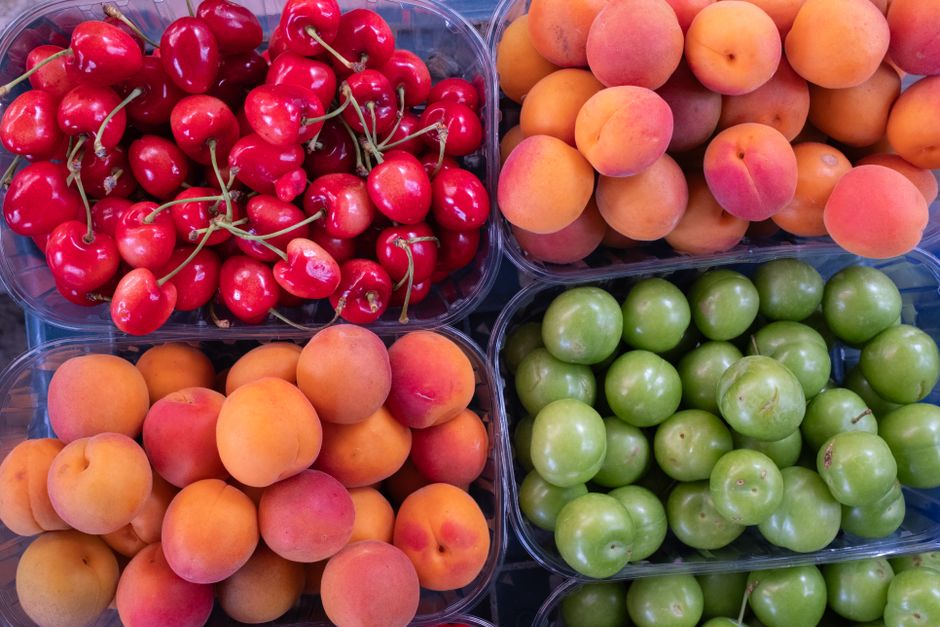
Stone fruits are fruits that contain a single hard pit, or “stone,” in the center. That pit holds the seed. The scientific name for this group is drupes, and it includes peaches, plums, cherries, apricots, nectarines, and mangoes. If you have ever bitten into a fresh peach and hit that woody center, you have met the stone up close.
What makes a fruit a drupe comes down to structure, not flavor or size. Each drupe has three layers: a thin outer skin, a fleshy middle, and a hard inner shell that protects the seed. Once you know the pattern, you start seeing it everywhere — even in fruits most people would never group together.
What Are Stone Fruits?
A stone fruit is any fruit that develops from a single flower and produces one seed enclosed in a hardened shell. Botanists call this a drupe. The word comes from the same root as “drupe,” which simply means a fleshy fruit with a stone inside.
The stone itself is not the seed. It is a protective layer of hardened tissue that surrounds the seed. In a peach, the rough pit you throw away is this shell. Crack it open and you find the actual seed inside — a small, almond-shaped kernel.
This structure matters because it is how the plant protects and disperses its offspring. The fleshy part attracts animals that eat the fruit and carry the seed away. The hard shell keeps the seed from being crushed or digested.
Which Fruits Are Stone Fruits?
The most familiar stone fruits belong to one plant genus called Prunus. This group includes peaches, nectarines, plums, cherries, apricots, and almonds. Yes, almonds are technically the seeds of a stone fruit — the fleshy part is just not the part we eat.
Other stone fruits come from entirely different plant families. Mangoes, lychees, and olives are all drupes. So are coconuts, which are among the largest stone fruits in the world. Coffee “beans” are the seeds of a drupe as well.
Here is where it gets confusing. Some fruits people assume are stone fruits are not. Strawberries, raspberries, and blackberries are aggregate fruits — they form from many tiny individual fruits clustered together. Each little bump on a raspberry is its own tiny drupe, but the whole berry is not a single stone fruit.
The table below sorts common fruits by their true botanical category.
| Fruit | Botanical Type | Stone Fruit? |
|---|---|---|
| Peach | Drupe | Yes |
| Plum | Drupe | Yes |
| Cherry | Drupe | Yes |
| Mango | Drupe | Yes |
| Olive | Drupe | Yes |
| Strawberry | Aggregate fruit | No |
| Raspberry | Aggregate fruit | No |
| Banana | Berry | No |
That last row surprises most people. Botanically, a banana is a berry, while a strawberry is not. The everyday words we use for fruit and the scientific categories do not always line up.
What Nutrients Do Stone Fruits Provide?
Stone fruits are mostly water, which is part of why they taste so refreshing in summer. Their nutrition varies by type, but a few patterns hold across the group.
Most stone fruits are good sources of vitamin C and vitamin A. They also provide potassium and dietary fiber, especially when eaten with the skin. The skin carries a meaningful share of the fiber and antioxidant compounds.
One detail worth knowing: the flesh and skin of a stone fruit are the parts we eat, but the seed inside the pit is a different story. Stone fruit seeds contain a compound that releases cyanide when metabolized. The amounts are small, and accidentally swallowing a whole pit is unlikely to cause harm because the hard shell resists digestion. Chewing or crushing the seeds, however, can release meaningful amounts of cyanide. This is why bitter almond extract and raw apricot kernels carry real safety warnings.
This is not a reason to avoid the fruit. It is a reason to avoid eating the kernels. Standard food safety guidance treats the fleshy fruit as safe and the crushed seeds as a hazard.




Are Peaches and Nectarines the Same Fruit?
Peaches and nectarines are so closely related that they are essentially the same species. The difference comes down to a single gene that controls whether the skin has fuzz. Nectarines are the smooth-skinned version.
Because they are so similar genetically, peach trees sometimes produce nectarines on the same branch, and nectarine trees sometimes produce peaches. Growers can even graft one onto the other. Nutritionally, the two are nearly identical.
The same close relationship exists between other stone fruits. Plums and apricots can crossbreed, which is how fruits like pluots and apriums came about. These are not laboratory creations — they are the result of natural cross-pollination that growers then selected and cultivated.
Why Do Stone Fruits Cause Allergies in Some People?
Stone fruit allergies are real and can range from mild to serious. The most common pattern involves itching or tingling in the mouth and throat after eating raw fruit. This is called oral allergy syndrome.
It happens because the proteins in stone fruits resemble proteins in certain pollens. If you are allergic to birch pollen, your immune system may mistake peach or cherry proteins for birch pollen and react. Cooking the fruit usually breaks down these proteins, which is why many people with this pattern can eat cooked or baked stone fruits without symptoms.
A separate and more serious allergy exists too. Some people react to a protein in peach skin and flesh that can trigger hives, swelling, or in rare cases a severe reaction called anaphylaxis. This type is not tied to pollen and can be more dangerous.
If you have had a reaction to any stone fruit, especially one involving swelling, trouble breathing, or a drop in blood pressure, that warrants medical evaluation. Do not test the fruit again on your own to see if it still causes a reaction.
How Should You Store and Prepare Stone Fruits?
Stone fruits ripen quickly and bruise easily. Firm fruit can sit at room temperature for a day or two to soften. Once ripe, refrigerating them slows further ripening and buys a few more days.
Washing before eating is standard. The skin is edible on most stone fruits, and it carries fiber and nutrients. Peeling is a matter of preference, not necessity, though some people peel peaches for texture or to reduce exposure to the fuzz.
To remove the pit, cut around the fruit along its natural seam and twist the halves apart. The pit usually pops out easily. For cherries, a small tool or a firm press with a knife tip does the job. There is no need to worry about the pit itself during normal eating — the concern is only with chewing or crushing the seeds inside.
One practical note: stone fruits brown quickly once cut because of an enzyme reaction with air. A squeeze of lemon juice slows this. It does not change the nutrition in any meaningful way.
Are Stone Fruits Part of a Healthy Diet?
Stone fruits fit comfortably into most eating patterns. They provide fiber, vitamins, and water, and they are naturally low in calories relative to their volume. Whole fruit intake in general is associated with better health outcomes in large population studies.
That said, fruit is not a treatment for any disease, and no single fruit group carries special protective powers beyond what the broader evidence supports for fruits and vegetables as a category. Claims that a specific stone fruit “detoxifies” the body or prevents a particular disease are not supported by clinical trials.
The most reliable guidance is also the simplest: eat a variety of fruits, including stone fruits when they are in season, and treat them as one part of an overall diet rather than a remedy.
Frequently Asked Questions
Is a mango a stone fruit?
Yes, a mango is a drupe, which means it is a stone fruit. Its large, flat pit in the center is the stone that surrounds the seed.
Are strawberries stone fruits?
No, strawberries are aggregate fruits, not stone fruits. The tiny seed-like bumps on the outside are actually individual small fruits clustered together.
Can you eat the pit of a stone fruit?
You should not chew or crush the pit or the seed inside it. Stone fruit seeds contain a compound that releases cyanide when metabolized, and crushing them can release harmful amounts.
Are peaches and nectarines the same fruit?
They are the same species, differing only by a single gene that controls whether the skin has fuzz. Nutritionally, they are nearly identical.
