
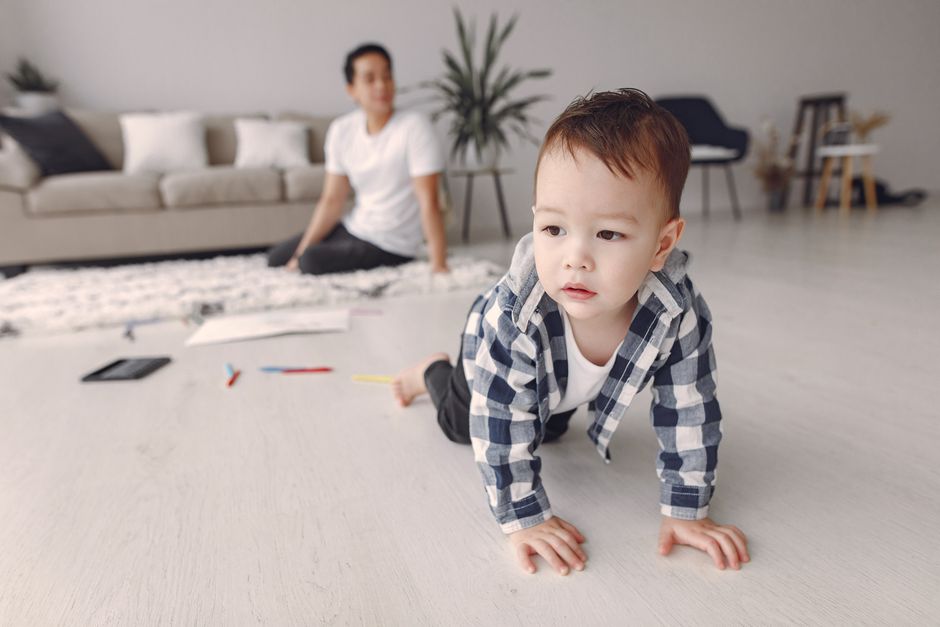
Most babies start crawling between 7 and 10 months old. Some start as early as 6 months. Others skip crawling entirely and go straight to pulling up and walking. All of these patterns fall within normal development.
What Are The Different Types Of Crawling?
Not all babies crawl the same way. The classic hands-and-knees crawl is the most common, but it is not the only version.
Some babies do a “commando crawl” where they drag their belly on the floor and push with their arms. Others do a “bear crawl” with straight arms and legs. Some scoot on their bottom or roll to get where they want to go.
All of these count as moving independently. The goal is mobility, not a specific technique. What matters is that your baby finds a way to move across the floor using their own body.
What Age Do Kids Learn To Crawl?
The typical crawling window is 6 to 10 months. Most babies master hands-and-knees crawling between 7 and 10 months. Some figure it out earlier, some later.
Premature babies often reach this milestone later than their due-date age would suggest. Pediatricians usually track milestones by adjusted age — the age your baby would be if born on their due date — for the first two years.
Crawling requires three things to come together: arm strength, leg strength, and coordination. Babies need enough muscle tone to lift their torso off the floor. They also need the coordination to move opposite arm and leg together. This pattern is called cross-body coordination and it is a complex skill.
What Comes Before Crawling?
Crawling does not happen suddenly. It builds on earlier milestones.
Most babies learn to roll over between 4 and 6 months. They start sitting without support around 6 to 8 months. Both of these skills build the core strength that crawling requires.
You may notice your baby rocking back and forth on their hands and knees before they actually move. This is called “creeping” and it is a normal preparation phase. They are figuring out how to balance on four points before they coordinate the movement.
Some babies get up on their hands and knees and rock for weeks before taking their first crawl step forward. This is not a delay. It is practice.





How Can Parents Encourage Crawling?
You cannot force a baby to crawl. But you can create conditions that make it easier and more appealing.
Tummy time is the foundation. Babies who spend regular time on their belly build the neck, shoulder, and arm strength that crawling requires. The American Academy of Pediatrics recommends starting tummy time from birth, with short sessions several times a day.
Once your baby can sit independently, give them plenty of supervised floor time. Put them on a firm, clean surface where they have room to move. Avoid walkers — they do not help with crawling and are associated with injury risk.
Place toys just out of reach. This gives your baby a reason to move. The motivation to reach something interesting is often what turns rocking into actual crawling.
Be patient with the process. Some babies are not interested in crawling and will find their own way to move. Others are cautious and take longer to venture away from a familiar spot.
When Should Parents Be Concerned About Crawling?
Most babies crawl by 12 months. If your baby is not showing any interest in moving independently by 12 months, talk to your pediatrician.
Here are signs that warrant a conversation with your doctor:
- No interest in bearing weight on their legs by 9 months
- Consistently using only one side of the body to move
- No attempt to move across the floor by 12 months
- Loss of previously acquired motor skills at any age
- Extreme stiffness or floppiness in the arms or legs
Remember that missing one milestone is rarely a problem on its own. Pediatricians look at the whole picture — how your baby plays, interacts, and develops across all areas, not just movement.
Some babies skip crawling entirely. They go straight from sitting to pulling up to standing and then walking. Research suggests this is not harmful. The developmental concern is not whether a baby crawls, but whether they are achieving mobility in some form.
Does Skipping Crawling Cause Problems Later?
This is a common question and the short answer is no. Some research has explored whether skipping crawling affects later coordination or learning, but the evidence does not support the idea that skipping crawling causes lasting problems.
Many children who never crawl go on to walk, run, and develop normally. Pediatric physical therapists look for a broader pattern of motor development, not one specific milestone.
What matters is that your baby is progressing. They should be gaining new skills over time. If they are moving, exploring, and meeting other milestones, skipping the crawl phase is not a concern.
The idea that crawling is essential for brain development is a popular belief, but it is not backed by strong evidence. Crawling does support coordination and spatial awareness. But children who skip it do not show measurable disadvantages in studies.
What If My Baby Crawls Backward?
Some babies crawl backward before they crawl forward. This is completely normal.
Backward crawling is often easier for babies because their arms are stronger than their legs at this stage. They push with their arms and end up moving away from the toy they wanted. It takes time for them to coordinate pushing with their legs and pulling with their arms to move forward.
This usually resolves on its own within a few weeks. It does not require intervention. If your baby is still only moving backward after several weeks and seems frustrated, mention it at your next pediatrician visit.
How Does Crawling Relate To Walking?
Crawling is not a prerequisite for walking. Some babies walk without ever crawling. But crawling does build skills that support walking.
Crawling strengthens the muscles in the shoulders, arms, core, and legs. It also develops balance and coordination. These same muscles and skills are needed for standing and walking.
Most babies pull themselves up to stand between 9 and 12 months. They cruise along furniture before taking independent steps, usually between 9 and 15 months. The average age for walking is around 12 months, but anything up to 15 months is considered normal.
If your baby is an early crawler, they may or may not be an early walker. The timing of one milestone does not predict the timing of the next.
Can Babies Crawl Too Early?
Some babies start moving on their hands and knees before 6 months. This is not a problem as long as they got there naturally.
If your baby is crawling very early, it usually just means they have strong muscles and good coordination. There is no evidence that early crawling is harmful.
Make sure your home is baby-proofed early if you have an early mover. Once a baby can move, they can reach things you did not expect them to reach. Electrical outlets, cords, and small objects become hazards quickly.
What Are The Signs Of A Crawling Problem?
A true crawling problem is rare. Most of the time, babies who are slow to crawl simply need more time or more practice opportunities.
That said, there are some red flags that deserve professional attention:
- Your baby does not use their arms and legs symmetrically
- Your baby drags one side of their body when moving
- Your baby cannot bear weight on their arms by 8 months
- Your baby shows no interest in movement by 12 months
- Your baby seems to be in pain when moving
If you notice any of these, talk to your pediatrician. They can refer you to a pediatric physical therapist if needed. Early intervention is always better when there is a genuine concern.
Frequently Asked Questions
What is the average age for crawling?
Most babies crawl between 7 and 10 months. Some start as early as 6 months and others skip crawling altogether.
Is it normal for a baby not to crawl at 9 months?
Yes. Some babies do not crawl until 10 or 11 months, and some never crawl at all. If your baby is moving in some way and meeting other milestones, this is usually fine.
Do babies need to crawl before walking?
No. Many babies skip crawling and go straight to pulling up and walking. Crawling builds strength and coordination, but it is not required for walking.
What should I do if my baby crawls backward?
Nothing. Backward crawling is normal and usually resolves on its own within a few weeks as your baby’s legs get stronger.
