
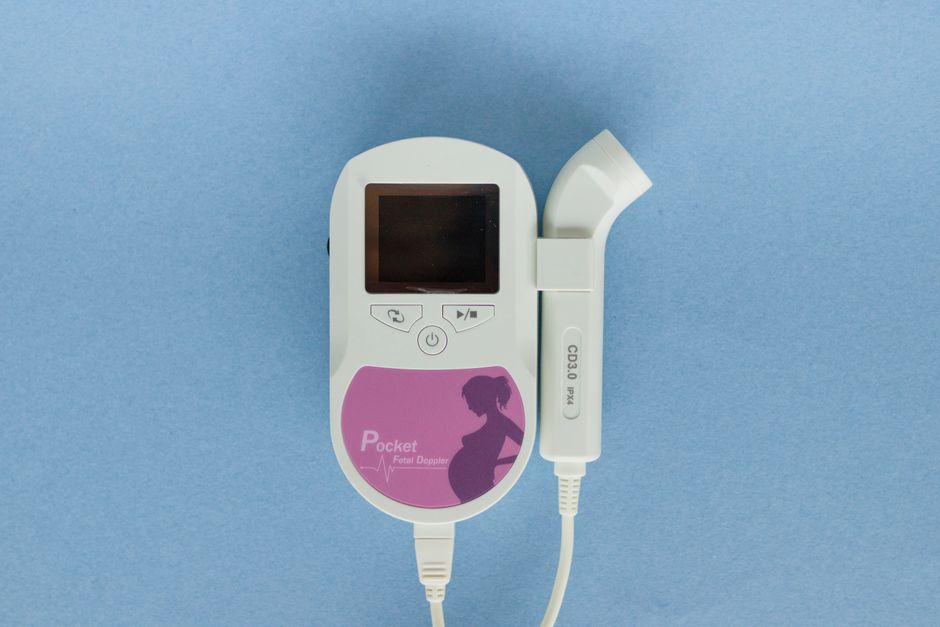
A baby Doppler is a handheld ultrasound device that lets you listen to a fetus’s heartbeat at home. You use it by applying ultrasound gel low on the belly, placing the probe flat against the skin, and moving it slowly at slight angles until you hear a fast, rhythmic sound. Safety comes down to three things: keep sessions short, never use it as a substitute for medical care, and understand that not finding a heartbeat at home does not prove anything is wrong.
What Is a Baby Doppler and How Does It Work?
A baby Doppler, sometimes called a fetal Doppler or home Doppler, is a small ultrasound device that sends high-frequency sound waves into the abdomen and converts the returning echoes into an audible sound. That sound is the fetal heart, amplified through a speaker or headphones.
At-home models are sold directly to consumers without a prescription in the United States. The technology itself is the same basic principle used in clinical settings, but the devices are generally simpler and less powerful than the equipment used by doctors and midwives. That difference matters — and it is one reason professional organizations have raised concerns about home use.
The fetal heart can typically be detected with a Doppler from about 10 to 12 weeks of pregnancy, though this varies. Some clinicians find it earlier, and some pregnancies take longer. Before roughly 10 weeks, the uterus sits low behind the pubic bone, and the sound is difficult to pick up reliably even with good equipment.
How Do You Find the Right Placement for a Baby Doppler?
Placement depends on how far along you are. The uterus moves upward as pregnancy progresses, so the spot where the heartbeat is easiest to hear changes over time.
- Early pregnancy (around 10–12 weeks): Place the probe very low, just above the pubic bone, angled slightly downward toward the pelvis.
- Mid pregnancy (around 20 weeks): Move the probe to the area around the navel, since the uterus has risen to roughly that level.
- Later pregnancy: The heartbeat may be heard over a wider area. The baby’s position also affects where the sound is clearest.
Use a generous amount of ultrasound gel. Without it, the sound waves do not travel well and you will hear mostly static. Move the probe slowly and tilt it at slight angles rather than sliding it quickly across the belly. Press gently — firm pressure is not helpful and can be uncomfortable.
One thing worth knowing: the sound you are listening for is fast. A fetal heart rate normally runs between 110 and 160 beats per minute, much quicker than an adult’s resting pulse of 60 to 100. You may also pick up your own heartbeat through a large vessel, or the whooshing sound of blood flow through the placenta. These are not the baby’s heartbeat, and telling them apart takes practice.
How Long and How Often Should You Use a Baby Doppler?
There is no established clinical guideline for how long or how often a pregnant person should use a home Doppler, because these devices were not designed or tested for unsupervised home use.
What is known is that ultrasound delivers a small amount of energy into tissue, and that energy has a heating effect that increases with exposure time. The general principle in medical imaging is to keep exposure as low as reasonably achievable. This is why clinical ultrasound sessions are kept brief and performed by trained operators.
Because no safe home-use duration has been established, the cautious approach is to keep any session short and infrequent rather than treating the device as something to use daily for extended periods. Anyone who wants more certainty about their own situation should ask their obstetric provider rather than relying on a general rule.




What Are the Main Safety Concerns With Home Dopplers?
The most significant safety concern is not the sound waves themselves — it is what people do with the information, or the lack of it.
Professional bodies including the American College of Obstetricians and Gynecologists and the Food and Drug Administration have advised against routine at-home fetal heart monitoring by untrained users. The core reason is that a home Doppler can create false reassurance or false alarm, and either one can delay real care.
Consider what happens when you cannot find the heartbeat. In early pregnancy, this is common and often means nothing more than an awkward angle or an early gestational age. But if you interpret it as a sign that something is wrong, you may experience significant anxiety. If you interpret a lack of sound as normal when there is a genuine problem, you may delay contacting a clinician.
Now consider the opposite. Hearing a heartbeat at home can feel reassuring, but it does not confirm that the pregnancy is healthy. A Doppler only detects the presence of a heart sound. It cannot assess growth, fluid levels, placental function, or the many other things a clinical ultrasound evaluates.
There is also the question of who is operating the device. Trained sonographers learn to distinguish fetal heart tones from maternal vessels, placental blood flow, and other sounds. Without that training, it is genuinely difficult to know what you are hearing.
When Should You Call Your Doctor Instead of Using a Doppler?
Decreased fetal movement, bleeding, cramping, fluid leakage, or any change that concerns you warrants a call to your provider — not a session with a home Doppler.
This is the single most important safety point in this article. A home Doppler is not a monitoring tool. It cannot tell you whether your baby is okay. If you are worried about your baby’s movement or your pregnancy in any way, contact your obstetric provider or go to the hospital. Do not use the Doppler to decide whether to seek care.
Reduced fetal movement in particular is a symptom that clinicians take seriously, and it should never be self-checked at home with a consumer device.
What Does a Fetal Heartbeat Sound Like?
A fetal heartbeat sounds like a rapid, steady galloping or horse-trotting rhythm — fast and regular, distinct from the slower thump of your own pulse.
You may hear other sounds along the way. The placenta produces a soft blowing or whooshing sound sometimes called a placental bruit. Your own pulse may come through if the probe rests over a major vessel. These can be confusing, and even experienced users sometimes mistake one for another.
If you use a Doppler and hear a rhythm, keep in mind that you cannot confirm from sound alone that it is the fetal heart. This is one more reason the device is a poor substitute for a clinical check.
Are Home Dopplers Regulated?
In the United States, fetal Dopplers are regulated as medical devices, and some models are cleared for sale to consumers while others are intended for professional use only. The FDA has expressed concern about the sale of prescription-only devices directly to consumers and has issued guidance discouraging unsupervised home use.
This does not mean the devices are illegal to own. It means the regulatory and clinical consensus is that they are best used by trained professionals in a clinical context. If you are considering buying one, that context is worth weighing before you decide.
What Are the Alternatives to a Home Doppler?
If your goal is reassurance between appointments, there are options that carry less risk of misinterpretation.
- Paying attention to your baby’s movement patterns once you can feel them, and reporting any change to your provider.
- Asking your obstetric provider to check the heartbeat at your regular visits — this is standard care.
- Discussing your anxiety with your provider, who may offer additional monitoring if it is clinically appropriate.
None of these replace a clinical assessment. But they avoid the central problem with home Dopplers, which is that they can produce information you are not equipped to interpret.
Frequently Asked Questions
Can I use a baby Doppler at home safely?
Professional organizations including ACOG and the FDA advise against routine at-home fetal heart monitoring by untrained users. The main concern is that it can cause false reassurance or unnecessary anxiety rather than providing reliable information.
When can you hear a baby’s heartbeat with a Doppler?
A fetal heartbeat can usually be detected with a Doppler from about 10 to 12 weeks of pregnancy, though this varies by person and pregnancy. Earlier than that, the uterus sits low behind the pubic bone and the sound is hard to pick up.
Where do you place a baby Doppler to hear the heartbeat?
In early pregnancy, place the probe low on the belly just above the pubic bone. By around 20 weeks, the uterus has risen to about the level of the navel, so move the probe there.
What should I do if I can’t find the heartbeat with a home Doppler?
Do not use a home Doppler to decide whether something is wrong. If you are worried about your baby or notice reduced movement, contact your obstetric provider or go to the hospital.
