
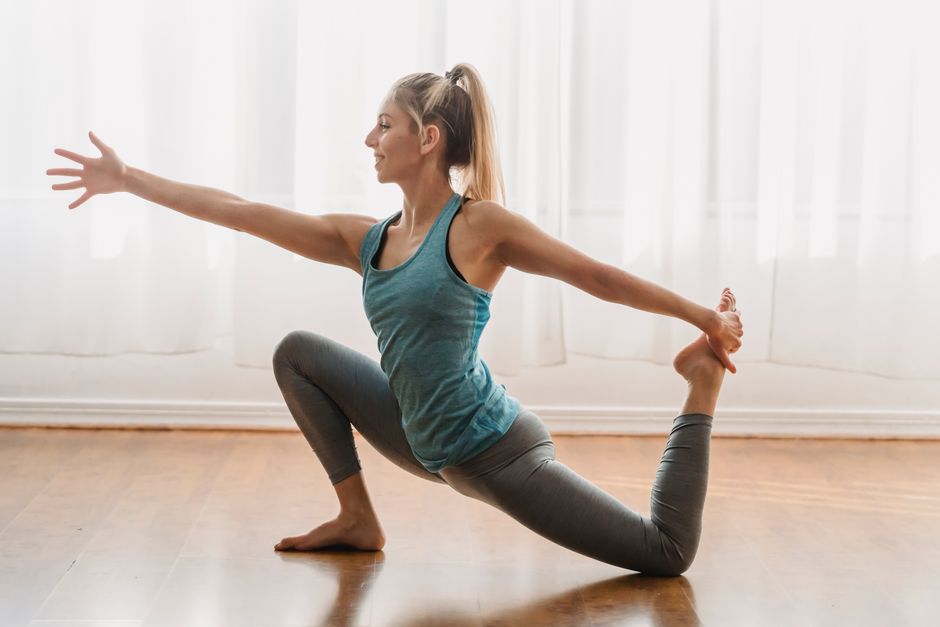
You can stretch your quadriceps while sitting in a chair by moving your heel toward your buttocks, or by pulling your ankle back behind the chair. Both moves lengthen the front of the thigh without standing up. The chair gives you balance and support, which makes these stretches easier to do safely at a desk, in a waiting room, or at home.
The quadriceps are the large muscles on the front of your thigh. They straighten your knee and help you walk, climb stairs, and stand up. Sitting for long periods shortens them over time. A seated stretch is a simple way to break up that sitting and keep the front of your thigh from feeling tight.
What Does the Quadriceps Muscle Group Actually Do?
The quadriceps is not one muscle. It is a group of four muscles on the front of the thigh that work together to straighten the knee. They also help stabilize the kneecap and play a role in hip flexion, which is lifting the thigh toward your chest.
Any quad stretch works by doing the opposite of what these muscles do. When you bend your knee and bring your heel toward your buttocks, you are lengthening the front of the thigh. That is the basic mechanics behind every quad stretch, whether you are standing, lying down, or sitting in a chair.
One detail worth knowing: a stretch does not permanently lengthen a muscle. What it does is temporarily increase your tolerance to the stretch sensation. Research on flexibility consistently shows that regular stretching improves how far you can move before feeling tight, largely by changing how your nervous system interprets that signal. That is a subtle but useful distinction. You are training your body to accept a longer position, not physically pulling the muscle longer like a rubber band.
How To Stretch Quads While Sitting In A Chair?
There are two main seated versions. Both are safe for most people and take less than a minute each.
The heel-to-chair stretch
Sit toward the front of the chair with your back straight and both feet flat on the floor. Slide one foot back toward the chair until your heel is under or just behind the seat. Keep your knee pointing down toward the floor. You should feel a stretch along the front of that thigh.
Hold it for 20 to 30 seconds, then switch legs. Keep breathing normally. Do not bounce.
The ankle-pull stretch
Sit upright and bend one knee so your foot lifts behind you. Reach back with the same-side hand and gently hold your ankle or the top of your foot. Draw your heel toward the chair leg or toward your buttocks until you feel the stretch.
Keep your knees close together and your thigh pointing down. If you cannot reach your ankle comfortably, loop a towel or strap around your foot and hold the ends instead. Hold for 20 to 30 seconds and repeat on the other side.
A general guideline used in physical therapy and fitness is to hold a static stretch for about 20 to 30 seconds and repeat it two to four times per side. That is a widely used range, not a rule that suits everyone. Shorter holds done more often also help.
Which Version Should You Choose?
The ankle-pull version gives a deeper stretch. The heel-to-chair version is gentler and easier on the knee. Pick based on your comfort, your flexibility, and how much space you have.
If your knees are sensitive, start with the heel-to-chair version. It keeps the knee in a more neutral position and puts less load on the kneecap. If you are flexible and want more of a stretch, the ankle-pull version takes you further.
Neither version requires you to lean forward or twist. Keep your torso upright. Leaning can shift the stretch away from the quad and into your lower back.



What Should a Quad Stretch Feel Like?
A quad stretch should feel like a mild to moderate pull along the front of your thigh. It should not feel sharp, and it should not cause pain in your knee.
Some tightness is normal, especially if you sit a lot. But stretching should never hurt. If you feel a sharp pinch at the front of the knee, you are probably pushing too far or letting your knee drift out to the side. Ease off and bring the knee back in line with the hip.
Stop and check with a doctor or physical therapist if you feel:
- Sharp or stabbing pain in the knee or thigh
- Numbness or tingling down the leg
- Pain that gets worse the longer you hold the stretch
- Swelling or a feeling that the knee may give way
A mild stretch sensation that fades within seconds of releasing the position is what you are aiming for.
Can You Stretch Quads in a Chair If You Have Knee Pain?
Sometimes, but it depends on the cause of the pain. Seated quad stretching is generally gentler on the knee than standing versions, because you are not balancing your full body weight on one leg. That makes it a reasonable starting point for many people with mild knee discomfort.
That said, knee pain has many causes, and a stretch is not a treatment for all of them. If your knee is swollen, unstable, or painful when you put weight on it, stretching is not the first step. Get it looked at.
For people recovering from a knee injury or surgery, a physical therapist can tell you which stretches are appropriate and when. Do not assume a seated stretch is safe just because it feels easy.
How Often Should You Do It?
Daily is fine for most people. Seated quad stretches are low intensity, and there is no strong evidence that daily static stretching of this kind causes harm in healthy adults.
If you sit for long stretches during the day, a short stretch every hour or two may help more than one long session. The goal is to interrupt long periods of sitting, not to hit a specific number of repetitions.
Consistency matters more than duration. A 30-second stretch done most days will do more for how your thighs feel than a long session once a week. Flexibility gains tend to fade when you stop, so regular practice is what maintains them.
What Are the Limits of a Seated Stretch?
A chair stretch is convenient, but it is not a full solution for tight quads. Here is where it falls short.
It does not strengthen the muscle. Stretching improves flexibility. It does not build strength. Strong quads support the knee and help with daily movement. If your goal is stronger legs, you need resistance exercise, not just stretching.
It does not fix the cause of tightness. Quad tightness often comes from prolonged sitting, certain training patterns, or simply individual anatomy. A stretch gives temporary relief. Changing how much you sit and how you move is what addresses the root.
It is not a warm-up replacement. A brief seated stretch can feel good before activity, but static stretching right before explosive movement is not the best warm-up. Light movement that raises your heart rate and takes your joints through their range is more useful before exercise.
None of this makes the seated stretch useless. It is a practical tool for a common problem. It just works best as part of a broader routine that includes movement and strength work.
Common Mistakes to Avoid
Most problems with seated quad stretches come from a few simple errors.
- Letting the knee drift outward. Keep the knee pointing down and in line with the hip.
- Pulling too hard. A gentle pull is enough. More force does not mean a better stretch.
- Holding your breath. Breathe normally. Tension in the body reduces how far you can stretch.
- Bouncing. Bouncing triggers a reflex that makes the muscle tighten. Hold steady instead.
- Rounding the back. Sit tall. A slumped posture takes the stretch out of the thigh.
These are easy to correct once you know what to look for. A mirror or a quick check of your posture can help at first.
Frequently Asked Questions
Can you stretch your quads while sitting down?
Yes. Bending your knee and drawing your heel toward the chair or your buttocks lengthens the front of the thigh. Both seated versions give a real quad stretch without standing.
How long should you hold a seated quad stretch?
A common guideline is 20 to 30 seconds per side, repeated two to four times. Shorter holds done more often also work well.
Is it safe to stretch quads in a chair with knee pain?
Often yes, because seated versions put less load on the knee than standing ones. If your knee is swollen, unstable, or painful with weight-bearing, get it checked before stretching.
Does stretching quads in a chair build muscle?
No. Stretching improves flexibility but does not build strength. Strong quads require resistance exercise.
