
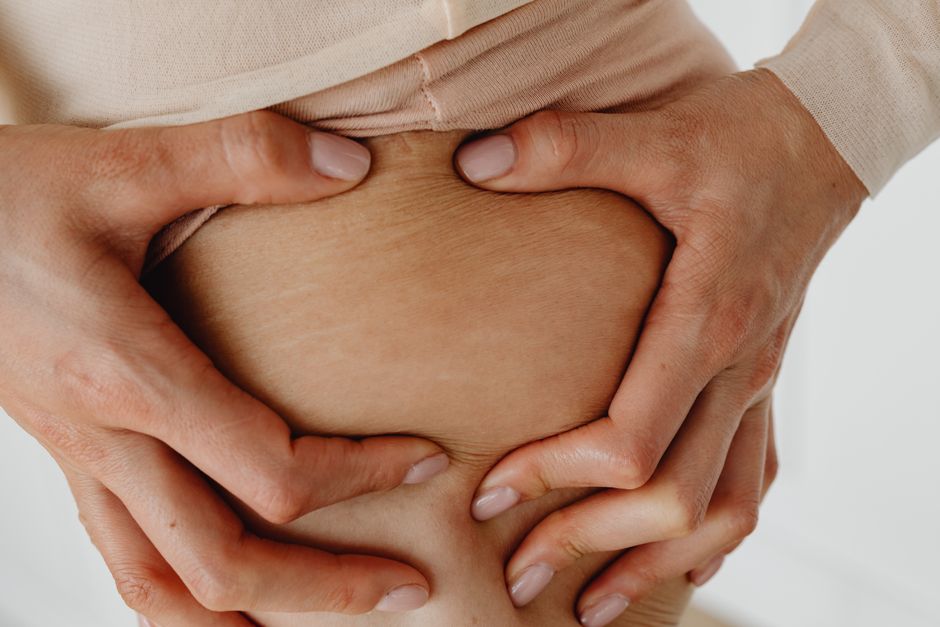
Stretch marks happen when your skin stretches faster than it can grow new collagen. The middle layer of your skin tears, and those tears show through as lines on the surface. Nearly everyone gets them at some point. Pregnancy, growth spurts, and rapid weight changes are the most common triggers. The good news is that stretch marks are harmless, and they usually fade significantly on their own over time.
What Exactly Happens Inside Your Skin?
Your skin has three layers. The top layer is the epidermis. The middle layer is the dermis. The deepest layer is the hypodermis. Stretch marks form in the dermis.
The dermis contains collagen and elastin. These proteins give your skin strength and flexibility. When your body grows faster than the skin can keep up with, the dermis gets pulled apart. The collagen fibers tear and break. Blood vessels show through the tears at first, which is why new stretch marks look pink, red, or purple.
Over time, the tears heal. The blood vessels shrink back. The area fills with scar tissue. That scar tissue is paler than your normal skin, which is why older stretch marks look white or silver. This healing process is normal and takes months to years.
How Do You Get Stretch Marks From Growth and Weight Changes?
Rapid growth is the most common cause. Teenagers often get stretch marks on their hips, thighs, and backs during growth spurts. The bones grow faster than the skin can stretch, and the dermis tears.
Weight gain works the same way. When you gain weight quickly, your skin stretches to cover the larger body. Areas with more fat storage tend to show marks first. The belly, thighs, hips, breasts, and upper arms are common spots.
Weight loss can also make stretch marks more visible. The skin was stretched, and when the fat underneath shrinks, the skin may wrinkle around the scar tissue. The marks themselves do not go away with weight loss, but they often become less noticeable as the skin tightens.
Muscle gain can cause them too. Bodybuilders and athletes who build muscle rapidly can develop stretch marks on their shoulders and chest. The skin stretches over the growing muscle just like it does over fat.
Why Do Pregnant Women Get Stretch Marks?
Pregnancy is one of the most common times for stretch marks to appear. The belly grows significantly over several months. The skin on the abdomen stretches to accommodate the growing baby.
Hormones play a role here too. During pregnancy, your body produces more corticosteroids. These hormones can weaken the collagen fibers in your skin. Weaker fibers tear more easily, even with the same amount of stretching.
Most pregnant women develop some stretch marks. They typically appear in the third trimester when the belly grows fastest. The marks usually show up on the abdomen, but they can also appear on the breasts and thighs as those areas change.
Genetics influence whether you get them during pregnancy. If your mother had stretch marks, you are more likely to get them too. Some research also suggests that younger mothers and women who gain more weight during pregnancy are more likely to develop them.





Can Hormones or Medications Cause Stretch Marks?
Yes. Hormonal changes can weaken your skin’s structure. Cortisol is a hormone your body produces naturally. When cortisol levels stay high for a long time, it breaks down collagen in the skin. This makes the skin more fragile and more likely to tear.
Some medical conditions cause high cortisol levels. Cushing’s syndrome is one example. People with this condition often develop stretch marks that are wider and more purple than typical ones.
Certain medications can also cause stretch marks. Corticosteroid creams and pills are the most common culprits. These are anti-inflammatory drugs used for conditions like asthma, eczema, and arthritis. Long-term use can thin the skin and make it more prone to tearing.
If you are using a corticosteroid and notice stretch marks forming, talk to your doctor. Do not stop the medication on your own. Your doctor can help you weigh the benefits against the side effects.
Do Genetics and Skin Type Matter?
Genetics play a large role. Some people have naturally stronger collagen fibers. Their skin can stretch further before tearing. Other people have weaker collagen and get stretch marks with minimal stretching.
Skin type also matters. People with lighter skin often develop red or pink marks that later fade to white. People with darker skin may develop marks that are lighter than their surrounding skin or sometimes darker. The color difference is often more noticeable on darker skin.
There is no way to change your genetic predisposition. You can, however, manage the factors you control. Gradual weight changes are easier on your skin than rapid ones. Staying hydrated helps keep your skin supple. But even with perfect habits, some people will still get stretch marks because of their genetics.
What Actually Works to Prevent Stretch Marks?
The evidence for prevention is limited. Many creams and oils claim to prevent stretch marks, but most have not been proven effective in clinical trials.
Moisturizers help keep the skin hydrated. Hydrated skin may feel more comfortable and look healthier. However, moisturizers do not strengthen the collagen fibers in the dermis. They only affect the top layer of skin. No study has confirmed that any moisturizer prevents stretch marks.
Some research has looked at specific ingredients. Centella asiatica, an herb used in some stretch mark creams, has shown some promise in small studies. Hyaluronic acid has also been studied. The evidence is not strong enough to recommend these as reliable prevention methods.
Maintaining a steady weight is the most practical prevention strategy. Rapid weight gain stretches the skin quickly, which increases the chance of tearing. Slow, gradual changes give your skin time to adapt.
Staying hydrated and eating a balanced diet support overall skin health. Foods rich in vitamin C help your body produce collagen. Protein is also important for skin repair. These habits support healthy skin, but they do not guarantee you will avoid stretch marks.
What Treatments Actually Help Stretch Marks?
Treatment options exist, but expectations should be realistic. No treatment completely removes stretch marks. Some treatments can make them less noticeable.
Topical retinoid creams are one option. Retinoids are vitamin A derivatives that can help rebuild collagen. Some studies show they improve the appearance of newer stretch marks. These creams are not safe during pregnancy, so talk to your doctor first.
Laser therapy is another option. Certain lasers target the blood vessels in new stretch marks, reducing redness. Other lasers stimulate collagen production in older marks. Multiple sessions are usually needed, and results vary.
Microneedling is a newer treatment. A device with tiny needles creates small wounds in the skin. This triggers your body’s healing response, which produces new collagen. Some studies show improvement in stretch mark appearance. The evidence is still emerging.
Chemical peels and microdermabrasion are sometimes used. These treatments remove the top layer of skin. They may help with texture but have limited evidence for stretch marks specifically.
All of these treatments require multiple sessions and can be expensive. Results are often modest. The most honest expectation is that treatment may make stretch marks less visible, not eliminate them.
When Should You See a Doctor About Stretch Marks?
Stretch marks themselves are harmless. You do not need medical treatment for them. But there are times when a doctor visit makes sense.
If your stretch marks appear suddenly without a clear cause like pregnancy or weight gain, see a doctor. Sudden stretch marks can be a sign of an underlying hormonal condition.
If the marks are very wide, dark, or painful, get them checked. Unusual stretch marks can sometimes signal Cushing’s syndrome or another medical issue. Your doctor can run tests to rule out these conditions.
If you are concerned about the appearance of your stretch marks and want treatment options, a dermatologist can help. They can assess your skin type and recommend treatments that are appropriate for you.
Can You Get Rid of Stretch Marks Completely?
No. Stretch marks are a form of scarring. Scars do not disappear completely. They fade and become less noticeable, but the tissue change is permanent.
Most stretch marks fade significantly within 6 to 12 months. The red or purple color fades to a lighter shade. The texture may smooth out somewhat. For many people, the marks become barely noticeable with time.
This natural fading is the most reliable “treatment” available. It happens on its own without any products or procedures. Patience is genuinely the most effective approach for most people.
Frequently Asked Questions
Are stretch marks permanent?
Yes, stretch marks are a form of scarring and do not fully disappear. They do fade significantly over time, usually becoming much less noticeable within a year.
Can men get stretch marks?
Yes, men get stretch marks too. Rapid weight gain, muscle growth, and growth spurts during adolescence are common causes for men.
Do stretch mark creams work?
Most stretch mark creams have not been proven effective in clinical studies. They may moisturize the skin, but no cream has been confirmed to prevent or remove stretch marks.
Do stretch marks itch?
New stretch marks can itch as the skin stretches and tears. This is normal and usually temporary, lasting until the marks begin to heal.
