
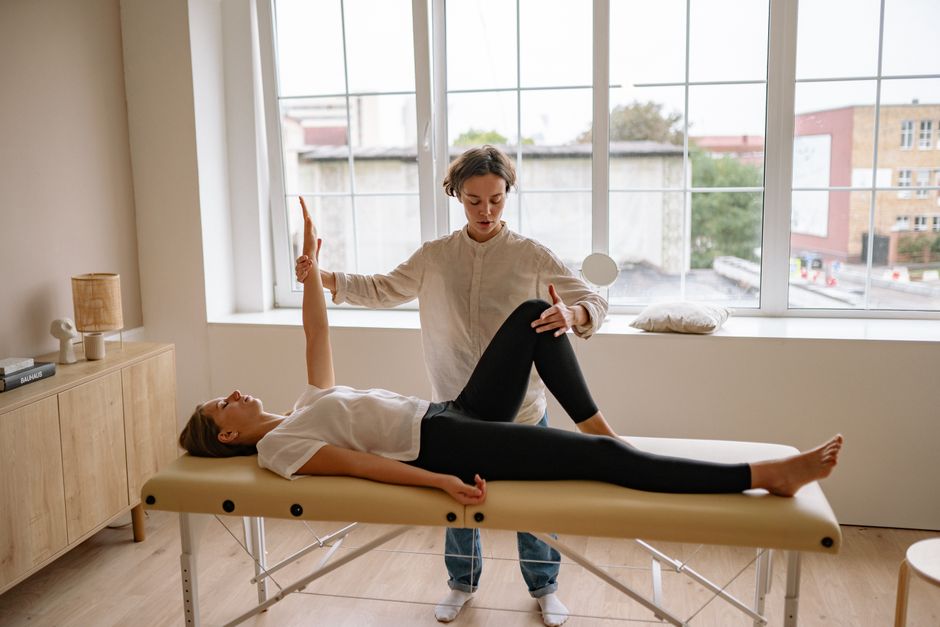
Your hip flexors are a group of muscles that let you lift your knee and bend at the waist. When they get tight, they can pull on your lower back and pelvis, causing aching and stiffness. Stretching them regularly can reduce that tightness and ease the pain it causes. The key is doing the right stretches with proper form and knowing when tightness is actually a sign of something else.
What Are Hip Flexors and Why Do They Get Tight?
The hip flexors are a group of muscles that connect your lower spine, pelvis, and thigh bone. The most well-known is the iliopsoas, made up of the psoas major and iliacus muscles. Others include the rectus femoris (part of your quadriceps) and the sartorius.
These muscles serve two main jobs. They lift your knee toward your chest. They also help stabilize your pelvis and lower spine when you stand and walk.
Tightness usually develops from too much sitting. When you sit for long periods, your hip flexors stay in a shortened position. Over time, the muscles and surrounding connective tissue adapt to that shortened length. This is sometimes called adaptive shortening.
It is not just about the muscle itself. Prolonged sitting also affects the hip joint capsule and the fascia that surrounds the muscles. The nervous system may also play a role by keeping the muscles in a state of low-level tension.
This is why stretching alone does not always solve the problem. If you sit for eight hours a day and stretch for five minutes, the sitting wins. Movement throughout the day matters as much as any single stretch.
How To Stretch Out Hip Flexors And Relieve Pain
The most effective hip flexor stretch is the kneeling hip flexor stretch, also called the couch stretch or lunge stretch. It directly lengthens the iliopsoas and rectus femoris.
Here is how to do it:
- Kneel on one knee with the other foot flat on the floor in front of you, knee bent at about 90 degrees.
- Keep your torso upright and your pelvis tucked slightly under (posterior tilt). This is critical. Without the pelvic tilt, you are not actually stretching the hip flexor.
- Gently shift your weight forward until you feel a stretch in the front of the hip of the kneeling leg.
- Hold for 30 seconds. Breathe normally. Do not bounce.
- Switch sides. Repeat 2 to 3 times per side.
The pelvic tilt is the part most people miss. If you arch your lower back during the stretch, you are compensating with your lumbar spine instead of lengthening the hip flexor. A small tuck of the pelvis makes the stretch far more effective.
Another option is the standing lunge stretch. Step one foot far forward and lower your back knee toward the floor. Keep your torso tall and tuck your pelvis. You should feel the stretch in the front of the back hip.
For the rectus femoris specifically, which crosses both the hip and the knee, you need to bend the knee during the stretch. A kneeling stretch with the back foot lifted toward your glutes will target this muscle more directly.
Some research suggests that holding a stretch for 30 to 60 seconds is more effective for improving flexibility than shorter holds. A 2021 review found that longer hold times produced greater gains in range of motion. But even 20 to 30 seconds per stretch, done consistently, can help.
Consistency matters more than duration. Stretching once a week will not do much. Most physical therapists suggest daily stretching or at least five days a week when you are trying to make a change.
Why Does Stretching Help Relieve Pain?
Stretching helps pain through several mechanisms, and they are not all about the muscle getting longer.
First, stretching can reduce muscle tension. When a muscle is chronically tight, it may have increased resting tone. Stretching can help reset that tone by influencing the nervous system’s signals to the muscle.
Second, stretching improves blood flow to the area. Tight muscles can compress local blood vessels. When you stretch, you temporarily reduce that compression and allow more circulation. This can help clear metabolic byproducts and deliver oxygen.
Third, stretching can improve joint mobility. If tight hip flexors are limiting how far your hip can extend, your lower back may compensate by arching more. This can lead to lower back pain. By improving hip extension, you take stress off the lumbar spine.
Fourth, stretching can reduce trigger points. These are taut bands of muscle fiber that can refer pain to other areas. Hip flexor trigger points can cause pain in the groin, front of the thigh, and even the lower back.
That said, stretching is not a cure-all. If your pain comes from a disc issue, arthritis, or nerve compression, stretching may not help and could make things worse. This is why it is important to know what is causing your pain.





When Hip Flexor Pain Is Not Just Tightness
Not all hip pain is muscle tightness. Several other conditions can cause similar symptoms, and stretching may not be the right approach for them.
Hip flexor strain is an injury to the muscle or tendon. It usually happens during activities like sprinting, kicking, or rapid direction changes. A strain causes sharp pain, swelling, and sometimes bruising. Stretching an acute strain can worsen it. Rest and gradual return to activity are typically recommended first.
Hip impingement, also called femoroacetabular impingement, occurs when the bones of the hip joint rub against each other abnormally. It causes a pinching pain in the front of the hip, especially with deep squatting or sitting for long periods. Stretching may not help and certain positions can aggravate it.
Osteoarthritis of the hip causes pain and stiffness that is often worse in the morning and after inactivity. It is a joint issue, not a muscle issue. While gentle movement can help, aggressive stretching is not the primary treatment.
Psoas syndrome is a condition where the psoas muscle becomes irritated or spasms. It can cause lower back pain, groin pain, and difficulty standing up straight. It is often diagnosed by ruling out other conditions.
Nerve compression in the lumbar spine, such as from a herniated disc, can cause pain that radiates into the hip and thigh. This is not a muscle problem, and stretching may not address it.
If your pain is sharp, gets worse with stretching, or comes with numbness, tingling, or weakness, see a healthcare provider before continuing to stretch. These are signs that something other than simple tightness may be going on.
Other Ways To Relieve Hip Flexor Pain
Stretching is one piece of the puzzle. Other approaches can help, especially when combined with stretching.
Strengthening the opposing muscles is important. If your hip flexors are tight, your glutes may be weak. Weak glutes can allow the pelvis to tilt forward, which keeps the hip flexors in a shortened position. Strengthening your glutes with exercises like bridges, clamshells, and hip thrusts can help correct this imbalance.
Foam rolling can help release tension in the hip flexors and surrounding tissues. A 2019 study found that foam rolling can increase range of motion without reducing muscle performance, unlike static stretching before activity. Roll the front of your hip and thigh for 30 to 60 seconds per side.
Changing your sitting habits matters. If you sit for long periods, take breaks every 30 minutes to stand and walk. Even a one-minute break can help. If you can, adjust your chair so your hips are slightly higher than your knees. This reduces the amount of hip flexion required.
Heat can help relax tight muscles before stretching. A warm shower or a heating pad for 10 to 15 minutes before stretching may make the tissue more pliable. Cold packs are better for acute pain or inflammation.
Some clinicians recommend manual therapy, such as massage or myofascial release, to help reduce hip flexor tightness. The evidence for these approaches is mixed. Some people find relief, but high-quality studies are limited.
If pain persists despite stretching and self-care, physical therapy may help. A physical therapist can assess your movement patterns and identify specific weaknesses or restrictions. They can also use techniques like dry needling or manual therapy that are not available at home.
How Long Does It Take To See Results?
Most people notice some improvement in flexibility within two to four weeks of consistent stretching. Pain relief may take longer, especially if the tightness has been present for months or years.
Research on stretching shows that measurable changes in range of motion can occur after just a few sessions. But these changes are temporary at first. Lasting changes require consistent practice over weeks to months.
If you have been stretching for six weeks with no improvement, or if your pain is getting worse, it is worth seeing a healthcare provider. Persistent pain may have a cause that stretching cannot fix.
Keep in mind that progress is not always linear. Some days will feel better than others. The goal is gradual improvement over time, not perfection every day.
Frequently Asked Questions
How often should I stretch my hip flexors?
Most physical therapists suggest stretching daily or at least five days a week for the best results. Consistency matters more than how long you hold each stretch.
Can tight hip flexors cause lower back pain?
Yes. Tight hip flexors can pull the pelvis into an anterior tilt, which increases the curve in your lower back and can cause pain. Stretching the hip flexors and strengthening the glutes can help correct this.
Should I stretch a strained hip flexor?
No. Stretching an acute muscle strain can make the injury worse. Rest, ice, and gradual return to activity are typically recommended first. See a healthcare provider if pain is severe or does not improve.
What is the best time of day to stretch hip flexors?
There is no strong evidence that one time of day is better than another. Many people find it helpful to stretch after a warm shower or light activity when muscles are more pliable. The most important thing is to do it consistently.
