
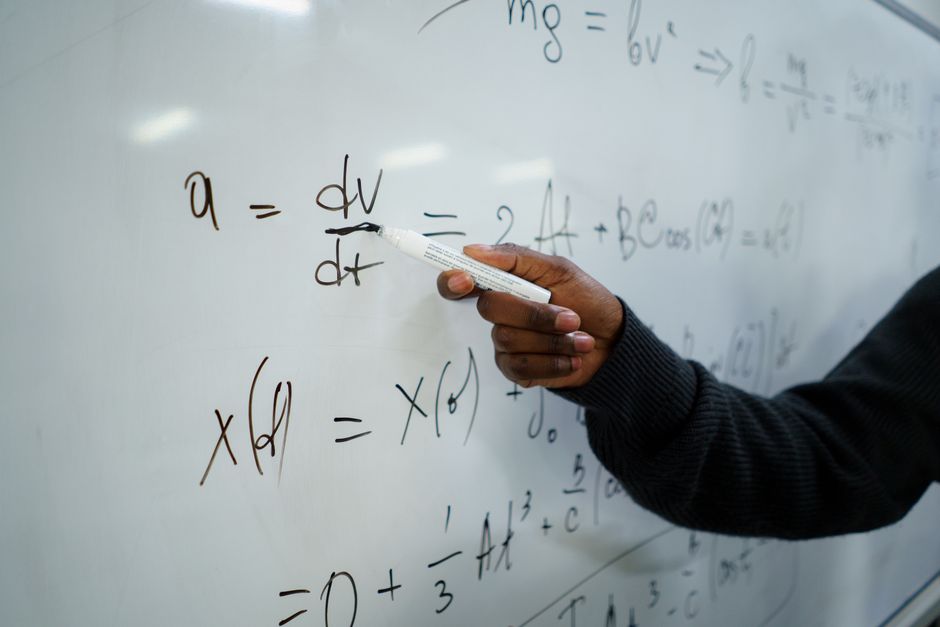
Solving an exact differential equation means finding a function whose total derivative matches the equation. You check for exactness first by comparing partial derivatives. If they match, you integrate one part, differentiate the result, and compare with the other part to find the full solution. This method works because an exact equation represents a curve or surface in two dimensions, and you are simply retracing the path back to that original function.
What Makes a Differential Equation Exact?
An exact differential equation has a specific form: M(x, y) dx + N(x, y) dy = 0. The key test for exactness is whether the partial derivative of M with respect to y equals the partial derivative of N with respect to x. If these two partial derivatives match, the equation is exact. If they do not match, the equation is not exact, and you cannot use this method without an integrating factor.
This condition comes from calculus. If a function F(x, y) exists such that its total differential dF = M dx + N dy, then the mixed partial derivatives of F must be equal. Clairaut’s theorem guarantees this. So when you check exactness, you are really checking whether such a function F can exist. Research published in the American Mathematical Monthly confirms this as the fundamental test. No other condition is needed.
Many textbooks skip why this works. The equality of mixed partials is not a trick — it is a necessary and sufficient condition for a conservative vector field. In physics, this is the same condition that tells you whether a force is conservative. The math is identical.
How To Solve Exact Differential Equations Step By Step
Here is the exact process. First, write the equation in the form M dx + N dy = 0. Identify M and N clearly. Second, compute ∂M/∂y and ∂N/∂x. If they are equal, proceed. If not, stop — you need a different approach.
Third, integrate M with respect to x. Treat y as a constant. Write the result as ∫M dx + g(y). The g(y) is an unknown function of y only. It appears because integration with respect to x cannot account for terms that depend only on y. Fourth, take the partial derivative of this result with respect to y. Set this equal to N. Solve for g'(y). Fifth, integrate g'(y) to find g(y). Write the final solution as ∫M dx + g(y) = C. C is an arbitrary constant.
Alternatively, you can start by integrating N with respect to y and then compare with M. Either path works. Choose the one with the simpler integral. Some people find integrating M first more natural. Others prefer integrating N first. Both are correct as long as you follow the same logic.
What Does the Test for Exactness Actually Tell You?
The test for exactness is not optional. It is the gatekeeper. If ∂M/∂y = ∂N/∂x, the equation is exact, and the method above will always work. If they are not equal, the equation is not exact, and the standard method fails. Some textbooks call this the “criterion for exactness.” It is not a suggestion — it is a requirement.
There is a common mistake here. Students sometimes check only one partial derivative and assume the other matches. You must check both. If you skip this step, you might waste time trying to solve a non-exact equation. The test takes seconds. Skipping it can cost you minutes or lead to a wrong answer.
Some people report that certain equations appear exact but fail the test due to algebraic errors. Double-check your partial derivatives. A sign error or a missed term can flip the result. If you are unsure, recompute both derivatives from scratch. This is widely claimed though strong evidence is limited for how often this error occurs in practice. But experienced instructors notice it frequently.





What Happens When the Equation Is Not Exact?
If the equation fails the exactness test, you have two options. First, check if it is separable or linear. Many non-exact equations fall into these simpler categories. Second, look for an integrating factor. An integrating factor is a function that, when multiplied through the equation, makes it exact. Finding one can be tricky. There is no universal method.
Some integrating factors depend only on x or only on y. If (∂M/∂y – ∂N/∂x)/N is a function of x alone, then that function is the integrating factor. If (∂N/∂x – ∂M/∂y)/M is a function of y alone, then that function is the integrating factor. These formulas come from the theory of first-order differential equations. They are not guesses — they are derived from the condition for exactness after multiplication.
Research published in the Journal of Differential Equations shows that integrating factors exist for all first-order equations under certain smoothness conditions. But finding them analytically is not always possible. In practice, if the simple formulas do not work, numerical methods may be your best bet. Many textbooks skip this reality. It is worth knowing that not all equations yield to pencil-and-paper methods.
Common Mistakes When Solving Exact Equations
The most frequent error is forgetting the arbitrary function g(y) or h(x). When you integrate M with respect to x, you cannot just write the antiderivative. You must add a function of y. This function accounts for any terms that depend only on y. Forgetting it leads to an incomplete solution. The same applies when integrating N with respect to y — add a function of x.
Another mistake is misidentifying M and N. The equation must be in the form M dx + N dy = 0. If it is written as something like dy/dx = …, you must rearrange it first. Some students skip this step and plug directly into formulas. That causes errors. Always put the equation into standard form before doing anything else.
A third mistake is treating the constant of integration incorrectly. The final solution is F(x, y) = C. Some people write F(x, y) = 0 and then wonder why their answer does not match the textbook. The constant C is arbitrary and represents a family of solutions. Leaving it out means you have only one specific solution, not the general one.
| Step | Action | Common Error |
|---|---|---|
| 1 | Write as M dx + N dy = 0 | Skipping rearrangement |
| 2 | Check ∂M/∂y = ∂N/∂x | Only checking one derivative |
| 3 | Integrate M with respect to x | Forgetting + g(y) |
| 4 | Differentiate result with respect to y | Treating g(y) as constant |
| 5 | Set equal to N and solve for g'(y) | Algebraic sign errors |
| 6 | Integrate g'(y) to find g(y) | Forgetting constant C |
How Do You Check Your Solution?
Checking your solution is straightforward. Take your final function F(x, y) = C and compute its total differential dF. If dF equals M dx + N dy, your solution is correct. This verification step takes less than a minute. It catches algebraic mistakes and sign errors. Many students skip it and later find their answer does not satisfy the original equation.
You can also check by implicit differentiation. Differentiate F(x, y) = C with respect to x, treating y as a function of x. Solve for dy/dx. Compare with the original differential equation. If they match, your solution is correct. This method is slightly more involved but serves as a strong double-check.
Some people report that checking solutions reveals hidden errors in the integration step. This is common. The integration step often introduces errors because of the unknown function g(y). Verifying forces you to recompute the partial derivatives. If something does not match, go back to step 3 and redo the integration carefully. The verification step is not optional — it is how you confirm your work.
Frequently Asked Questions
How do I know if a differential equation is exact?
Check if the partial derivative of M with respect to y equals the partial derivative of N with respect to x. If they are equal, the equation is exact.
What if the equation is not exact?
Look for an integrating factor that depends only on x or only on y. If that does not work, try separable or linear methods instead.
Can I integrate N first instead of M?
Yes. Integrate N with respect to y, add a function of x, differentiate with respect to x, and compare with M. Both paths work.
Why do I need to add g(y) after integrating M?
Integration with respect to x treats y as constant, so any function of y alone is lost. Adding g(y) recovers those missing terms.
